How a Low Code App Builder Accelerates Your Mobile Product Launch
Explore how a low code app builder accelerates development with real-world use cases, key benefits, and tips to choose the right platform.
By Rishav
4th Dec 2025
Last updated: 4th Dec 2025

A low code app builder is your secret weapon for getting a mobile app from idea to launch, fast. It lets you build your app using a visual, drag-and-drop interface, drastically reducing the amount of manual coding required.
Think of it like this: instead of building a house brick by brick (traditional coding), a low code app builder gives you pre-fabricated, high-quality wall panels, window frames, and roofing systems. You assemble them quickly to get the core structure up in days, not months. But, when you need a custom-designed staircase or a unique window, you have the total freedom to build it from scratch and slot it right in.
This hybrid approach makes building mobile products faster and more accessible for your entire team.
What Is a Low Code App Builder, Really?
You’ve got a killer idea for a mobile app. The traditional route? Hire a team of expensive developers and wait months for them to write thousands of lines of code from scratch. A low code app builder completely flips that script.
It provides a visual canvas where your team—designers, PMs, and developers—can design the user interface (UI), map out user flows, and connect to data using intuitive tools. Instead of starting with a blank code editor, you begin with a toolbox full of pre-built, functional components like user login screens, data grids, and forms.
Empowering Your Whole Product Team
This approach opens up the building process to more than just seasoned developers. It empowers the "citizen developer"—a product manager, a designer, or a founder who understands the customer problem deeply but isn't a professional coder. A low code platform gives them the power to build and test functional prototypes themselves, without waiting for the engineering team to free up.
Here's what makes a low code app builder a game-changer for mobile product teams:
- Visual Development: You drag, drop, and configure components on a screen, seeing a live preview of your app as you build.
- Pre-built Components: Why build a login screen for the hundredth time? These platforms provide reusable blocks for common app features, saving hundreds of hours.
- Click-to-Configure Logic: You can define what happens when a user taps a button by connecting visual nodes in a flowchart, rather than writing complex conditional statements.
- Custom Code Escape Hatch: This is the critical difference from "no-code" tools. A good low code builder always allows a developer to step in and write custom code for unique features, complex animations, or performance-critical functions.
A low code app builder is designed to translate your product vision directly into a working mobile app, faster. It puts powerful tools into the hands of the people who own the product vision, giving them a direct role in creating the solution.
The market data confirms this shift. Forecasts suggest that by 2025-2026, a staggering 75% of new business applications will be built using low-code or no-code technologies. That’s a huge leap from less than 25% back in 2020. This explosive growth is a direct response to the massive demand for new digital products and the ongoing shortage of expert developers. You can dive deeper into the statistics and trends on low-code adoption to see just how fast things are changing.
Low Code vs No-Code vs Traditional Development
When you're building a new mobile product, one of the first big decisions is how to build it. Choosing between low-code, no-code, and traditional development is like choosing your mode of transport. Are you building a custom race car from scratch, leasing a high-performance car, or taking a city bus?
Your choice depends on your timeline, budget, team skills, and how much control you need.
Let's start with the traditional, code-heavy approach. This is like building a custom race car. You have absolute control over every single detail, allowing for unlimited customization and peak performance. It's the right choice for highly complex, enterprise-scale applications where every nuance matters. The catch? It requires an expert engineering team and a significant investment in time and money.
At the other end, you have no-code development. Think of this as taking the bus. It's simple, affordable, and will get you to common destinations easily. No-code tools are great for building simple internal tools, landing pages, or basic prototypes. The trade-off is that you're stuck on the bus route. If the tool doesn't support a feature you need, you're out of luck. You can learn more about the pros and cons of a no-code mobile app builder.
Finding The Sweet Spot With a Low Code App Builder
This brings us to the low code app builder, which strikes the perfect balance for most product teams. It’s like leasing a high-performance car. You get a powerful, ready-to-go vehicle to move fast, but you still have the keys. You can take any route you want, and when you need a custom modification, you can pop the hood and let your developers get to work.
This approach lets your team ship a real product much faster by blending visual tools with the power of custom code.
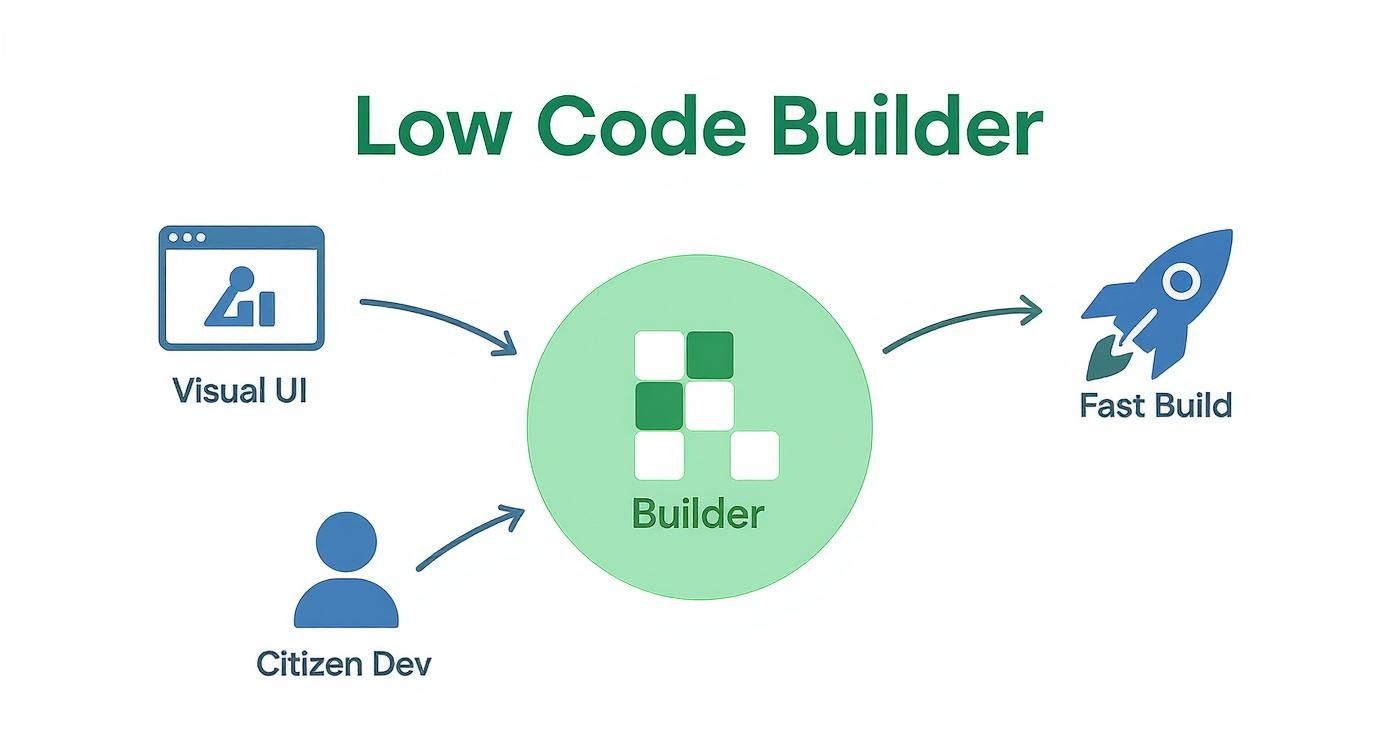
The magic of low-code is how it shortens the feedback loop between an idea and a working feature.
A low code app builder gives you the speed of no-code with the power and flexibility of traditional coding. It's the practical choice for product teams that need to launch fast and iterate based on user feedback, without getting painted into a technical corner.
For your team, this means launching a feature-rich MVP in weeks, not months. When you hit a roadblock—a unique animation or a third-party API the builder doesn't support—your developers can jump in, write the specific code, and plug it seamlessly into the app. It’s a strategic advantage for both agile startups and enterprise innovators.
Comparing Development Approaches
To help clarify the trade-offs, here's how the three approaches stack up for a mobile product team.
| Feature | Low-Code | No-Code | Traditional Code |
|---|---|---|---|
| Required Skill | Product/Design sense; coding optional | Business user; no coding required | Expert software development |
| Development Speed | Very Fast | Fastest | Slow |
| Customization | High (with code) | Low (template-based) | Unlimited |
| Best For | MVPs, business apps, custom workflows | Internal tools, simple web apps, landing pages | Complex systems, large-scale platforms |
| Scalability | Good to excellent | Limited | Excellent |
Ultimately, the best option is the one that fits your product goals, timeline, and team. Understanding these differences is the first step to making a smart decision.
How Product Teams Use Low-Code App Builders
It's one thing to talk about what a low-code app builder is, but it's more helpful to see how real teams use them to solve everyday product challenges. Across every industry, teams are using these platforms to ship faster, validate ideas, and fix internal pain points without getting stuck in a six-month development cycle.
Let's look at a few practical use cases where a low-code app builder becomes a product team's most valuable asset.

Launching an MVP to Validate an Idea
Imagine a startup founder with a game-changing idea for a new fitness-tracking app. The old way meant spending $50k+ and six months building a Minimum Viable Product (MVP) just to see if anyone cared. With a low-code platform, they can build and launch a functional V1 in a few weeks.
- The Problem: The founder needs to answer a critical question: Will people actually use this? They need to test their core assumptions with real users before committing their entire seed round to development.
- The Low-Code Solution: A product manager or designer uses the visual builder to assemble the key screens: user signup, workout logging, and a progress dashboard. They connect it to a simple backend like Firebase to save user data and push a real, native app to the app stores.
- The Outcome: They get immediate, real-world feedback on what users love and what they ignore. This allows them to iterate based on data, not just assumptions, saving thousands of dollars and months of building the wrong product.
Automating Internal Workflows
Consider a mid-sized company where the sales team's process for logging customer notes is a clunky mess of spreadsheets and manual data entry. It’s an operational bottleneck that slows everyone down. The engineering team is too busy with the main product to build a custom internal tool.
A low-code app builder empowers departments to solve their own problems. It lets the business experts become the builders, creating solutions that fit exactly how they work.
Here, a sales ops manager could use a low-code builder to create a simple mobile app for the sales team. Reps can quickly log notes and update deal statuses from their phones between meetings. The app syncs directly with the company's CRM. This simple tool saves hours of admin work, improves data quality, and makes life easier for the entire team.
For digital agencies and development shops, this speed is a massive competitive advantage. See more real-world examples in our guide to low-code for agencies.
Building a Custom Client Portal
A B2B SaaS company wants to offer its clients a self-service portal where they can track their usage, manage their subscriptions, and access support documents. Building this from scratch would be a major project for their core engineering team.
Using a low-code platform, a product manager can rapidly design and build a secure, branded portal that connects to their existing billing and support systems via APIs. This improves the customer experience and frees up the support team from handling repetitive queries, allowing them to focus on more complex issues.
The Strategic Benefits of Building with Low Code
Adopting a low-code app builder is more than a development shortcut—it’s a strategic business decision. Product teams that embrace this shift gain a significant competitive edge by changing how they build and ship software. The benefits go far beyond just writing less code.
You unlock speed, agility, and a new level of collaboration between technical and non-technical team members. This means you can react to market changes faster, test new ideas with less risk, and empower your domain experts to build the tools they need. It’s about getting more done with the team you already have.
Accelerate Your Time to Market
In today's fast-moving market, being first can make all the difference. Traditional development can take 6-12 months to get a new app to market. A low-code app builder can shrink that timeline to just a few weeks or months.
How is this possible? Instead of starting from zero, you start with pre-built components and visual workflows.
- Launch MVPs Faster: Test your core product hypothesis with real users in a fraction of the time, gathering crucial feedback before you burn through your budget. You can learn more about finding the right tool in our guide to the best MVP app builder.
- Respond to Market Changes: A competitor just launched a new feature? You can design, build, and deploy a response in weeks, not quarters.
Reduce Development Costs and Dependencies
Let's be blunt: hiring mobile developers is expensive and time-consuming. A low-code app builder fundamentally changes the economics of app development.
By empowering product managers and designers to build significant parts of the app, you reduce the direct burden on your engineering team. This frees up your senior developers to focus on the truly hard problems—complex backend architecture, performance optimization, and custom algorithms—instead of being bogged down with routine UI tasks.
The real financial win with a low-code app builder isn't just saving on developer salaries. It's about multiplying the creative output of your entire product team by empowering more people to build.
Foster True Business and IT Collaboration
One of the biggest challenges in product development is the communication gap between the product team (who has the vision) and the engineering team (who builds it). Requirements docs get misinterpreted, and wires get crossed, leading to frustrating rework.
A low-code app builder acts as a common language. A product manager can build a functional, clickable prototype that shows exactly how a feature should work. A developer can then inspect the underlying logic and inject custom code precisely where it's needed. This shared, visual environment leads to better products, fewer misunderstandings, and a faster, more collaborative workflow.
The market’s explosive growth proves this isn’t just a niche idea. The global low-code platform market was valued at $24.83 billion and is expected to grow at a compound annual rate of about 22.5% through 2030. A big driver of this is small and medium-sized businesses, which make up about 57% of the market share because these platforms are so accessible and affordable. You can learn more about the growth of the low-code market and its drivers from industry reports.
How to Choose the Right Low-Code App Builder
Choosing a low-code app builder is a critical decision that will impact your product's entire future. The market is noisy with options, and it's easy to be swayed by flashy demos. The key is to find a platform that aligns with your team's skills, your product's complexity, and your long-term roadmap.
Think of it less like buying a tool and more like choosing a foundational technology partner. You need to evaluate both the business and technical aspects to ensure the platform can help you launch quickly and scale successfully.

The Business Checklist
For founders, product managers, and business leaders, the decision hinges on strategy and operations.
- Total Cost of Ownership (TCO): Look beyond the monthly subscription fee. What are the costs for additional users, data storage, or premium integrations you'll eventually need? A transparent pricing model is essential to avoid budget blowouts.
- Support and Community: When you hit a roadblock at 2 AM, what's your plan? A platform with excellent documentation, responsive technical support, and an active user community is invaluable. Check their forums and see how quickly users get real answers.
- Ease of Use for Non-Developers: Can your product designer or PM actually build a functional prototype without a week of training? The platform should be intuitive enough to empower your non-technical team members, which is key to rapid iteration.
The Technical Deep Dive
For developers and engineering leads, the platform must be robust, flexible, and compatible with professional workflows.
- Scalability and Performance: Will the app crash when you go from 100 beta testers to 100,000 active users? Investigate the platform's underlying architecture. Does it run on scalable infrastructure like AWS or Azure? Look for case studies of apps that have scaled successfully.
- Integration Power: Your app won't exist in a vacuum. Ensure the platform has robust REST API capabilities and, ideally, pre-built connectors for essential services like Stripe, Segment, or Salesforce. This saves countless hours of custom integration work.
- Code and Extensibility: This is the most important factor. A true low-code platform is never a dead end. Can your developers inject custom code to override default behavior? Most importantly, can you export clean, human-readable source code if you ever decide to leave the platform?
For any serious product team, "vendor lock-in" is a deal-breaker. The best platforms provide an escape hatch. They allow you to export the source code, giving you full ownership and control of your intellectual property.
This is where platforms like RapidNative are changing the game. It’s designed on the principle of speed without sacrificing control. It generates clean, production-ready React Native code from a simple prompt, giving developers a massive head start on UI development. Teams get the velocity of low-code upfront while retaining the freedom to take the code and continue building with standard, professional tools.
Common Questions About Low-Code Development
When a technology promises to change how you build products, it’s natural to be skeptical. Founders, product leads, and developers all have valid concerns about low-code. They worry about performance at scale, ownership of their IP, and whether these tools are just for toy projects. Let’s address these head-on.
Getting clear answers helps you cut through the hype and understand how a low-code app builder can realistically fit into your professional product development workflow.
Can Low-Code Apps Truly Scale?
This is the million-user question. Can an app built with a visual editor handle a massive, active user base? The answer is a clear yes—if you choose the right platform.
Enterprise-grade low-code platforms are architected for performance. They are built on top of the same scalable cloud infrastructure used by major tech companies, such as AWS or Azure. This means they are designed to handle high traffic, large databases, and complex operations without breaking a sweat.
The key is to look for platforms that are transparent about their architecture and can share case studies of customers who have successfully scaled.
What About Vendor Lock-In?
No product team wants to be trapped. The fear of building your core product on a proprietary platform, only to realize you can never leave, is a major concern. This is where the distinction between a closed "walled garden" and an open, developer-friendly platform is critical.
Many low-code tools are closed systems; what you build there, stays there. However, a modern, developer-first low-code app builder prioritizes ownership and flexibility.
The best low-code platforms give you an "escape hatch." They allow you to export the application's source code, giving you full control over your intellectual property. This ensures you are never locked in and can transition to a traditional development workflow whenever you choose.
For any team building a serious product, a code export feature is non-negotiable.
Does Low-Code Replace Developers?
Absolutely not. This is the most common misconception. A low-code app builder doesn’t make developers obsolete; it makes them more strategic and productive.
Instead of spending weeks building standard UI screens or boilerplate API connections, developers can use a low-code platform to automate that foundational work in hours. This frees them up to focus on the high-value challenges that truly require their expertise:
- Designing complex backend architecture.
- Optimizing app performance and security.
- Integrating with proprietary or legacy systems.
- Building the unique, custom features that visual tools can't handle.
Low-code automates the repetitive parts of development, allowing your best engineers to focus on the problems that create a competitive advantage.
Ready to see how a developer-first approach to low-code can speed up your mobile app development without forcing you to give up control? RapidNative turns your prompts into clean, exportable React Native code, giving you the best of both worlds. Build your UI faster at RapidNative.
Ready to build your app?
Turn your idea into a production-ready React Native app in minutes.
Free tools to get you started
Free AI PRD Generator
Generate a professional product requirements document in seconds. Describe your product idea and get a complete, structured PRD instantly.
Try it freeFree AI App Name Generator
Generate unique, brandable app name ideas with AI. Get creative name suggestions with taglines, brand colors, and monogram previews.
Try it freeFree AI App Icon Generator
Generate beautiful, professional app icons with AI. Describe your app and get multiple icon variations in different styles, ready for App Store and Google Play.
Try it freeFrequently asked questions
What is RapidNative?
RapidNative is an AI-powered mobile app builder. Describe the app you want in plain English and RapidNative generates real, production-ready React Native screens you can preview, edit, and publish to the App Store or Google Play.
Can I export the code?
Yes. RapidNative generates clean React Native and Expo code that you can export at any time. No lock-in, no proprietary format. Hand it to your developers or keep building inside RapidNative.
Is RapidNative free to use?
Yes. You can build apps on the free plan with no credit card required. Paid plans unlock unlimited AI generations, code export, and direct publishing to the App Store and Google Play.
Do I need to know how to code?
No. Most users build apps by describing what they want in plain English. Developers can drop into the code whenever they want more control, but coding is optional.
How long does it take to build an app?
Most users have a working first screen in under a minute. A full MVP usually takes a few hours instead of the weeks or months traditional development requires.