The 12 Best MVP Builder for Startups Tools in 2025
Discover the top 12 tools for any mvp builder for startups. Compare no-code, AI-powered, and code-exporting platforms to launch your mobile app faster.
By Paridhi
11th Dec 2025
Last updated: 17th Feb 2026
Choosing the right MVP builder for startups can mean the difference between months of development and a successful product launch in weeks. The modern landscape is filled with options, from pure no-code platforms that create web apps to AI-powered tools that generate real, production-ready mobile code. This guide is for founders, product managers, and designers who need a practical, real-world comparison of the best tools to build and test a mobile product.
We'll cut through the marketing hype to show you which tools fit specific use cases. Whether you're building a simple clickable prototype, a data-driven internal tool, or the first version of a scalable mobile app, this list provides a clear roadmap. We'll analyze each tool based on its core purpose, technical output (e.g., a locked platform vs. exportable code), ideal user profile, and practical limitations.
Once you've built your MVP, the next critical step is getting it in front of users. To maximize your chances of success, it's essential to understand founder-focused landing page optimization best practices to attract your first users. This list will equip you with the right tool to build; from there, it’s about getting it in front of the right people.
1. RapidNative
RapidNative is a standout AI-first mobile app builder engineered specifically for startups that need to move from idea to interactive prototype with exceptional speed and developer-friendly outputs. Its core strength lies in translating plain-English prompts, hand-drawn sketches, or even screenshots into clean, production-ready React Native and Expo code. This approach makes it a premier MVP builder for startups that value both rapid validation and a seamless transition to full-scale development, eliminating the typical throwaway work associated with traditional no-code tools.
Unlike platforms that lock you into a proprietary ecosystem, RapidNative generates high-quality, exportable source code. The output uses a modern tech stack (React Native, Expo, TypeScript, and NativeWind), ensuring the components, navigation scaffolding, and theming are modular and ready for a developer to extend in an IDE. The chat-driven iteration feature is particularly powerful, allowing non-technical founders and product managers to conversationally tweak UIs, refine layouts, and adjust styles without writing a single line of code.
Who It's For
RapidNative is purpose-built for anyone involved in the early stages of mobile product development:
- Non-Technical Founders: Validate an app idea by generating a functional prototype directly from a description or sketch. For example, you could sketch a social feed, a user profile, and a settings screen on a whiteboard, take a picture, and have RapidNative generate the initial screens.
- Product Managers & Designers: Quickly create and test high-fidelity UX flows on actual devices, facilitating faster team alignment and user feedback. Instead of just a Figma prototype, you can test a real, tappable app on a phone.
- Developers & Small Teams: Drastically reduce boilerplate UI work and accelerate the initial stages of app development, freeing up engineering resources to focus on core backend logic.
Core Features & Benefits
- AI-Powered Generation: Converts text prompts, whiteboard sketches, and images into functional UI screens.
- Exportable Source Code: Provides clean, extendable React Native code, avoiding no-code vendor lock-in.
- Chat-Driven Iteration: Refine and modify your app's UI through a simple conversational interface.
- Modern Tech Stack: Built with TypeScript and NativeWind for maintainable and themeable components.
- Cross-Platform Ready: Generates code that works on iOS, Android, and web via the Expo framework.
"I was shocked at how clean the generated code looked. It's properly componentized, uses TypeScript and is ready to extend. As a developer, this is the first AI UI tool I've used that actually accelerates my workflow instead of creating a mess." - Joey Judd
Limitations & Pricing
While excellent for UI scaffolding, RapidNative does not generate backend logic, databases, or complex native module integrations. These components still require manual engineering. Its pricing model is designed to scale with usage, starting with a generous free tier that offers 20 free credits per month. Paid plans include Starter at $20/month (50 requests/month) and Pro at $50/month (150 requests/month), with custom options available for larger teams. This structure makes it an accessible yet powerful MVP builder for startups at any stage. You can discover more about its capabilities by reading their guide to using an MVP app builder on RapidNative.com.
Website: https://www.rapidnative.com
2. Bubble
Bubble has established itself as a cornerstone in the no-code world, empowering non-technical founders to build fully functional web applications. It's a powerful MVP builder for startups aiming to create complex platforms like SaaS products, social networks, or two-sided marketplaces without writing a single line of code. Its visual, drag-and-drop interface allows users to design the UI while simultaneously building out backend logic, database structures, and complex workflows.
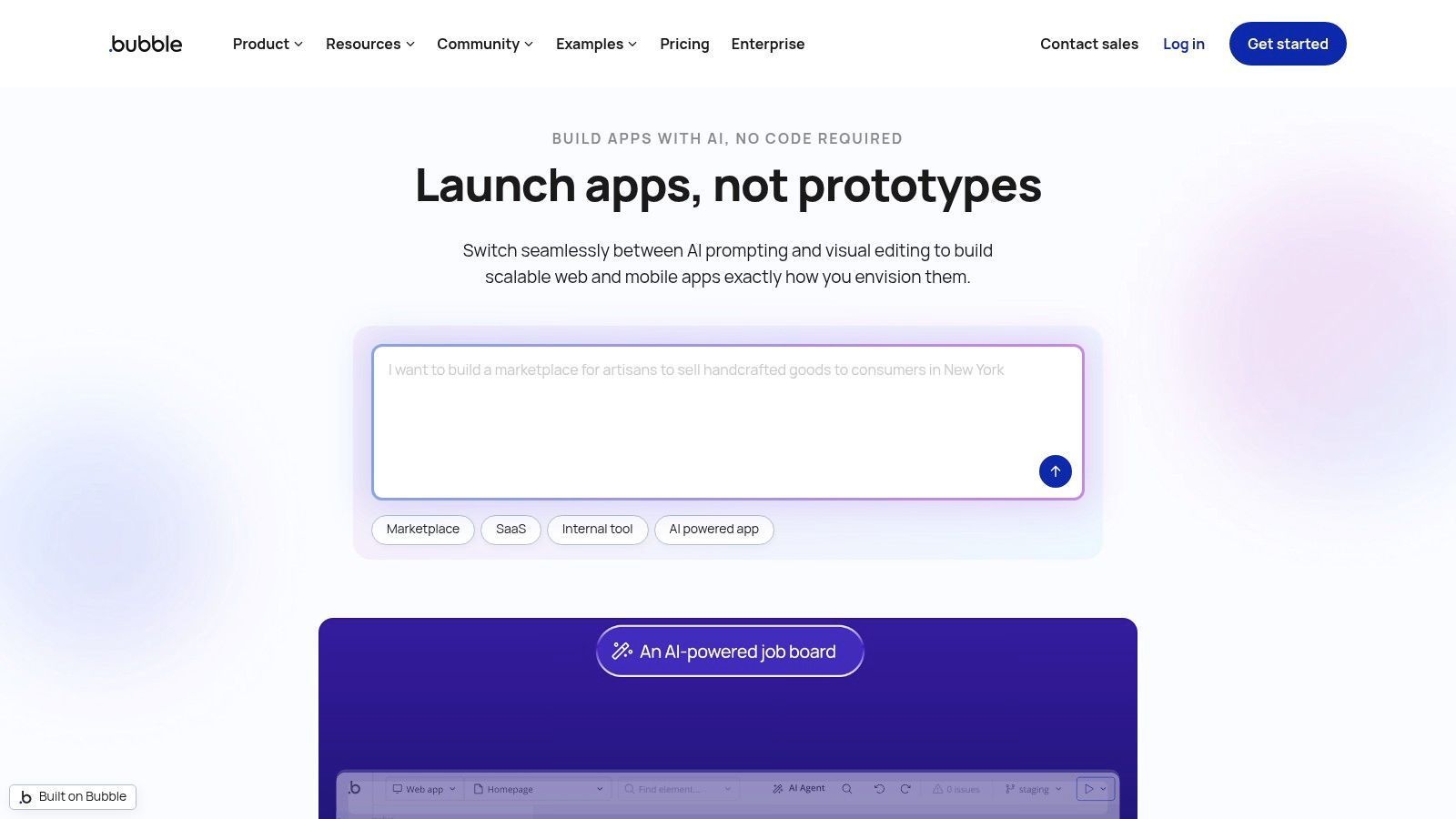
The platform’s real strength lies in its all-in-one nature. You can go from a simple idea to a live, scalable product on one stack. While historically web-focused, Bubble is now in beta with native mobile app building capabilities, making it a contender for cross-platform MVPs. For example, a founder could build a marketplace like Airbnb, complete with user profiles, listings, booking logic, and payments, all within Bubble.
Key Considerations
- Best For: Founders and product managers who need to build and launch a complex web app MVP with database and workflow logic, and are willing to invest time in learning a powerful tool.
- Pricing: Starts with a free plan for learning and building. Paid plans begin at $29/month (billed annually) and scale based on server capacity, measured in "Workload Units" (WUs).
- Limitations: The learning curve can be steep, especially for mastering database design and performance optimization. Vendor lock-in is a significant factor, as you cannot export your application's source code. You can learn more about how Bubble's no-code approach compares to code-export solutions.
Website: https://bubble.io
3. Webflow
Webflow has carved out a niche as the go-to platform for designers and marketers needing to build production-grade websites without code. While not a traditional app builder like Bubble, it serves as a powerful MVP builder for startups whose initial validation hinges on a polished marketing site or a content-driven platform. Its visual canvas gives you granular, CSS-level control over design, allowing for the creation of pixel-perfect, responsive landing pages that look custom-coded.
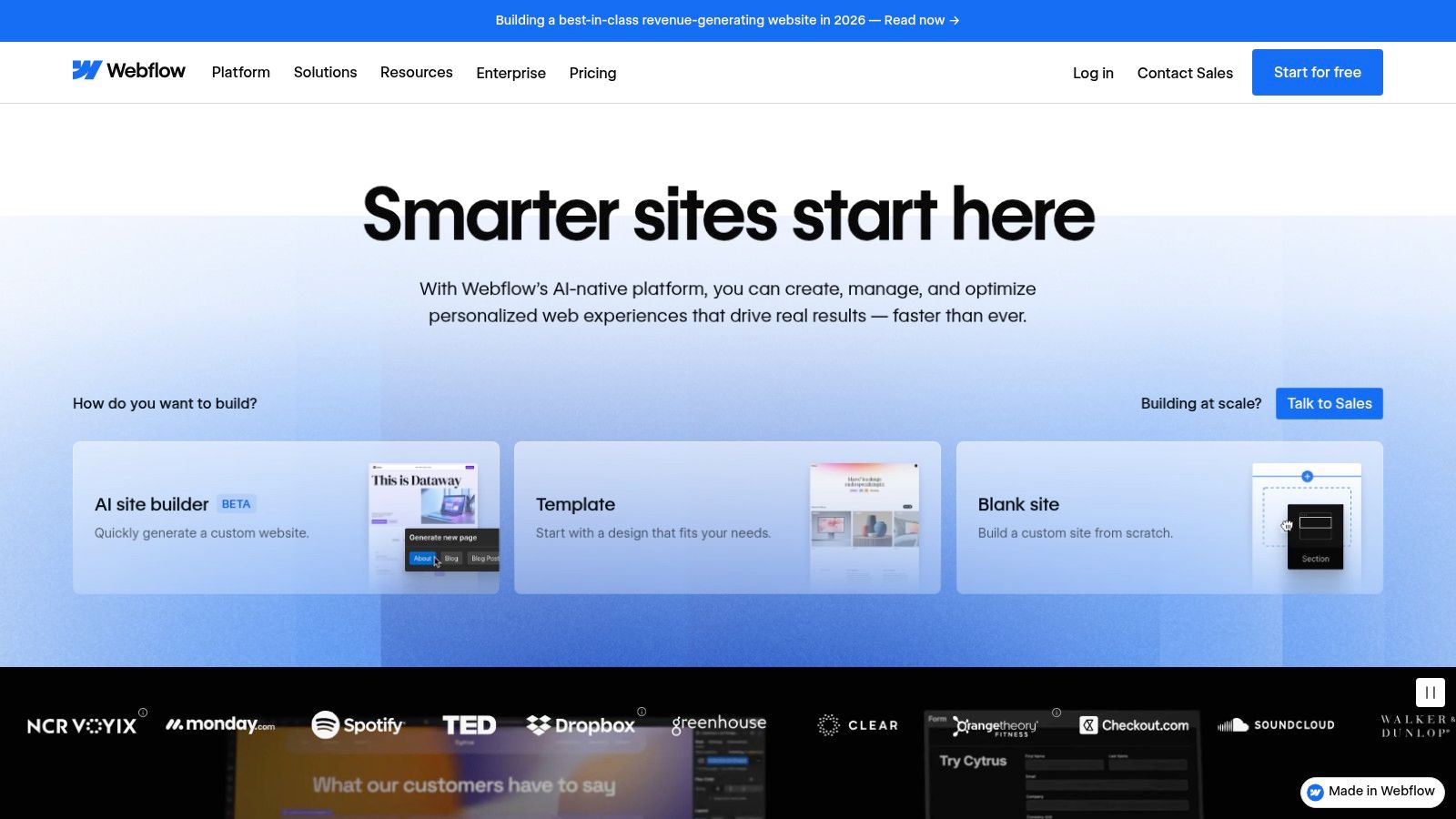
For a mobile product MVP, this means you can quickly launch a high-fidelity landing page to capture emails for your app's waitlist, or build a resource hub to test content-market fit before committing to building the app itself. Webflow empowers founders to create a credible web presence that supports user acquisition efforts long before a full-scale app is necessary.
Key Considerations
- Best For: Mobile-first startups, designers, and marketers who need a visually stunning and highly performant website or landing page as their primary MVP to attract early users and validate an idea.
- Pricing: Offers a free plan to build and learn. Paid site plans start at $14/month (billed annually) for basic sites, with CMS and E-commerce plans scaling up from there.
- Limitations: It is not designed for building interactive mobile applications with backend logic or databases. Its core function is front-end web design and content management, not app development. The learning curve is steeper than simpler site builders.
Website: https://webflow.com
4. Glide
Glide excels at turning spreadsheets and other data sources into powerful, data-driven applications with remarkable speed. It's an ideal MVP builder for startups that need to create internal tools, client portals, or simple customer-facing apps quickly. Founders familiar with Google Sheets or Airtable will feel right at home, as Glide allows you to build a functional app interface directly on top of your existing data, transforming static rows into an interactive experience. The platform primarily ships progressive web apps (PWAs), which behave like native apps on mobile devices.
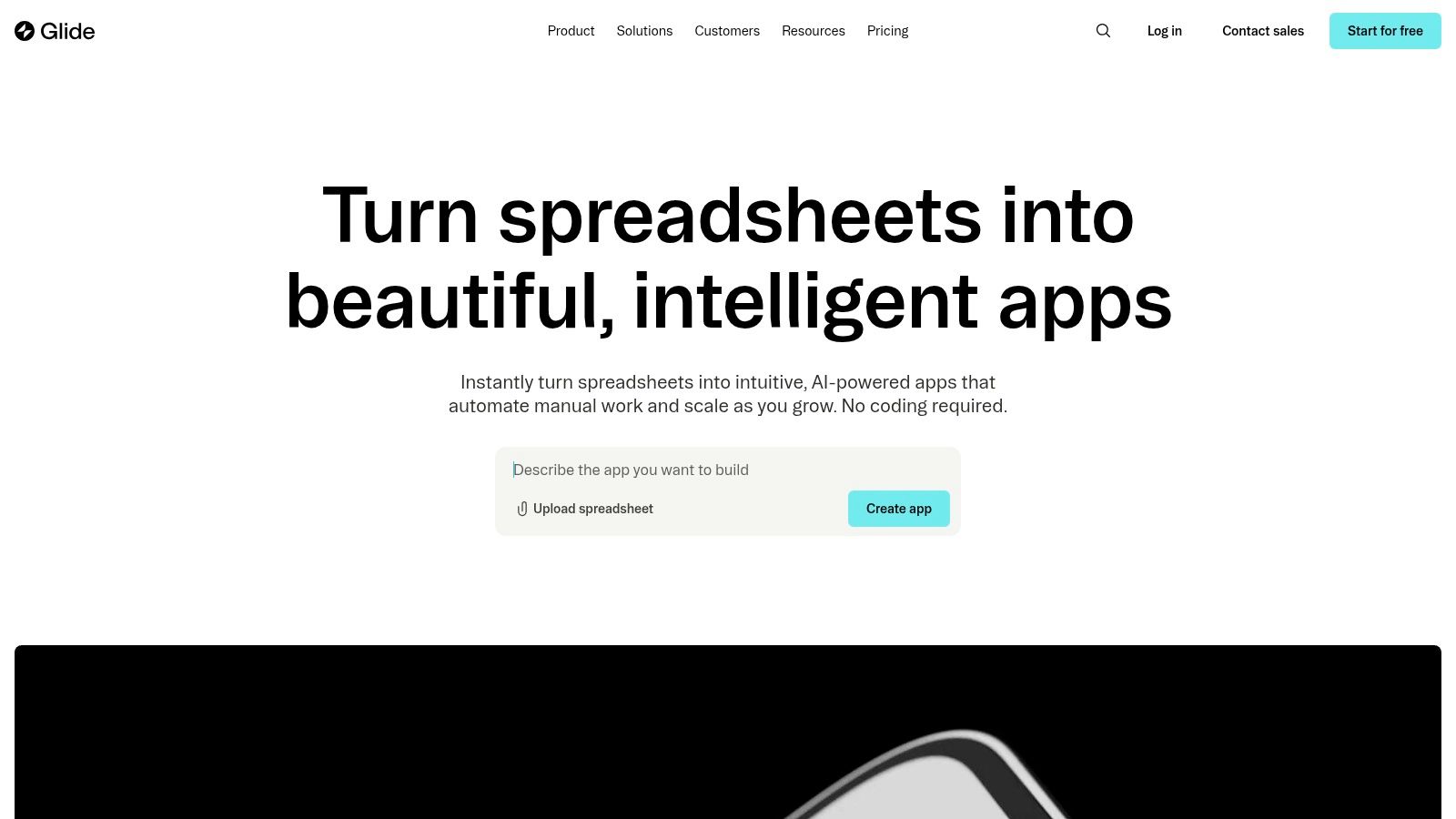
The core strength of Glide is its simplicity. For instance, a startup could create an internal tool for their sales team to track leads, or a simple event app for a conference, all built on top of a Google Sheet and launched in a single afternoon. While you don't get source code, the platform includes Glide AI, API integrations, and automation features that allow for significant functionality. It's a fantastic choice for validating an idea that revolves around displaying, collecting, and managing structured data.
Key Considerations
- Best For: Spreadsheet-savvy founders and teams needing to rapidly prototype and launch data-centric MVPs like internal dashboards, customer directories, or simple inventory management apps.
- Pricing: Offers a free plan for small projects. Paid plans start at $25/month and are structured around the number of users, app updates, and data rows.
- Limitations: The platform's architecture is not suited for building highly complex, consumer-grade applications with bespoke UI/UX. Scalability is tied to usage-based quotas (updates and rows), which requires careful monitoring as your user base grows.
Website: https://www.glideapps.com
5. Softr
Softr excels at turning existing data sources like Airtable and Google Sheets into fully functional web applications, making it a standout MVP builder for startups that are data-centric. It is particularly adept at creating client portals, internal tools, and marketplaces where user access and data visibility need to be tightly controlled. The platform operates on a block-based system, allowing founders to rapidly assemble complex interfaces like lists, charts, and calendars without needing design or development expertise.
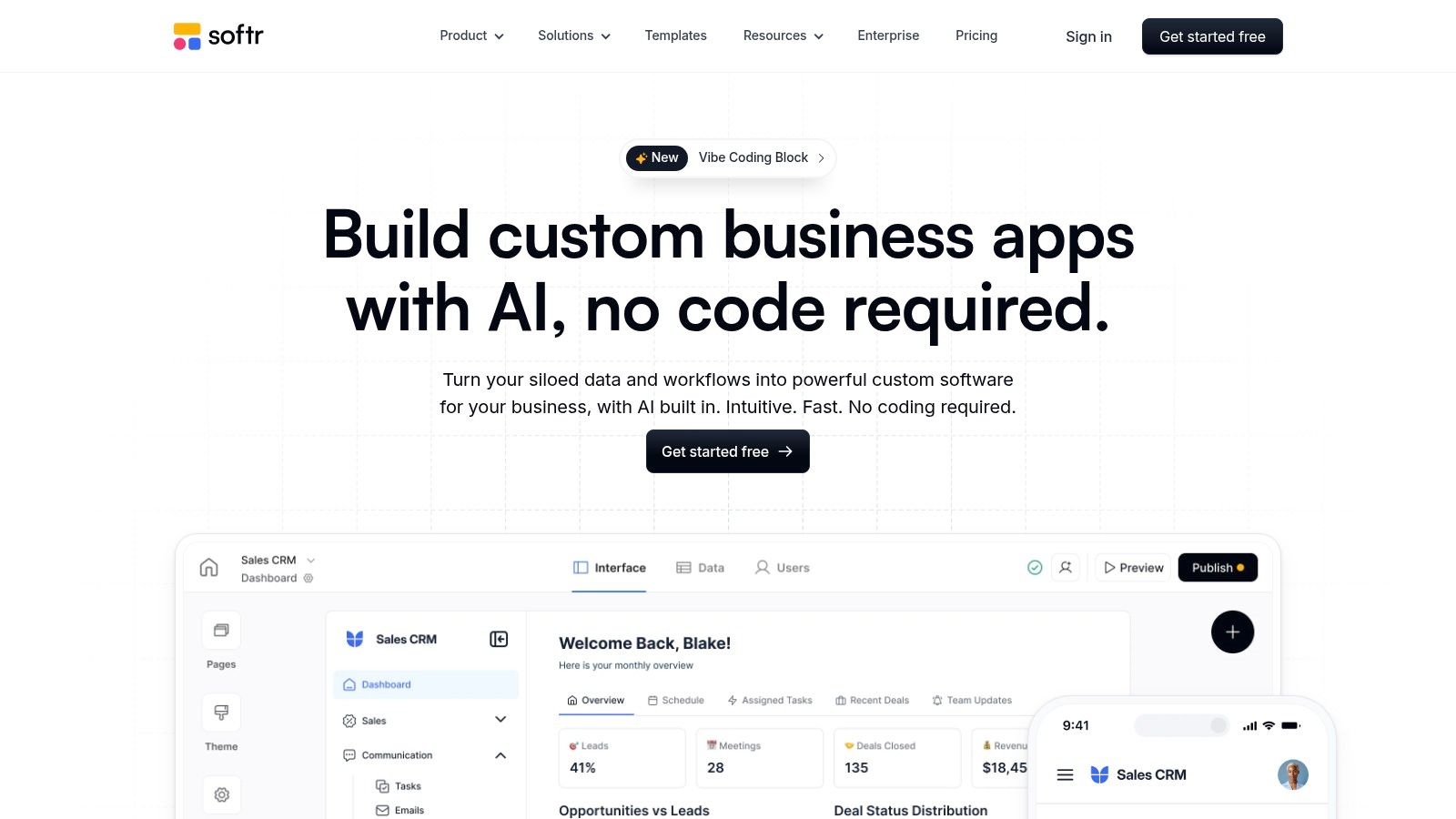
Its core strength is the seamless integration of user authentication and granular permissions directly linked to your data source. For example, you could build a client portal MVP where each client logs in and only sees their project data, which is pulled directly from a specific view in your Airtable base. With built-in support for payments and custom branding, Softr provides a fast track from spreadsheet to a professional-looking, interactive web app that can be used on mobile.
Key Considerations
- Best For: Non-technical founders who need to quickly launch a data-driven web app, such as a client portal or internal dashboard, using an existing Airtable or Google Sheet as the backend.
- Pricing: Offers a free plan for single-app projects. Paid plans start at $49/month (billed annually) and increase based on the number of app users and features like advanced permissions.
- Limitations: While powerful for its intended use, creating highly complex custom logic can be challenging. The platform is web-first, so it's not a solution for building true native mobile apps for the app stores.
Website: https://www.softr.io
6. Adalo
Adalo carves out a specific niche as a no-code MVP builder for startups laser-focused on creating native-feel mobile and web applications. It excels at empowering founders to build and publish real apps to the Apple App Store and Google Play Store without writing code. Its drag-and-drop interface is intuitive, allowing for the quick assembly of screens, user flows, and database collections, making it ideal for straightforward consumer-facing apps.
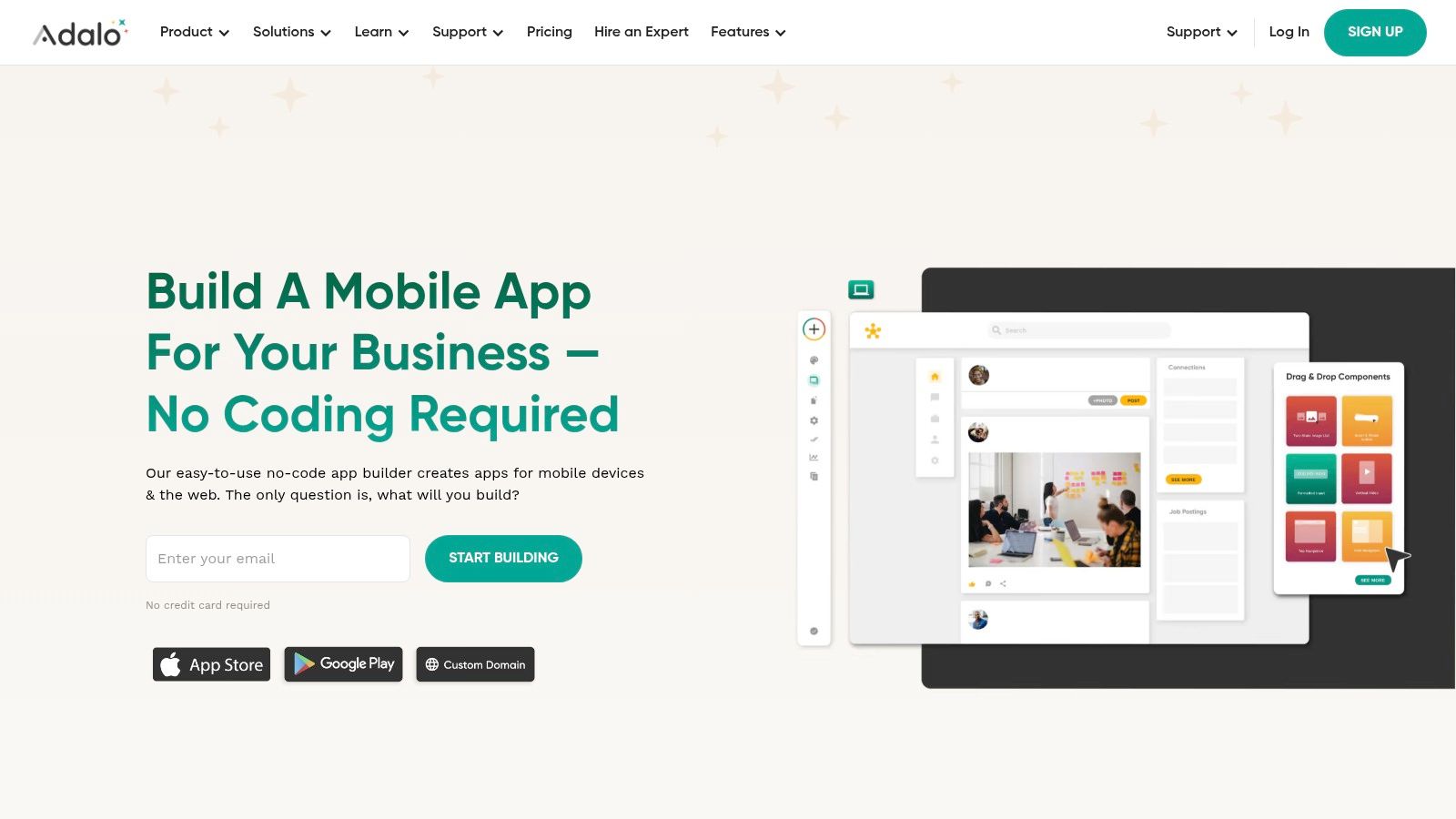
What sets Adalo apart is its streamlined path from idea to app store. A founder could use it to build a simple two-sided marketplace for local services, a member directory app for a community, or a booking app for appointments. It provides a built-in database, user authentication, and a marketplace for custom components to extend functionality, lowering the barrier to entry for non-technical creators aiming to launch a mobile-first product.
Key Considerations
- Best For: Non-technical founders and designers who need to quickly build and launch a functional mobile app MVP for iOS and Android, particularly for B2C use cases.
- Pricing: Offers a free plan to build and preview apps. Paid plans that allow for app store publishing start at $36/month (billed annually) and scale based on app actions and data records.
- Limitations: Performance can become a consideration as an app scales in complexity and user base. The platform operates within a no-code ecosystem, meaning you cannot export source code, which can be a limiting factor for long-term scalability and custom development.
Website: https://www.adalo.com
7. Builder.ai
Builder.ai offers a unique, hybrid approach that sits between a traditional agency and a pure DIY platform. It combines an AI-powered scoping tool with a managed human delivery team, making it an excellent MVP builder for startups who want a guided experience. Founders select pre-packaged features like building blocks (e.g., "user login," "shopping cart"), which the AI uses to generate a fixed-price quote and timeline, removing budget uncertainty from the development process.
This platform demystifies the build process for non-technical founders. You are assigned a dedicated team, including 'Productologists', who translate your vision into a technical roadmap. After the fixed-price build is complete, you receive ownership of the source code, a crucial benefit for long-term scalability and avoiding vendor lock-in.
Key Considerations
- Best For: Non-technical founders or teams without an in-house development capacity who prioritize predictable budgets, fixed timelines, and a managed build process for their mobile app.
- Pricing: Custom-quoted based on the features selected. A fixed price is provided upfront in a "Buildcard" before any development begins.
- Limitations: The process is less flexible for rapid, hands-on iteration compared to DIY tools. Any scope changes after the initial quote will likely impact the cost and timeline. You can explore more about AI-driven MVP development to see how it compares to other solutions.
Website: https://www.builder.ai
8. Upwork
Sometimes, the best MVP builder for startups isn’t a tool but a specialized team. Upwork provides access to a massive global talent marketplace where founders can hire individual freelancers or assemble entire on-demand teams to build their mobile MVP. Instead of a DIY platform, it offers a way to source expert developers, designers, and project managers for any technology stack, including native iOS/Android, React Native, or even specific no-code platforms.
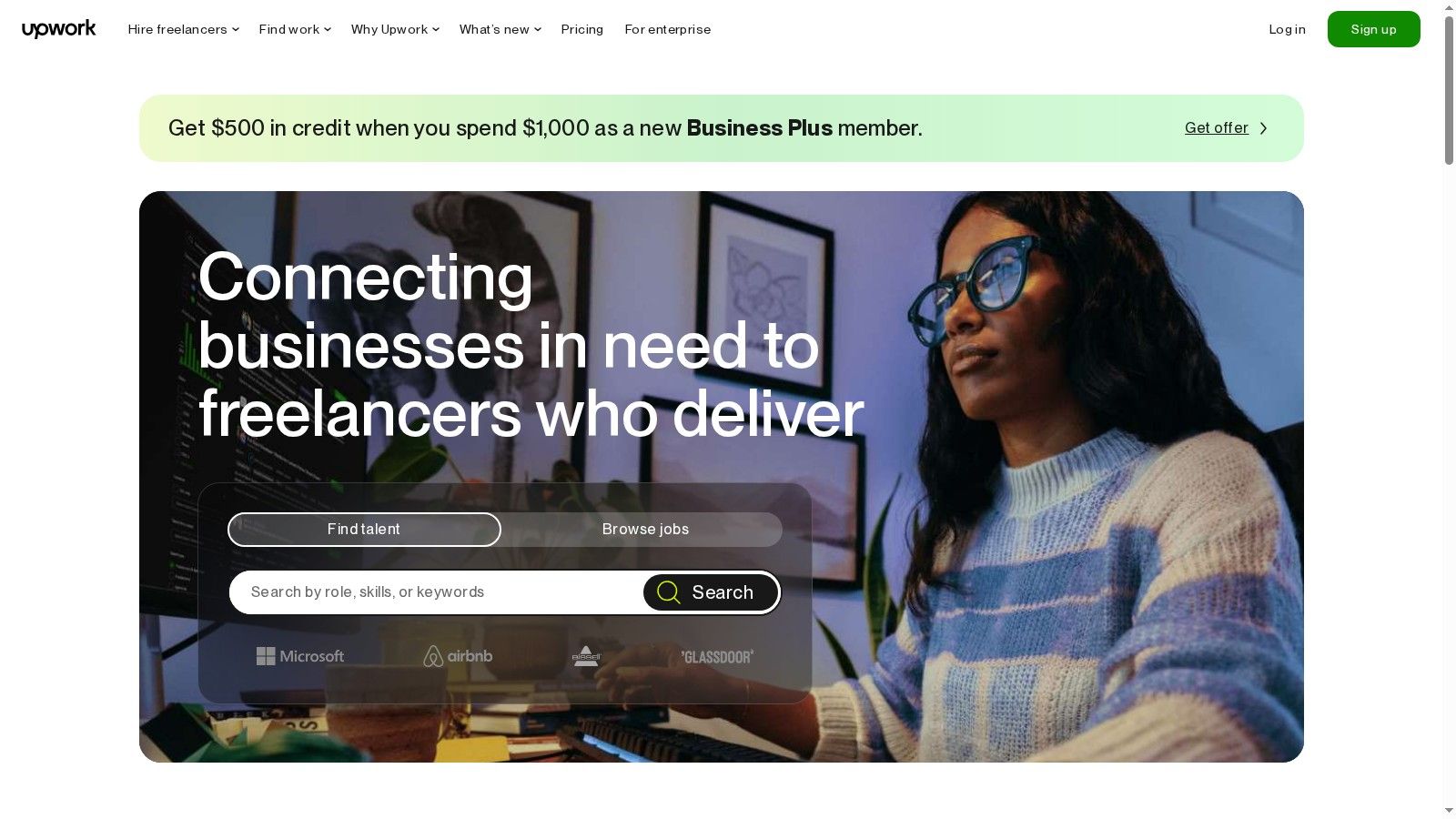
The platform's strength is its flexibility. For instance, a founder could hire a UX designer for two weeks to create wireframes, then hire a React Native developer for two months to build the app based on those designs. Features like escrow protection and built-in time tracking provide a framework for managing remote teams, enabling a fast ramp-up for product development without the commitment of full-time hires.
Key Considerations
- Best For: Founders who have a defined scope and budget but lack the in-house technical skills to build the MVP themselves. It's ideal for assembling a flexible, project-based team quickly.
- Pricing: Varies based on freelancer rates. Upwork charges a marketplace fee (typically 5-10% for clients) on top of the freelancer's price.
- Limitations: The primary challenge is vetting and managing talent. The quality can vary significantly, and the responsibility for project management falls on the founder.
Website: https://www.upwork.com
9. Fiverr Pro
While not a tool itself, Fiverr Pro offers a different kind of MVP builder for startups: curated, high-quality human talent. Instead of learning a new platform, you can hire a vetted professional to build your mobile MVP using their tool of choice. This is an accelerator for founders who have the budget but lack the time or specific technical skills to execute their vision, whether it's a no-code build in Adalo, a UI/UX prototype in Figma, or initial code development in React Native.
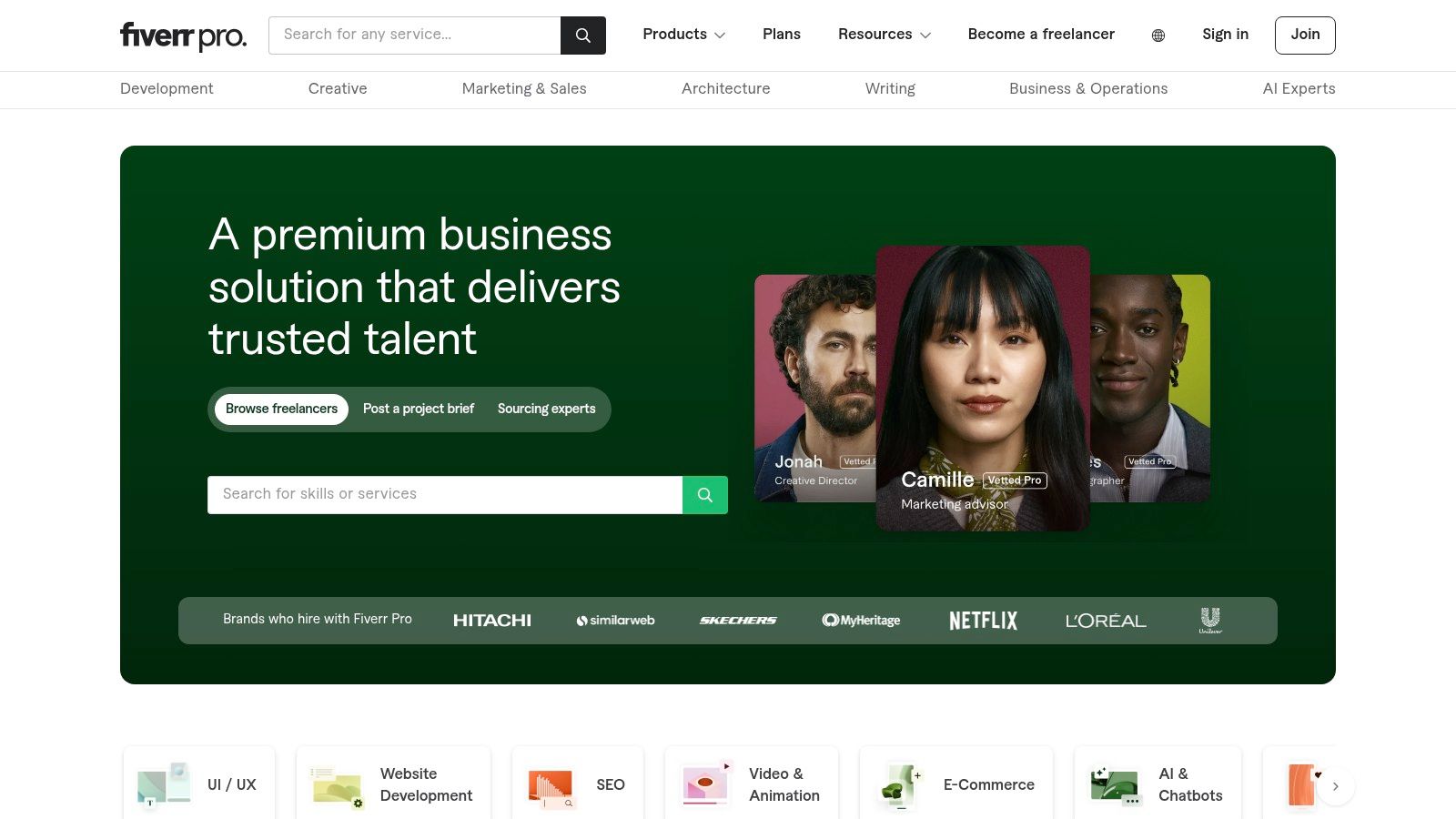
The "Pro" designation signifies that freelancers have been rigorously vetted by Fiverr for quality and professionalism, reducing the risk often associated with freelance marketplaces. This makes it a reliable way to source experts for specific, project-based tasks. For example, you could hire a Pro developer to build just the login and user profile features of your app to get you started.
Key Considerations
- Best For: Founders and businesses who prefer to outsource specific parts of their MVP development to a vetted expert rather than building it all themselves.
- Pricing: Gig-based pricing varies significantly by freelancer and project scope. Expect to pay a premium for Pro-vetted talent.
- Limitations: The cost is higher than a DIY software subscription, and success depends heavily on clear communication. Careful project scoping is essential to avoid budget overruns.
Website: https://www.fiverr.com/pro
10. Toptal
Toptal offers a different approach to MVP development by connecting startups with the top 3% of freelance talent, including senior developers, designers, and product managers. Rather than a software tool, Toptal is a premium talent network. This makes it an excellent MVP builder for startups that prefer to hire a vetted expert or a dedicated team to build their product from the ground up, ensuring high-quality execution from day one. The platform's matching process quickly connects you with suitable candidates, often within 24-48 hours.
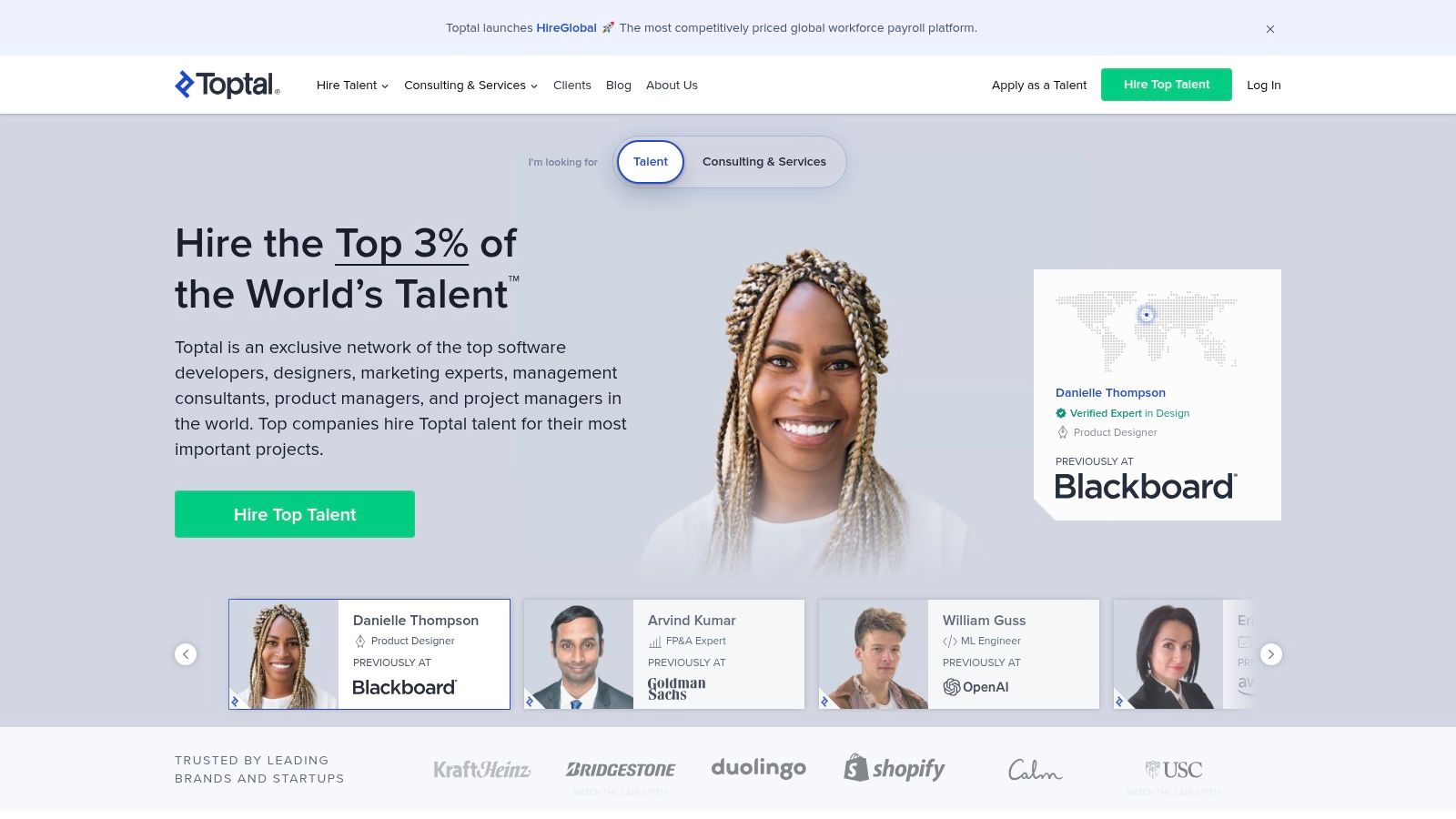
The key advantage is risk reduction. Toptal's rigorous screening process means you're working with proven professionals, and their two-week, no-risk trial period allows you to validate the fit before committing significant capital. This model is ideal for funded founders who prioritize speed and quality over learning a new no-code platform. By hiring an expert, you get a fully-coded, scalable MVP built with best practices.
Key Considerations
- Best For: Funded startups who need to build a high-quality, fully-coded MVP and prefer to outsource development to a highly vetted, senior-level professional or team.
- Pricing: Requires an initial refundable deposit of $500. Talent rates are premium and vary based on role and location.
- Limitations: This is the most expensive option on this list, making it less accessible for bootstrapped founders. You lose the hands-on control and learning experience of building the MVP yourself.
Website: https://www.toptal.com
11. Aloa
For founders who prefer a managed, expert-led approach over a DIY tool, Aloa offers a unique service-based solution. It functions as a strategic development partner, pairing startups with vetted global engineering teams overseen by a U.S.-based product owner. This model is a powerful MVP builder for startups that need to execute on a clear vision but lack the internal resources or time to manage a development project from scratch.
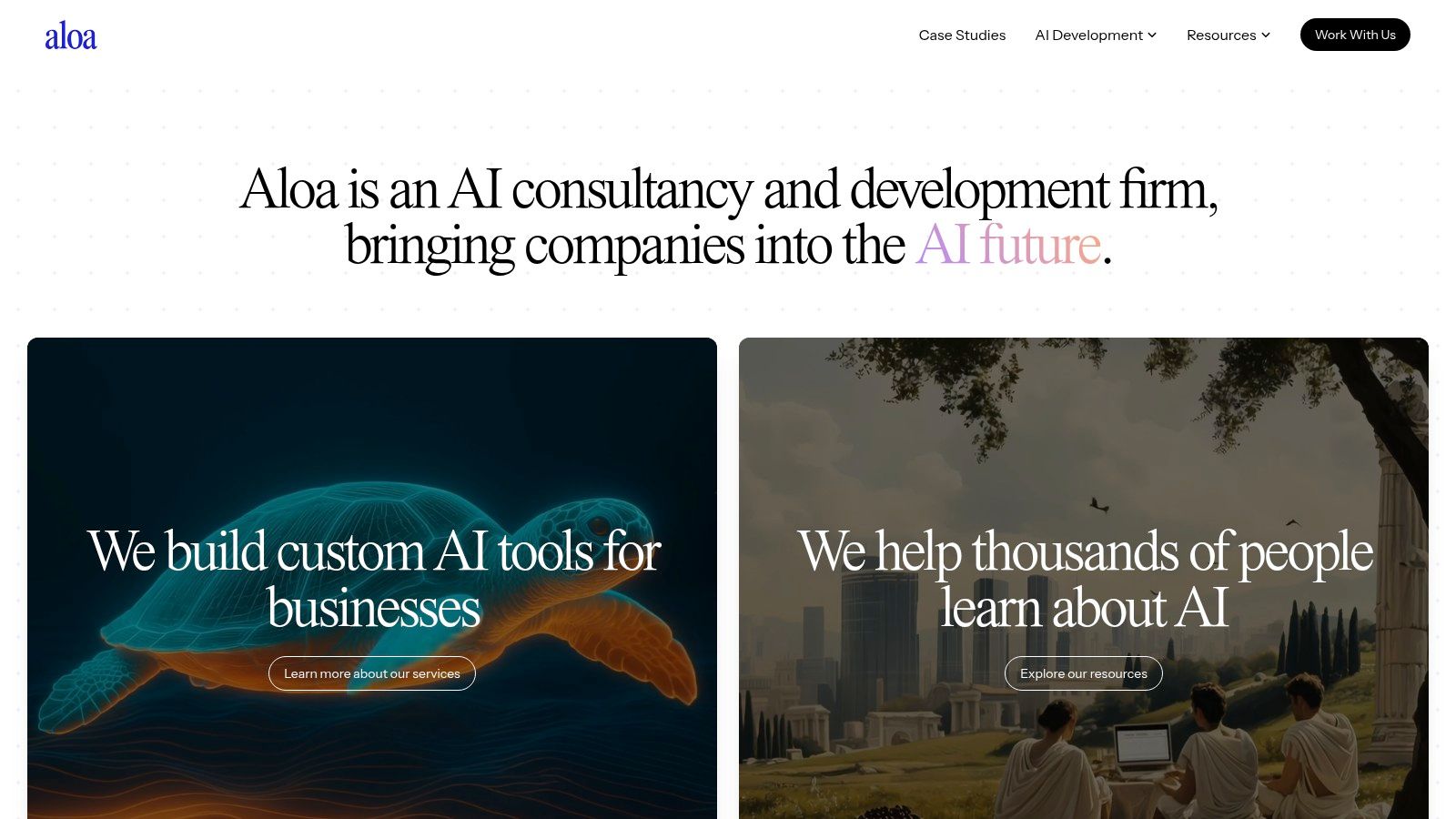
Aloa’s strength lies in its structured, phase-based delivery paths, such as a 6-8 week Proof of Concept or a full production build. This predictable scoping provides clarity on timelines and costs. Instead of a platform, you get a partnership that handles the technical execution, allowing you to focus on product strategy and user feedback. They cover a broad range of technologies, including complex mobile and AI-powered applications.
Key Considerations
- Best For: Startups that have a validated concept and budget, and want a reliable, managed team to build a high-quality MVP without the overhead of direct project management.
- Pricing: Custom-quoted based on project scope. They offer packaged phases, providing a cost-effective blended rate compared to purely U.S.-based development agencies.
- Limitations: This is not an instant, self-service platform; quotes and timelines are project-dependent. It is best suited for startups that value expert oversight over the hands-on control of a no-code tool.
Website: https://aloa.co
12. Xperts
Xperts, the rebranded services arm of Crowdbotics, offers a managed approach to app development, framing their core offering as a '90-Day MVP' engagement. This makes it a compelling MVP builder for startups who prefer a hands-on partner over a DIY platform. They combine AI-assisted planning tools, which help generate initial product requirements and UI mockups, with a structured development process to deliver a functional product quickly.
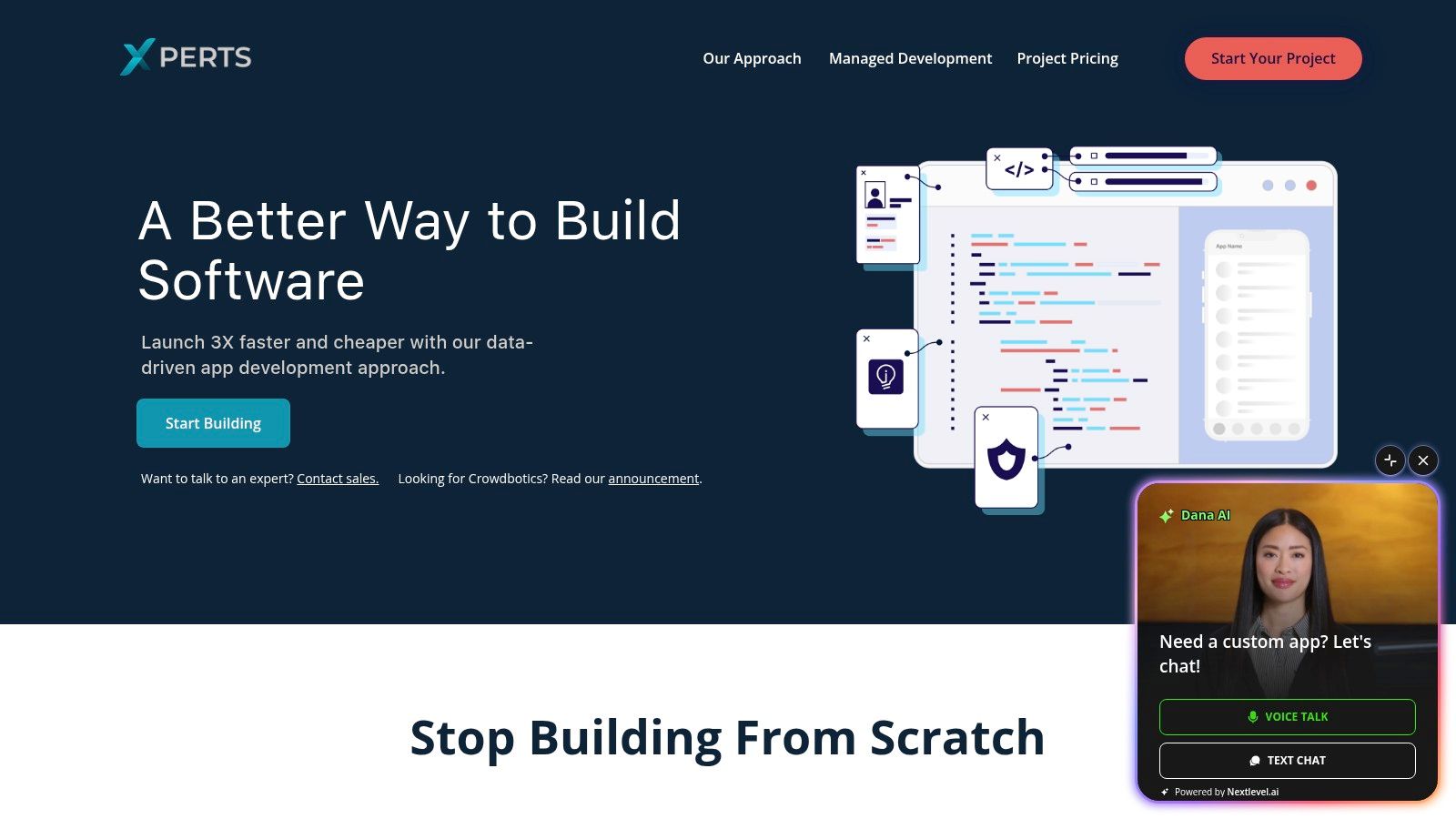
The platform is designed for founders who want to accelerate the scoping and building phases by leveraging a dedicated team. Xperts provides access to studio tools like a UI builder and template catalog to streamline the initial design process. After launch, they offer subscription-based 'Care' plans that cover hosting, maintenance, and ongoing support, providing a clear path for iteration without the need to immediately hire an in-house technical team.
Key Considerations
- Best For: Founders who need a dedicated development partner to scope, build, and launch an MVP within a structured 90-day timeline and want ongoing maintenance options.
- Pricing: Engagements are custom-quoted based on the project scope. Post-launch "Care" plans are available via subscription.
- Limitations: Pricing is less transparent than self-service tools, requiring a custom quote. As a rebrand from Crowdbotics, startups should verify current service level agreements to ensure alignment with their project needs.
Website: https://www.xperts.com
12 MVP Builders: Features & Pricing
| Tool | Core focus / Output | Target users | Unique selling points | Limitations | Pricing model |
|---|---|---|---|---|---|
| RapidNative — Recommended | AI prompt/sketch/image → production-ready React Native + Expo UI; exportable TypeScript + NativeWind code | Founders, PMs, UX designers, small dev teams, agencies | Prompt-to-UI chat-driven edits; whiteboard & image-to-app; clean modular code ready for IDE handoff; developer-first | UI/navigation scaffolds only; deep native modules, backend logic, complex animations need manual work; quota-based usage | Free tier (20 req/month + credits); Starter $20/mo; Pro $50/mo; Teams/Enterprise custom |
| Bubble | No-code full web apps (DB, workflows, plugins); native mobile in beta | Founders building SaaS, marketplaces, internal tools | All-in-one stack; large plugin marketplace; API/connectors; scales to production | Learning curve for workflows; performance and Workload Unit limits | Free → Enterprise; usage-based (WUs); mobile plans in beta |
| Webflow | Visual web builder for sites, CMS & e‑commerce; production hosting | Designers, marketing teams, content-heavy MVPs | Designer-grade control; CMS & hosting; advanced animations | Steeper learning curve; CMS/export limits on lower tiers | Site/CMS/e-commerce plans (tiered pricing) |
| Glide | Data-driven apps (Glide Tables, Sheets, Airtable) → PWAs/mobile | Spreadsheet-savvy founders; internal tools; simple SaaS | Very fast prototyping; spreadsheet/data connectors; predictable update model | Row/update quotas and limits; may outgrow for complex consumer apps | Free → paid tiers; usage/row limits per plan |
| Softr | Web apps/portals on Airtable/Sheets with prebuilt blocks & auth | Teams launching gated MVPs, client portals, marketplaces | Prebuilt blocks, permissions, payments, workflows | User/workflow action limits on lower tiers; complex logic may need workarounds | Free → paid plans with feature/user limits |
| Adalo | No-code mobile app builder focused on native-feel apps & app-store publishing | Mobile-first founders building B2C MVPs | Visual editor for native-feel UI; direct app-store publishing path | Record/action limits; performance considerations at scale; custom components sometimes needed | Free → paid plans for publishing and advanced features |
| Builder.ai | Managed AI-assisted app builds plus delivery team and support | Non-technical founders seeking managed delivery & predictable budgets | Fixed-price scoping; feature catalog + human customization; year-one support | Less DIY control; changes post-scope affect cost/timeline | Custom fixed-price quotes per project (Studio One packages) |
| Upwork | Global talent marketplace to hire devs, designers, PMs | Founders needing flexible, on-demand teams or contractors | Massive talent pool; flexible contract models; escrow/time-tracking | Requires vetting and management; marketplace fees add overhead | Hourly or fixed-price; platform fees and escrow |
| Fiverr Pro | Curated/vetted freelance talent for higher-stakes work | Teams needing vetted specialists quickly | Vetted Pro freelancers; business features and guarantees | Pro subscription/spend thresholds for some features; variable gig pricing | Per-gig pricing; Pro features/subscription (some tiers $129/mo) |
| Toptal | Premium vetted senior talent & white-glove matching | Startups needing senior engineers, designers, PMs | High talent bar; 2‑week no‑risk trial; fast hand-matching | Higher cost than open marketplaces; platform subscription fee applies | Premium hourly/project rates; $79/mo subscription when proceeding |
| Aloa | U.S. product owner + vetted global delivery with packaged phases | Startups wanting managed, phase-based MVP delivery | U.S. oversight, packaged POC → production paths, retainers | Quotes vary and are less instant than DIY tools | Custom quotes; packaged phase pricing |
| Xperts | 90‑Day MVP with AI-assisted PRD/UI generation and care plans | Founders wanting a partner to scope, ship and maintain MVP | 90‑day framing; AI PRD/UI tools; ongoing care/hosting options | Rebrand transition from Crowdbotics; custom quoting; less price transparency | Custom quotes; subscriptions for hosting/care plans |
Making Your Choice: Which MVP Builder Is Right for Your Startup?
Choosing the right MVP builder for your mobile product can feel overwhelming, but the options we've explored show there's a clear path for every type of founder. Your journey from idea to a real product hinges on selecting a tool that aligns with your immediate needs, technical skills, and long-term vision. We've seen a wide spectrum, from all-in-one no-code platforms to specialized freelance marketplaces.
The key takeaway is that there is no single "best" MVP builder; there is only the best one for your specific situation. Your decision should be strategic, balancing the need for speed against the crucial requirement for future scalability.
A Framework for Your Decision
To make a confident choice, filter the options through these critical questions:
- What is your primary goal? Is it to quickly validate a concept with a simple, functional prototype? Or is it to build the foundational codebase for a scalable, production-ready mobile application? Tools like Glide or Adalo excel at the former, while a solution like RapidNative is designed for the latter.
- What are your team's skills? If you have a non-technical founding team, a pure no-code platform like Bubble or Adalo offers an accessible entry point. However, if you have access to development talent (or plan to hire it soon), an AI code generator provides a powerful bridge, allowing non-technical members to contribute while producing high-quality code that developers can extend.
- What is your long-term product roadmap? If your MVP is a throwaway prototype to test an idea, platform lock-in is less of a concern. But if you intend for your MVP to evolve directly into your V1 and beyond, owning your codebase is non-negotiable. This is the fundamental difference between a platform that hosts your app and a tool that helps you build it.
The No-Code vs. Code-Ownership Dilemma
The most significant fork in the road is choosing between a walled-garden no-code ecosystem and a tool that grants you code ownership. Traditional no-code platforms offer incredible speed but often come with performance ceilings, design limitations, and the risk of hitting a wall that requires a complete, costly rebuild.
Conversely, the emerging category of AI-driven code generation, exemplified by RapidNative, presents a modern compromise. It delivers the speed and accessibility of a visual builder but outputs clean, exportable React Native code. This hybrid approach de-risks your technical future. Your MVP is not a dead end; it's the first version of your real product, ready to be handed off to an engineering team for limitless customization and scaling. When evaluating potential MVP builders, it's crucial to consider specific website design considerations for startups that align with your long-term vision, ensuring your initial build supports your brand and user experience goals down the line.
Ultimately, the right mvp builder for startups is an accelerator, not an anchor. It should empower you to learn from your users faster, iterate with agility, and build a solid foundation for sustainable growth. Choose the tool that not only gets you to market quickly but also clears the path for the ambitious journey ahead.
Ready to build your mobile MVP with the speed of no-code but the power of real code? Get started with RapidNative and transform your app idea into a fully functional React Native prototype in minutes. Go from prompt to product and own your codebase from day one.
Ready to build your app?
Turn your idea into a production-ready React Native app in minutes.
Free tools to get you started
Free AI PRD Generator
Generate a professional product requirements document in seconds. Describe your product idea and get a complete, structured PRD instantly.
Try it freeFree AI App Name Generator
Generate unique, brandable app name ideas with AI. Get creative name suggestions with taglines, brand colors, and monogram previews.
Try it freeFree AI App Icon Generator
Generate beautiful, professional app icons with AI. Describe your app and get multiple icon variations in different styles, ready for App Store and Google Play.
Try it freeFrequently asked questions
What is RapidNative?
RapidNative is an AI-powered mobile app builder. Describe the app you want in plain English and RapidNative generates real, production-ready React Native screens you can preview, edit, and publish to the App Store or Google Play.
Can I export the code?
Yes. RapidNative generates clean React Native and Expo code that you can export at any time. No lock-in, no proprietary format. Hand it to your developers or keep building inside RapidNative.
Is RapidNative free to use?
Yes. You can build apps on the free plan with no credit card required. Paid plans unlock unlimited AI generations, code export, and direct publishing to the App Store and Google Play.
Do I need to know how to code?
No. Most users build apps by describing what they want in plain English. Developers can drop into the code whenever they want more control, but coding is optional.
How long does it take to build an app?
Most users have a working first screen in under a minute. A full MVP usually takes a few hours instead of the weeks or months traditional development requires.