How to Build a Dating App That Stands Out
A practical guide on how to build a dating app. Learn to define your niche, design core features, prototype with AI, and launch a successful app.
By Sanket Sahu
4th Jan 2026
Last updated: 4th Jan 2026
If you’re thinking about building a dating app, your first instinct might be to make a better version of what’s already out there. That’s a mistake. The key to success isn't about cloning Tinder; it's about finding a corner of the market that the big players have overlooked and solving a real problem for that specific group. This initial decision will shape every single thing you do next, from features to marketing.
Finding Your Niche in a Crowded Market
Let's be practical: trying to build a dating app for everyone is a recipe for getting lost in the noise. Giants like Tinder, Hinge, and Bumble have spent years and millions building their brands. You can’t outspend them, so you have to outsmart them. The way you do that is by going deep, not wide.
The real opportunity lies in focusing on psychographics—the shared interests, values, and lifestyles that bring people together. Instead of just filtering by age and location, think about the communities that are hungry for a more meaningful way to connect.
Identify Frustrations and Unmet Needs
What do people actually complain about when using dating apps? Talk to your friends or browse Reddit, and you'll see the same issues pop up again and again.
- Endless Swiping Fatigue: The sheer volume of profiles is exhausting. It feels impersonal and leads to serious burnout.
- Superficial Connections: It’s hard to know if you're truly compatible with someone based on a few carefully selected photos.
- Lack of Safety and Trust: Users are constantly worried about catfishing, bots, and bad actors, which kills the whole experience.
- Misaligned Intentions: People looking for a serious relationship get stuck wading through a sea of users who just want something casual.
Pick one of these frustrations and make it your mission to solve it. This focus is what will make people choose your app over the dozen others on their phone. Of course, before you pour time and money into development, you have to be sure you're onto something. It's critical to validate your product ideas fast and confirm there's a real audience for your solution.
Brainstorming Niche Dating App Concepts
Once you’ve zeroed in on a problem, start thinking about which communities feel that pain most acutely. Your goal isn't just to build another swipe-and-match tool; it's to create a genuine community.
For instance, what if you built an app specifically for:
- Board Game Enthusiasts: A place where profiles showcase favorite games, and people match based on finding the perfect partner for game night.
- Sustainability-Focused Singles: An app connecting people who share eco-conscious values, from veganism to zero-waste living.
- Sober and Mindful Individuals: A community for people who prefer dates that don’t revolve around alcohol, focusing instead on activities like hiking or coffee.
- Travelers Seeking Connections: A way for solo travelers to meet up with others in a new city, whether for a date or just a friendly face.
If you’re wondering whether this is a viable business strategy, just look at the numbers. The global dating app market pulled in over $6 billion in revenue in 2024 and is on track to hit $8.9 billion by 2030. What's fascinating is that this growth is happening even as user acquisition slows down. The market is maturing. It's shifting from a numbers game to a quality game, where niche apps that deliver real value can truly thrive. This trend confirms the business case for specialized apps that solve specific user needs. You can dig deeper into this by reading the full report on global dating app revenue growth.
This strategic pivot from broad appeal to niche focus is the single most important decision you'll make. It transforms your project from a high-risk gamble against industry giants into a targeted solution for a passionate, underserved audience more likely to become loyal advocates.
This is where an idea can quickly start to feel real. For example, a simple prompt in a tool like RapidNative can generate an initial UI for a niche app concept, bridging that gap between a great idea and a tangible design.
This gives you an immediate visual starting point. From here, you can iterate quickly, testing how your concept translates into an interface that people will actually want to use.
Designing Your Core User Experience and MVP Features
You’ve found your niche—the specific community you’re going to bring together. Now comes the exciting part: turning that idea into an actual app people will use and love. This is also where a lot of great ideas fall apart. The temptation is to build every feature you can dream of, but that path leads to a bloated, confusing app that never sees the light of day.
The secret is to focus relentlessly on your Minimum Viable Product (MVP). An MVP isn't a half-baked version of your app. It’s the leanest, most focused version that perfectly solves the core problem for your audience. For a dating app, this means nailing four critical user experiences. Everything else is just noise, at least for now.
The Four Pillars of a Dating App MVP
To get this right, you have to think like a user. What’s their journey from the moment they download your app to their first real conversation? That entire experience needs to be seamless, and it’s built on these four essential pillars.
Frictionless Onboarding
You have seconds to make a good first impression. If signing up is a chore, people will just leave. Your onboarding has to be dead simple. Leaning on social logins from Google or Apple is a smart move here because it drastically cuts down on typing and gets people into the app faster. The whole point is to move them toward creating their profile as quickly and painlessly as possible.
Intuitive Profile Creation
This is where your app’s personality—and its unique value—truly shines. Don't just copy the generic fields you see everywhere else. Tailor your profile prompts to your niche. If you’re building an app for board game fanatics, ask for their "Top 3 Favorite Games" or "Ideal Game Night Vibe." For an eco-conscious community, prompts like "My Go-To Sustainable Swap" can be fantastic conversation starters. The goal is to encourage authenticity with a mix of photos, a short bio, and prompts that actually reflect who your users are.
A Compelling Matching Mechanic
How will your users find each other? The swipe-right mechanic is iconic, but it's far from the only game in town. Your matching logic should feel like a natural extension of your app's purpose. Maybe you offer a daily, curated batch of profiles based on deep compatibility scores. Or, for an app aimed at travelers, a map-based discovery feature could be a game-changer. Whatever you decide, it needs to be easy to grasp and, frankly, a little addictive.
Secure Real-Time Messaging
Once two people match, they need a safe and reliable place to talk. A solid, real-time chat feature is absolutely non-negotiable. For your MVP, keep it simple: focus on delivering text and photos flawlessly. Don't get bogged down with read receipts, emoji reactions, or video calls just yet. The priority is to create a secure space where a connection can actually begin.
This simple diagram shows how the initial stages flow together—you research the market, find your unique angle, and then build the features that solve a real problem for that group.
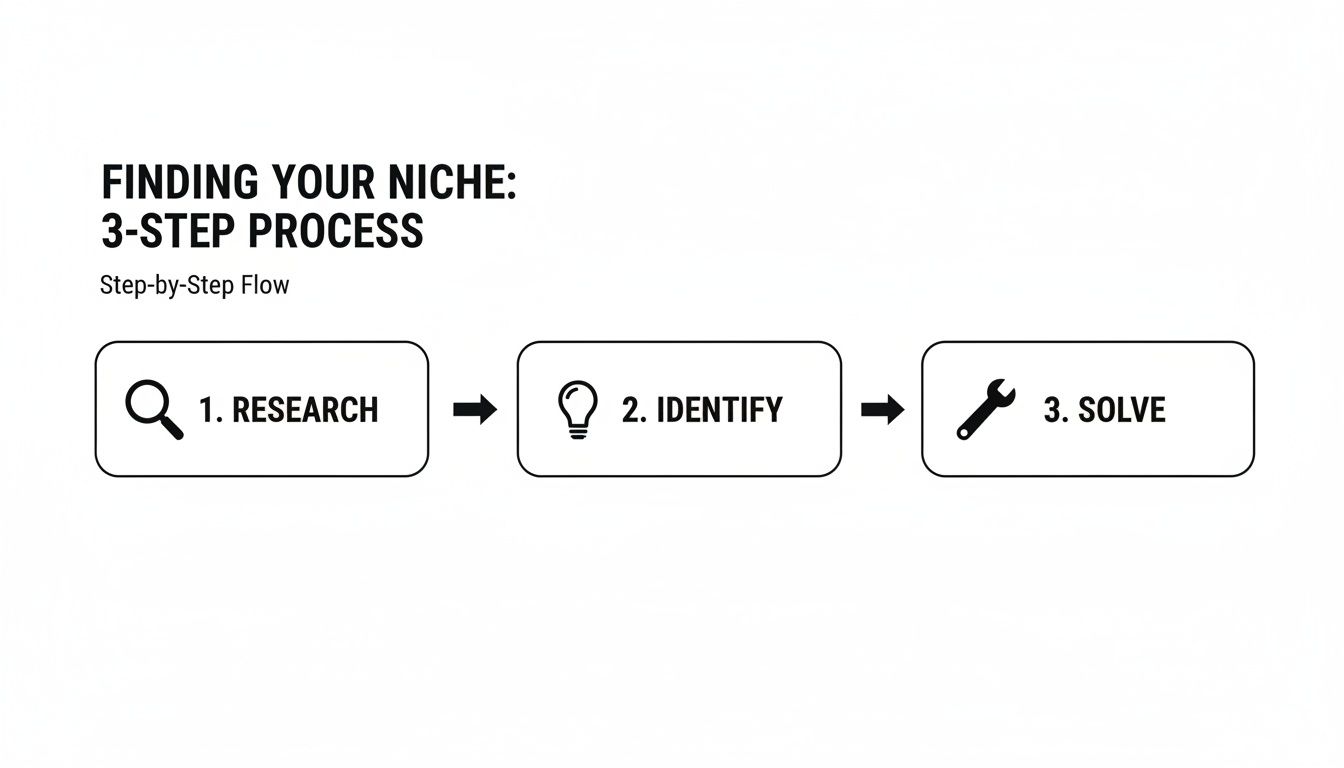
Your MVP features are the direct answer to the "solve" stage, giving your specific audience exactly what they need to connect.
Prioritizing Your Feature Roadmap
It’s incredibly easy to get sidetracked by flashy features like video profiles, AI icebreakers, or complex event integrations. While cool, these are classic examples of "scope creep" that can blow up your timeline and budget. A successful launch is all about disciplined prioritization. Get a working, valuable product into users' hands, listen to their feedback, and then build what they ask for.
Your MVP is not about launching with the fewest features possible. It’s about launching with the right features that deliver on your core promise and prove people want what you're building.
To keep your project on track, it’s helpful to draw a clear line between what’s needed for launch and what can wait. This distinction is critical for managing scope as you move into development.
MVP vs Post-Launch Feature Prioritization for a Dating App
Here’s a practical way to think about what's essential for day one versus what you can build out over time. This approach helps you launch faster while still delivering a great core experience.
| Feature Category | Essential MVP Feature | Post-Launch Enhancement |
|---|---|---|
| User Profiles | Photo uploads, bio, age, location, niche-specific prompts | Video introductions, Spotify/Instagram integration |
| Matching | A single, core mechanic (e.g., swiping, daily batch) | Advanced filters (e.g., height, education), "Super Likes" |
| Communication | Real-time text chat, basic photo sharing, block/report functionality | GIF support, voice messages, video calls |
| Monetization | (Optional) Simple, single-tier subscription for a premium feature | Freemium model, multiple subscription tiers, in-app purchases |
By sticking to this focused roadmap, you can avoid the common trap of overbuilding. You’ll launch an app that immediately resonates with your target users, creating a solid foundation for future growth and success.
Prototyping Your App UI in Minutes with AI
Once you've nailed down your MVP's core features, it's time to bring that vision to life. Traditionally, this was the point where you’d face a slow and expensive handoff to designers and developers. But that's not the world we live in anymore. Today, you can use AI to build a functional, interactive prototype in minutes, moving from an idea to a testable product faster than ever.
This isn't about creating static, lifeless mockups. We're talking about generating a real, interactive UI that looks and feels like a finished app. For anyone who isn't a coder—especially founders and product managers—this is a massive advantage. You can actually see your app and get user feedback before sinking a six-figure budget into development. It's the smartest way to build a dating app on a solid foundation.
From Simple Prompts to Interactive Screens
The whole process kicks off with plain English. Forget about writing rigid user stories or messing with complex wireframing tools. You just describe the screen you have in your head.
For instance, to get the main discovery screen for your dating app, you could type a prompt like this:
"Create a card-swiping interface for discovering new profiles. Each card should feature a large user photo, their name, age, and a short bio. Include 'like' and 'pass' buttons at the bottom."
In seconds, an AI tool like RapidNative can spit out a fully-formed screen. And here’s the best part: it’s not just a picture. It’s a component-based UI built with production-ready React Native code. What you see is what you can actually build upon, which dramatically shortens the distance between a design concept and a developer-ready asset. To see how this can speed up your whole process, you can check out these AI-powered mobile workflows.
Of course, that first screen is just a starting point. The real magic happens when you start refining the design through a simple conversation.
Iterating and Refining with Chat-Driven Design
Your first draft is never going to be perfect. Maybe the "like" button feels too small, or the color palette is off-brand. With chat-driven design, you can make those tweaks instantly with follow-up prompts.
- "Make the 'like' button a vibrant green and increase its size by 20%."
- "Change the background color to a soft, off-white with the hex code #F5F5F5."
- "Add a 'Super Like' icon between the 'like' and 'pass' buttons."
This back-and-forth feels more like a conversation than a design process, cutting out the typical delays between stakeholders and designers. You can experiment with layouts, colors, and components in real-time until the UI is exactly what you envisioned.
Let’s try this with another crucial screen: the user profile. A detailed prompt can get you 90% of the way there on the very first try.
"Generate a user profile screen with a large, rounded profile image at the top. Below the image, add a section for the user's name and age, followed by a short bio. Include a horizontally scrollable gallery of smaller photos, a section for interest tags, and a prominent 'Send a Message' button at the bottom."
Just like that, you have a complete, functional screen ready to go.
This shows how a simple text idea can be instantly turned into a tangible design you can actually interact with and get feedback on.
Linking Screens to Test the Full User Flow
An app is more than just a collection of pretty screens; it’s about how they all work together. The final prototyping step is to connect these individual screens to map out the entire user journey.
You can do this conversationally, too.
- Link Discovery to Profile: "When a user taps on a profile card, navigate to the User Profile screen."
- Connect to Messaging: "Make the 'Send a Message' button on the profile screen navigate to a new Chat screen."
- Create a Match Flow: "After a mutual like, show a 'You Matched!' pop-up screen with buttons to 'Keep Swiping' or 'Send a Message'."
By linking these flows, you create an interactive prototype that you can load right onto your phone. You can hand it to potential users and watch them go from swiping to matching to messaging. This gives you invaluable, real-world feedback on your app's flow and feel long before you write a single line of backend code.
This validation cycle drastically cuts down your risk and ensures you build a dating app that people will genuinely love using. Better yet, the final output is clean React Native code, making the handoff to your developers seamless. They can take it and immediately start integrating the backend services to bring your app to life.
Getting the Engine Right: Key Technical and Backend Decisions
A slick user interface is what gets people to download your dating app, but it's the engine humming under the hood that will make them stay. If your backend can't keep up, your app will fail. It's that simple. Getting these infrastructure choices right from day one is non-negotiable for scaling, security, and giving users a reliable experience.
For founders who aren't career software engineers, these choices can feel a bit daunting. But you don't need to be a coder to understand the core pillars of your app's architecture. Let's walk through the three most important technical decisions you'll face: how people sign in, how they talk to each other, and how they find each other.
Choosing Your Authentication Method
How users log into your app is their very first handshake with your backend. This isn't just about a username and password; it's about making things easy and secure right from the start. You've really got two main paths: the classic email/password combo or social logins (think "Sign in with Google" or "Sign in with Apple").
- Social Logins: This is usually the best bet for an MVP. Why? It dramatically lowers the barrier to entry. People don't have to think up and remember another password. Even better, you're offloading the heavy lifting of account security to giants like Google and Apple, who have massive teams dedicated to it.
- Email and Password: Going this route gives you more direct control, but it also comes with more responsibility. You have to build and maintain a secure system for storing passwords (hashing and salting are absolute musts), handling account recovery, and verifying emails. It's more work, but you own the user relationship completely.
Honestly, the best approach for most new dating apps is a mix of both. Make social logins the main, easiest option, but always include an email alternative for those who prefer to keep their accounts separate.
Implementing Real-Time Messaging
The chat feature is the heart of your app—it’s where the magic happens. That means it has to be fast, reliable, and secure. A single delayed or dropped message can completely kill the vibe of a new conversation and sour the user experience. You're facing a classic "build vs. buy" decision here.
You can either plug into a ready-made, third-party service or build your own chat system from the ground up.
| Approach | Pros | Cons | Best For |
|---|---|---|---|
| Managed Service (e.g., Firebase, Sendbird) | Much faster to get running, handles scaling for you, often includes extras like read receipts and typing indicators. | Less control over features and data, can get expensive as you grow, potential for vendor lock-in. | MVPs and teams who need to launch fast without deep backend expertise. |
| Custom Solution (e.g., using WebSockets) | Total control over features and data, can be cheaper at massive scale, allows for truly unique chat features. | Needs significant development time and expertise, you're on the hook for all scaling and maintenance, much more complex to secure. | Well-funded startups with a dedicated backend team and a vision for highly custom chat. |
For your first version, a managed service is almost always the smart move. It frees up your limited time and money to focus on what actually makes your app special—your community and matching logic—instead of rebuilding complex chat infrastructure. As you weigh these options, having a grasp of fundamental system design principles will help you make choices that support your app's long-term health.
Demystifying Your Matching Algorithm
Every founder thinks their "secret sauce" is a complex, AI-powered matching algorithm. But for an MVP, simplicity is your best friend. The goal isn't to build a "perfect" algorithm from day one; it's to create a solid baseline that delivers relevant matches and can be improved as you start to see how real people use your app.
The best initial matching algorithm is one that is simple enough to build quickly but effective enough to create genuine connections. Start with what you can measure, and iterate based on real user behavior.
Begin with a straightforward, rule-based system that combines just a few key data points:
- Location: This is table stakes. Use geolocation to connect people who are actually near each other. It's the most basic and crucial filter.
- Basic Preferences: Let users set their deal-breakers, like age range and gender identity.
- Niche-Specific Interests: This is where you lean into what makes you different. If your app is for board game lovers, match them based on their favorite games. If it's for hikers, match them based on preferred activities.
This simple logic is more than powerful enough to launch with. As your community grows, you can start layering in more sophisticated signals, like analyzing user behavior (who they swipe right on vs. who they ignore) to make smarter recommendations over time. Keep in mind that your technology stack plays a role here, too; understanding the trade-offs in native vs. hybrid app development can impact how smoothly your backend logic and frontend experience work together.
Building Trust with User Safety and Privacy
When you’re building a dating app, trust is your most valuable asset. A beautiful UI and a brilliant matching algorithm are worthless if your users don't feel safe. You're asking people to be vulnerable, so creating a secure platform isn't just a feature—it's the bedrock of your entire product.
Baking robust safety measures in from day one is a huge differentiator. It shows users you’re serious about their well-being, which is a game-changer for attracting and keeping a loyal community in a crowded market.
Core Safety Features Your MVP Cannot Skip
It’s tempting to push some safety features to a later release to get to market faster, but some are simply non-negotiable. These are the tools that give your users control and help you maintain a healthy, respectful community.
Your MVP must include:
- Robust Reporting and Blocking: This has to be more than a simple button. Users need an easy way to report specific messages or entire profiles with clear reasons (like harassment, spam, or fake profiles). Blocking has to be instant and absolute—the blocked user should never be able to see or contact them again.
- Clear Content Moderation Policies: Don't wait for a problem to arise. Define what is and isn't acceptable on your platform right from the start. Create clear, easy-to-find community guidelines and be ready to enforce them consistently.
- Accessible Privacy Terms: Your Privacy Policy and Terms of Service shouldn't be buried in a footer. They need to be accessible and written in plain language. Being upfront about what data you collect and how you use it builds a massive amount of trust.
The Fight Against Bots and Scammers
Fake profiles, bots, and scammers can quickly poison your app's ecosystem, destroying trust and ruining the user experience. You need a proactive strategy to combat them from the outset.
This is where identity verification becomes a critical tool. Yes, it adds a tiny bit of friction to the sign-up process, but the payoff in user trust is enormous.
For your MVP, you can start with a simple verification method:
- Photo Verification: Ask new users to take a live selfie or short video mimicking a specific pose. You can then compare this against their profile pictures—either manually or with AI—to confirm they’re a real person.
- Social Profile Linking: Allowing users to link a verified social media account can add another layer of authenticity. Just be sure to keep this optional to respect user privacy.
Building a safe environment isn't just about reacting to problems; it's about proactively designing a system where bad actors struggle to thrive. A simple "Verified" badge on profiles can be one of the most powerful trust signals you offer.
The market data confirms the urgency here. While the online dating market is projected to hit $14.4 billion by 2030, it’s also facing a serious threat. Romance scams resulted in a staggering $1.14 billion in losses in 2023 alone. This creates a huge opportunity for apps that make fraud detection and user safety a core part of their brand.
For any dating app, Mastering application security best practices is essential for protecting user data and maintaining that hard-won trust. These measures don't just help you comply with regulations like GDPR; they become a powerful marketing tool that proves your platform is a genuinely safe place to connect.
Common Questions About Building a Dating App
Jumping into the dating app world always brings up a host of questions, especially for first-time founders. Getting from a concept to a live product is a path filled with common tripwires. Let's break down the big questions we hear all the time to give you a clearer picture of the road ahead.
How Much Does It Cost to Build a Dating App MVP?
This is almost always the first question, and the honest answer is: it depends. If you go the traditional route with a development agency, you can expect a Minimum Viable Product (MVP) to cost anywhere from $25,000 to over $75,000. That number typically covers the essentials: UI/UX design, frontend and backend coding, testing, and project management.
But that cost isn't just a lump sum; it's a breakdown of where your money is going. A huge chunk of that budget gets eaten up by frontend development—crafting all the screens and interactions users will see. This is exactly where a more modern approach can be a game-changer for your budget.
Think about it: if you can use an AI tool to generate your UI code, you're not just saving money, you're reallocating it. You can slash the frontend development cost and pour that capital into the things that truly make your app unique, like a killer matching algorithm or rock-solid security.
How Do Dating Apps Actually Make Money?
Once your app is built, it needs to pay for itself and fuel its own growth. There are really three battle-tested ways to make that happen in the dating app market, and each has its own vibe.
- The Freemium Model: This is the playbook for giants like Tinder and Bumble. The core experience is free, but you make money from users willing to pay for premium features—think "Super Likes," unlimited swiping, or peeking at who's already liked them.
- The Subscription Model: Apps like Hinge have made this popular. Users pay a recurring fee (monthly or yearly) for full access. This approach naturally signals a user base that's more serious about finding a real connection, which can be a huge selling point.
- In-App Purchases: This can be a standalone model or a supplement to another. It involves selling one-off perks like profile boosts or the ability to "rewind" on a swipe. It offers flexible revenue but can sometimes make the experience feel a bit too transactional if not handled carefully.
For a new, niche app, starting with a subscription or a well-designed freemium model is often the smartest move. It connects your revenue directly to the quality of the user experience, keeping the focus on making connections rather than serving ads.
How Do You Get Your First 1,000 Users?
Ah, the classic "chicken and egg" problem. No one wants to join a dating app with no people, but how do you get people to join an empty app? The secret isn't to go big; it's to go incredibly small.
Your best bet is a hyper-local marketing strategy. Forget launching nationwide, or even city-wide. Instead, focus every ounce of your energy on one dense, self-contained community. This could be a single university campus, a large co-working building, or a well-defined, tight-knit neighborhood.
Find out where your target audience hangs out online and become part of the conversation. If your app is for avid hikers, for example, get active in hiking subreddits or Facebook groups long before you ever mention what you're building. When you do launch, create a referral program that gives your first 100 users a real incentive to bring their friends on board.
By creating user density in one small area first, you guarantee that every new person who signs up has a great first experience with plenty of profiles to see. That initial, concentrated growth is what builds the foundation for everything that comes next.
Ready to turn your dating app idea into a tangible, interactive prototype in minutes? RapidNative lets you generate production-ready React Native UI from simple text prompts, helping you validate your vision and accelerate development. Get started with RapidNative today.
Ready to build your app?
Turn your idea into a production-ready React Native app in minutes.
Free tools to get you started
Free AI PRD Generator
Generate a professional product requirements document in seconds. Describe your product idea and get a complete, structured PRD instantly.
Try it freeFree AI App Name Generator
Generate unique, brandable app name ideas with AI. Get creative name suggestions with taglines, brand colors, and monogram previews.
Try it freeFree AI App Icon Generator
Generate beautiful, professional app icons with AI. Describe your app and get multiple icon variations in different styles, ready for App Store and Google Play.
Try it freeFrequently asked questions
What is RapidNative?
RapidNative is an AI-powered mobile app builder. Describe the app you want in plain English and RapidNative generates real, production-ready React Native screens you can preview, edit, and publish to the App Store or Google Play.
Can I export the code?
Yes. RapidNative generates clean React Native and Expo code that you can export at any time. No lock-in, no proprietary format. Hand it to your developers or keep building inside RapidNative.
Is RapidNative free to use?
Yes. You can build apps on the free plan with no credit card required. Paid plans unlock unlimited AI generations, code export, and direct publishing to the App Store and Google Play.
Do I need to know how to code?
No. Most users build apps by describing what they want in plain English. Developers can drop into the code whenever they want more control, but coding is optional.
How long does it take to build an app?
Most users have a working first screen in under a minute. A full MVP usually takes a few hours instead of the weeks or months traditional development requires.