A Founder's Guide to Cross Platform Mobile Phone Development
Discover cross platform mobile phone development to build your app faster and cheaper. This founder's guide covers frameworks, tradeoffs, and AI tools.
By Rishav
29th Dec 2025
Last updated: 29th Dec 2025

Building a mobile app often feels like you have to make a tough choice: do you build for the iPhone first, or for Android? Cross-platform mobile phone development lets you skip that choice entirely. It's a method for building one app from a single codebase that works beautifully on both iOS and Android. Instead of pouring time and money into two separate projects, you build it once and launch it everywhere. For a startup, that’s a massive shortcut.
What Is Cross-Platform Development Anyway?
Think about building a new house. The traditional "native" approach is like drafting two entirely different blueprints—one for a sleek, modern home in Los Angeles and another for a cozy log cabin in the mountains. Each is perfectly suited to its environment, but you need separate architects, different materials, and unique construction crews. It's a huge, expensive undertaking.
Now, imagine the cross-platform approach. This is like creating a single, clever modular design that can be built in both locations with only minor tweaks for the local setting. You design the core structure once, and it works beautifully everywhere. That’s the entire "write once, run anywhere" philosophy in a nutshell.
The Core Concept Explained
For founders and product managers, this idea is incredibly practical. Instead of hiring an iOS team that codes in Swift and an Android team that codes in Kotlin, you can bring on a single team that uses one framework. They write one set of code, and it runs smoothly on both platforms.
This efficiency brings some serious business advantages to the table:
- Launch Faster: You can release on both the Apple App Store and Google Play at the same time, instead of staggering your launch.
- Cut Development Costs: Working with one team and one codebase can slash your initial development budget by as much as 30-50% compared to native development.
- Simpler Updates: Need to fix a bug or add a new feature? You just update the one codebase, and the changes roll out to both your iOS and Android users.
The real point of cross-platform development isn't just to save a few bucks—it's about strategic efficiency. It lets you get your product in front of the largest possible audience from day one with a consistent experience, which is absolutely vital when you're trying to validate an MVP.
Why It Matters to Your Whole Team
This approach connects the dots between technical work and business objectives. For a non-technical stakeholder like a founder or PM, understanding this choice is critical because it directly impacts your budget, your project timeline, and your entire go-to-market plan. While a developer might get into the weeds about framework details, the core benefit is always the same: a faster, more direct path from an idea to a live app.
It's also important to know that modern cross-platform tools are miles ahead of older "hybrid" technologies, which often just felt like a website clumsily stuffed into an app. Today's frameworks produce apps that are smooth, responsive, and feel right at home on the device.
For a closer look at how this stacks up against other methods, check out our guide on the key differences between native vs hybrid app development. Choosing your development path is a major business decision, and getting the fundamentals right is your first step toward a successful launch.
Why Smart Startups Choose Cross-Platform
For a startup, every decision comes down to time and money. When your runway is short and speed is your only real advantage, your technical choices become business strategy. This is exactly why cross-platform mobile phone development is more than a developer preference; for lean teams, it’s a powerful competitive edge.
The logic is brutally simple. Instead of building two completely separate apps for iOS and Android—which means two teams, two budgets, and two timelines—you build just one. That single focus can literally cut your path to market in half and slash your initial costs.
Maximize Reach and Minimize Burn
Think about launching your first product, your MVP. The whole point is to get it into the hands of as many potential users as possible, see what they do, and learn. If you choose to launch only on iOS, you're willfully ignoring the roughly 70% of the global market running on Android. That’s a huge gamble.
Cross-platform development sidesteps this entire dilemma. You can launch on the App Store and Google Play at the same time, giving you access to the whole mobile world from day one. That wider net pulls in more comprehensive data, which is gold when you're trying to iterate quickly and convince investors you've found product-market fit.
Speed as a Strategic Weapon
In the startup world, frameworks like React Native have completely changed the game. Industry reports show these tools can reduce development expenses by up to 50% compared to building native apps, all by letting one codebase power both iOS and Android versions. For a deeper dive, check out this article on the future of cross-platform mobile development.
But it’s not just about launching faster; it’s about learning faster. When your first users find a critical bug or demand a new feature, your team can fix it once and push the update everywhere. For example, a fintech startup could patch a security vulnerability and deploy the fix to all users simultaneously, rather than managing two separate release cycles. This rapid feedback loop is how small, agile teams run circles around bigger, slower competitors.
For a startup, the ability to pivot based on real-world feedback is a survival skill. A single codebase means you can implement changes, run A/B tests, and push updates across your entire user base without the logistical nightmare of coordinating two separate development pipelines.
Unifying the User Experience
Brand consistency is another huge, often-overlooked benefit. When you have separate native teams, it's almost guaranteed that small differences will creep into the UI and user experience between your iOS and Android apps. They might seem minor, but those little inconsistencies can slowly erode your brand's identity.
A cross-platform approach enforces a consistent look, feel, and set of features for every user, no matter what phone they pull out of their pocket. This creates a much stronger, more cohesive brand experience right from the start.
- One Design System: A single codebase makes it far easier to maintain a unified design language.
- Identical Feature Rollouts: New features get to everyone at the same time, so one group of users doesn't feel left behind.
- Simplified Support: Your customer support team is troubleshooting one product, not two slightly different ones, making their job a whole lot easier.
At the end of the day, going cross-platform is a strategic move to do more with less. It lets a startup make the biggest possible splash in the market with the least amount of friction, setting a solid foundation for growth and future success.
Choosing Your Framework: React Native vs. Flutter
Once you've decided to go with cross-platform mobile development, you’ll almost immediately find yourself at a major crossroads: React Native or Flutter? These two are the undisputed heavyweights in the arena.
Both promise the holy grail of building a great app for iOS and Android from a single codebase, but they get there in fundamentally different ways. This isn't about picking the "best" framework, but about finding the best fit for your team, your product, and your goals.
Think of it like choosing a vehicle for a road trip. React Native is like a reliable, highly customizable SUV built with proven, universally understood parts. It’s adaptable and leverages existing knowledge. Flutter, on the other hand, is like a sleek, high-performance sports car, designed from the ground up for raw speed and a stunning visual experience. Both will get you to your destination, but the skills you need and the feel of the ride are completely different.
React Native: The Versatile Veteran
Backed by Meta, React Native has been a dominant force for years. Its core appeal is brilliantly simple: it lets developers who already know web development—specifically the React library—build genuine, native mobile apps. It doesn't just wrap a website in an app shell; it uses JavaScript to command the real, native UI components on iOS and Android.
This is a massive strategic advantage, especially for companies that already have a web team. Your developers can dive right into mobile development without hitting a steep learning curve, putting their existing skills to work immediately.
- Use Your Existing Team: If your team knows JavaScript and React, they're already 80% of the way there. This widens your talent pool and makes hiring much easier.
- Mature Ecosystem: React Native has been around the block. That means it has a massive community and a vast library of third-party packages and tools for almost any problem you can think of.
- Feels Truly Native: Because it uses the actual UI building blocks of the operating system, the final app can look and feel completely at home on both iOS and Android, respecting the subtle design cues of each platform.
The main trade-off is the "bridge" that lets JavaScript talk to the native side. For most apps, it’s a non-issue. But for those with intensely complex animations or heavy data crunching, this bridge can sometimes create performance bottlenecks.
Flutter: The UI Powerhouse
Flutter is Google's contender, and it takes a radically different approach. Instead of using native UI components, Flutter brings its own. It uses a high-performance rendering engine called Skia to draw every single pixel you see on the screen.
What does that mean for you? Your Flutter app will look and feel exactly the same on an iPhone 15 as it does on a Google Pixel. This gives you absolute control over your brand and user experience. It's built for crafting beautiful, expressive, and incredibly fast interfaces.
The philosophy behind Flutter is all about UI consistency and raw performance. By controlling the entire rendering pipeline, it can deliver buttery-smooth, 60-frames-per-second animations and intricate visual designs without breaking a sweat. This makes it a phenomenal choice for brand-forward apps with a strong, unique design identity.
The language behind it is Dart, which is a breeze for developers coming from languages like Java or C# to pick up. Developers absolutely love its "hot reload" feature, which lets them see code changes reflected in the app instantly, making the whole development process faster and more interactive.
A Practical Comparison for Your Team
So, which one should you choose? Neither is a silver bullet. The right decision comes from a clear-eyed look at your project's needs and your team's existing strengths.
| Factor | React Native | Flutter |
|---|---|---|
| Primary Language | JavaScript/TypeScript | Dart |
| UI Approach | Uses native OS UI components | Renders its own UI widgets |
| Best For | Teams with React web skills; apps needing a native look | Apps with custom, brand-heavy UIs; high-performance animations |
| Talent Pool | Massive (JavaScript is everywhere) | Growing fast, but smaller than JavaScript's |
| Performance | Excellent, but can be complex to optimize | Generally higher out-of-the-box for UI |
| Real-World Example | Instagram (parts of UI) | BMW App (infotainment) |
Ultimately, it comes down to this: if your priority is to leverage your existing web team to get to market fast with an app that feels perfectly at home on iOS and Android, React Native is a battle-tested and incredibly solid choice.
But if your vision is a visually stunning, highly custom application with fluid animations and a uniform brand experience across every single device, then Flutter gives you a powerful, purpose-built toolkit to make it happen.
Understanding the Real-World Trade-Offs

No technology is a silver bullet. While cross-platform mobile phone development brings huge advantages in speed and cost, it's only fair to talk about the compromises. Knowing the limitations isn’t meant to scare you off—it’s about helping you make a genuinely smart, informed decision for your project.
The first question that always gets asked is about performance. Can a cross-platform app really feel as fast and smooth as a native one? For the vast majority of apps—your typical e-commerce store, social media app, or productivity tool—the answer is a resounding yes. Your users will never know the difference.
Where Performance Gaps Can Emerge
So, when does the performance gap actually matter? It tends to show up in a very specific class of hyper-demanding applications that push a phone’s hardware to its absolute limit.
Think of it this way: a high-performance sedan is perfect for 95% of your driving needs, from the daily commute to a road trip. But if you’re trying to win a Formula 1 race, you'll need a car engineered for that single, specialized purpose. The same logic applies here.
You might hit a performance ceiling in scenarios like these:
- Graphically Intense 3D Games: Apps with complex rendering and physics simulations often need direct, unhindered access to the device's graphics processing unit (GPU), which native development provides best.
- Complex Augmented Reality (AR): Heavy-duty AR apps processing real-time camera feeds and overlaying intricate digital objects can sometimes strain the "bridge" connecting the cross-platform code to native device functions.
- Heavy Background Processing: Apps doing intense calculations behind the scenes—think video rendering on the device or complex data analysis—might see a boost from a native build.
The real takeaway here is that the performance trade-off isn't a universal problem. It’s a situational one. For most businesses, the performance is more than enough, and the strategic wins of a single codebase dwarf the tiny speed differences you might see in a benchmark test.
Navigating Native Feature Integration
The other major trade-off circles around access to the latest and greatest operating system features. When Apple or Google drops a new capability—maybe an advanced Bluetooth protocol, a novel camera API, or a new type of interactive widget—native developers can use it on day one.
For cross-platform frameworks, there’s usually a short delay. The community or the core framework team needs a bit of time to build a "bridge" or wrapper that exposes that new native feature to the shared code.
This lag is often brief, but it’s a dealbreaker if your app’s entire value depends on being first to market with that brand-new OS feature. For example, if you were building an app around the iPhone 15 Pro's new "Action Button" the week it was announced, you'd need to go native. This is where a clear plan makes all the difference; learning how to create user stories can help your team nail down these critical requirements.
For most startups and established businesses, however, these trade-offs are a perfectly reasonable part of a savvy strategic move. You get incredible speed, massive cost savings, and wider market reach. In exchange, you accept limitations that only really matter for a small, highly specialized slice of the app world.
How AI Is Changing the Development Game
Think about the traditional way we build mobile apps: a designer polishes a mockup in Figma, a product manager documents every feature, and then a developer begins the long process of translating it all into code. It's a slow, sequential handoff.
Now, imagine this: the designer finishes their work, and instead of a developer spending days building out that UI, an AI tool analyzes the design and, in minutes, generates clean, production-ready React Native code. This isn’t science fiction; it’s what tools like RapidNative are doing right now.
From Design to Functional Code in Minutes
Bringing AI into the development process instantly turns visual concepts into a tangible, working codebase. This fundamentally changes the dynamic for the entire product team. The frustrating delays between design, feedback, and a working prototype shrink from weeks down to hours.
This speed boost empowers everyone on the team:
- For Founders and PMs: You can prototype and test ideas almost instantly. Forget staring at a static design—you can actually hold and interact with a real UI on a device, getting a genuine feel for the user experience long before you commit serious development resources.
- For Designers: Your vision springs to life immediately. You get to see how your designs feel and perform as a real app, creating a much tighter feedback loop with engineering.
- For Developers: This is where the biggest shift happens. AI takes over the tedious, repetitive work of building UI from scratch. This frees up developers to focus on what really matters: the complex business logic, performance tuning, and backend integrations that give an app its power.
AI isn't here to replace developers; it's here to supercharge them. By automating the most time-consuming parts of UI development, it lets a small team build with the speed of a much larger one. The whole design-to-code process becomes a single, fluid motion.
Shortening the All-Important Feedback Loop
There's a reason cross-platform development has exploded in popularity. React Native's share of new app releases has been climbing by over 3% each year. This is being supercharged by the rise of low-code and AI-powered tools. The market hit $28.75 billion in 2024 and is on track to hit $37.39 billion in 2025, a clear sign that teams are desperate for faster, more efficient ways to build. You can dig into more of these mobile development trends and statistics.
This growth is all about speed. A shorter feedback loop means you can test ideas, get real user input, and pivot your strategy faster than the competition. When you can go from a sketch to a testable prototype in a single afternoon, you gain an incredible strategic advantage. To see how this works in practice, check out our guide on AI-powered mobile workflows.
Real Code, Not a Locked-In System
Here’s a crucial point to understand about modern AI development tools: they produce real, extensible code. This is nothing like older no-code platforms that trap you in their proprietary ecosystem. Instead, these tools generate clean, modular React Native components that you can export and hand off to a professional developer.
It’s the best of both worlds. You get the incredible speed of AI generation paired with the power and flexibility of a real codebase. Your team can use AI to build the initial UI, then have developers layer in the complex logic and custom features that make your app truly special. This is how smart teams are building better apps, faster.
Making The Right Call For Your App
Picking between native and cross-platform development isn't just a technical detail—it's a critical business decision that will shape your budget, your timeline, and the future of your product. To get it right, you have to be brutally honest about what really matters for your project.
The entire choice really comes down to a handful of practical questions every founder and product manager should be asking their team.
A Founder's Decision Checklist
Before you lock in your approach, run through these key points. There’s no universally "correct" answer here, just the one that fits your app and your unique situation.
- What's our real-world timeline and budget? If getting an MVP into users' hands as quickly and cheaply as possible is the top priority, cross-platform is almost always the clear winner. You can expect to cut initial development costs by around 30% compared to building and maintaining two separate native apps.
- Is our app's magic tied to the latest and greatest native features? If your app absolutely depends on immediate access to brand-new, OS-specific hardware or APIs (think advanced ARKit features on iOS the day they’re announced), then a native approach might be unavoidable.
- What's our team's existing skillset? If you’ve already got a great team of web developers who live and breathe JavaScript and React, going with React Native lets them start contributing to your mobile app almost immediately. This saves a ton of time and money on hiring and training.
- How critical is a pixel-perfect, consistent brand experience? For brands where the visual identity must be absolutely identical everywhere, a cross-platform framework like Flutter gives you that granular, pixel-level control across both iOS and Android.
This flowchart shows how a modern, AI-assisted workflow can seriously accelerate the journey from a design concept to actual, working app code.
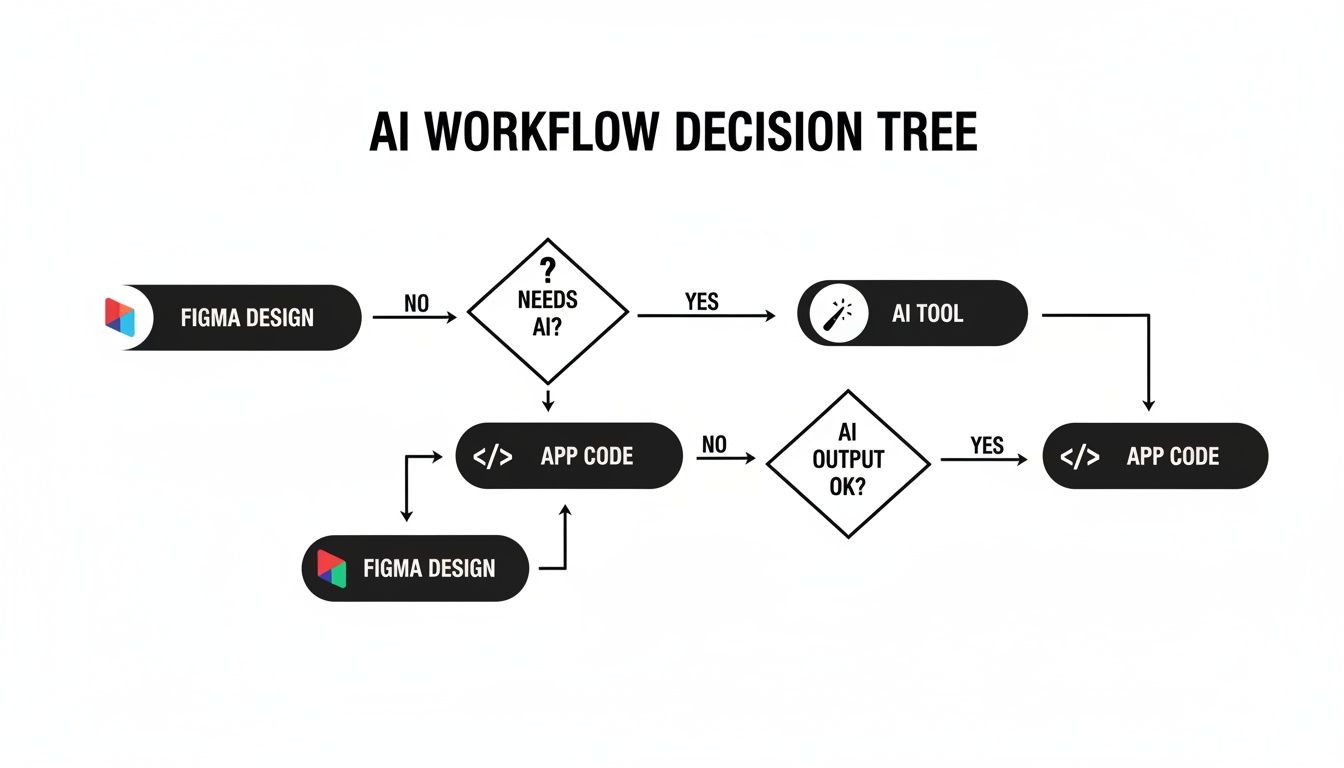
As you can see, today's tools are squashing the old, linear development cycle into something much faster and more integrated. When you're trying to make the right decision, looking at real-world examples can be a huge help. You can check out a portfolio of successful mobile application projects that have navigated these very same choices.
At the end of the day, this isn't about "good" vs. "bad" tech. It's about making a smart, pragmatic trade-off. For the vast majority of businesses, cross-platform development provides a massive strategic edge by letting them prioritize speed and market reach without making huge compromises.
It's also interesting to see how the lines are blurring between different ways of building software. For a deeper dive, it's worth exploring the differences between no-code vs. real code and seeing how AI is carving out a powerful new middle ground. With this information in hand, you’re ready to have a truly productive conversation with your technical team and confidently pick the right strategy for your app.
Frequently Asked Questions
Diving into cross-platform mobile phone development always brings up a few key questions. For founders and product managers trying to balance the tech with business goals, getting clear answers is crucial. Here are some of the most common things people ask.
Is Cross-Platform Only for Simple Apps?
Not anymore. It’s a common myth that cross-platform is just for MVPs or basic apps. In reality, modern frameworks like React Native and Flutter are more than capable of handling complex, feature-heavy applications. Major players like Shopify and Airbnb rely on React Native for core parts of their apps.
The real question isn't about complexity; it's about specific needs. We estimate that cross-platform is a perfect fit for about 95% of mobile apps out there, from e-commerce and social media to powerful productivity tools. The only exceptions are apps that demand extreme performance, like a high-fidelity 3D gaming engine, or need instant access to the latest OS-level hardware on day one. For everyone else, it's a solid choice.
Will My App Feel Less "Native" to Users?
This is probably the biggest concern we hear, but modern frameworks have come a long way in solving this. React Native, for example, doesn't just mimic native components—it compiles your code down to the actual native UI building blocks. That means the buttons, switches, and lists your users see are the real deal for iOS and Android, making the app feel right at home on their device.
Flutter takes a different route. It uses its own rendering engine to draw every pixel on the screen, which gives you a perfectly consistent look and feel everywhere. Honestly, for the vast majority of users, a well-built cross-platform app is indistinguishable from a native one.
The goal is always a great user experience, no matter what technology is running under the hood. Today’s cross-platform tools are built from the ground up to deliver exactly that, merging shared code with a truly native feel.
What's the Biggest Mistake Teams Make When Choosing This Path?
Hands down, the most common pitfall is ignoring the team's existing skillset. I've seen teams of brilliant React web developers decide to adopt Flutter, forcing everyone to learn a new language (Dart) and a new framework from scratch. That adds a massive, and often avoidable, learning curve right at the start of a project.
The smartest move is to play to your strengths. If your developers already live and breathe JavaScript, picking React Native is a no-brainer. They can hit the ground running and be productive almost immediately. Aligning your technology choice with your team's expertise is the single best way to build faster and more efficiently.
Ready to see how AI can give your cross-platform development a major boost? With RapidNative, you can transform ideas and designs into production-ready React Native code in minutes, not days. Start building faster today at https://www.rapidnative.com.
Ready to build your app?
Turn your idea into a production-ready React Native app in minutes.
Free tools to get you started
Free AI PRD Generator
Generate a professional product requirements document in seconds. Describe your product idea and get a complete, structured PRD instantly.
Try it freeFree AI App Name Generator
Generate unique, brandable app name ideas with AI. Get creative name suggestions with taglines, brand colors, and monogram previews.
Try it freeFree AI App Icon Generator
Generate beautiful, professional app icons with AI. Describe your app and get multiple icon variations in different styles, ready for App Store and Google Play.
Try it freeFrequently asked questions
What is RapidNative?
RapidNative is an AI-powered mobile app builder. Describe the app you want in plain English and RapidNative generates real, production-ready React Native screens you can preview, edit, and publish to the App Store or Google Play.
Can I export the code?
Yes. RapidNative generates clean React Native and Expo code that you can export at any time. No lock-in, no proprietary format. Hand it to your developers or keep building inside RapidNative.
Is RapidNative free to use?
Yes. You can build apps on the free plan with no credit card required. Paid plans unlock unlimited AI generations, code export, and direct publishing to the App Store and Google Play.
Do I need to know how to code?
No. Most users build apps by describing what they want in plain English. Developers can drop into the code whenever they want more control, but coding is optional.
How long does it take to build an app?
Most users have a working first screen in under a minute. A full MVP usually takes a few hours instead of the weeks or months traditional development requires.