No Code vs Real Code: A Practical Guide for App Builders
Deciding between no code vs real code for your app? This guide provides a balanced comparison of cost, speed, scalability, and use cases to help you choose.
By Damini
14th Dec 2025
Last updated: 14th Dec 2025
If you’re building a mobile product, the choice between no-code and real code is one of the first strategic decisions you’ll make. No-code gets you a functional app incredibly fast, letting you test your idea in the real world. Real code delivers the limitless customization and performance you need to build a complex, scalable product that can lead a market.
The right path depends entirely on your project's goals, your timeline, and where you see your app in the long run. This guide is built for founders, product managers, and designers who need to make this call without getting bogged down in technical jargon.
The Core Choice Explained for App Builders
Think of it like choosing between renting a fully furnished apartment and building a custom home from the ground up. This isn't just about technology; it's a strategic move that dictates your budget, timeline, and the ultimate ceiling of what your mobile app can become.
Renting vs. Building Your App
No-code is like renting that apartment. You get a solid structure with all the essentials—pre-built components like user logins and payment forms—that you can quickly arrange to make a functional living space. You can "move in" almost overnight. It's fast, relatively cheap, and perfect for testing if you even like the neighborhood (or, in this case, if your app idea has paying customers). The catch? You can’t knock down walls or install a custom home theater. You’re playing by the landlord’s rules.
Real code is your custom-built home. You have total control over the blueprint, the materials, and every last detail. It takes a lot more time and money upfront, but what you end up with is a unique asset that can grow, change, and perfectly match your vision. You own the code, and the only limit is your imagination and engineering budget.
The real question isn't "Which is better?" It's "Which is the right tool for this job, right now?" An MVP built to secure your first round of funding has completely different needs than an enterprise app built to serve a million users.
This guide will break down the comparison, side-by-side, so you can make the right call. We'll look at these two approaches through the lens of what actually matters when you're building a mobile product—from speed and cost to scalability and team fit.
Here’s a quick look at the fundamental trade-offs:
| Factor | No Code (e.g., Bubble, Adalo) | Real Code (e.g., Swift, React Native) |
|---|---|---|
| Primary Goal | Speed, idea validation, and cost-efficiency | Customization, performance, and total ownership |
| Best For | MVPs, internal tools, simple consumer apps | Complex products, high-growth platforms, unique features |
| Initial Cost | Low (typically a monthly subscription) | High (developer salaries, infrastructure) |
| Time to Market | Days or weeks | Months or even years |
| Flexibility | Limited to the platform's feature set | Practically limitless |
Comparing the Fundamental Differences
Deciding between no-code and real code isn't just a technical choice; it's a strategic one that will define your product's entire lifecycle. The core trade-off seems simple—speed versus control—but the reality is far more nuanced. This decision impacts everything from your launch timeline to your app's long-term competitive edge.
To make the right call, we need to break down the comparison across the dimensions that truly matter for building a mobile product.
First, let's get a high-level view of the core trade-offs.
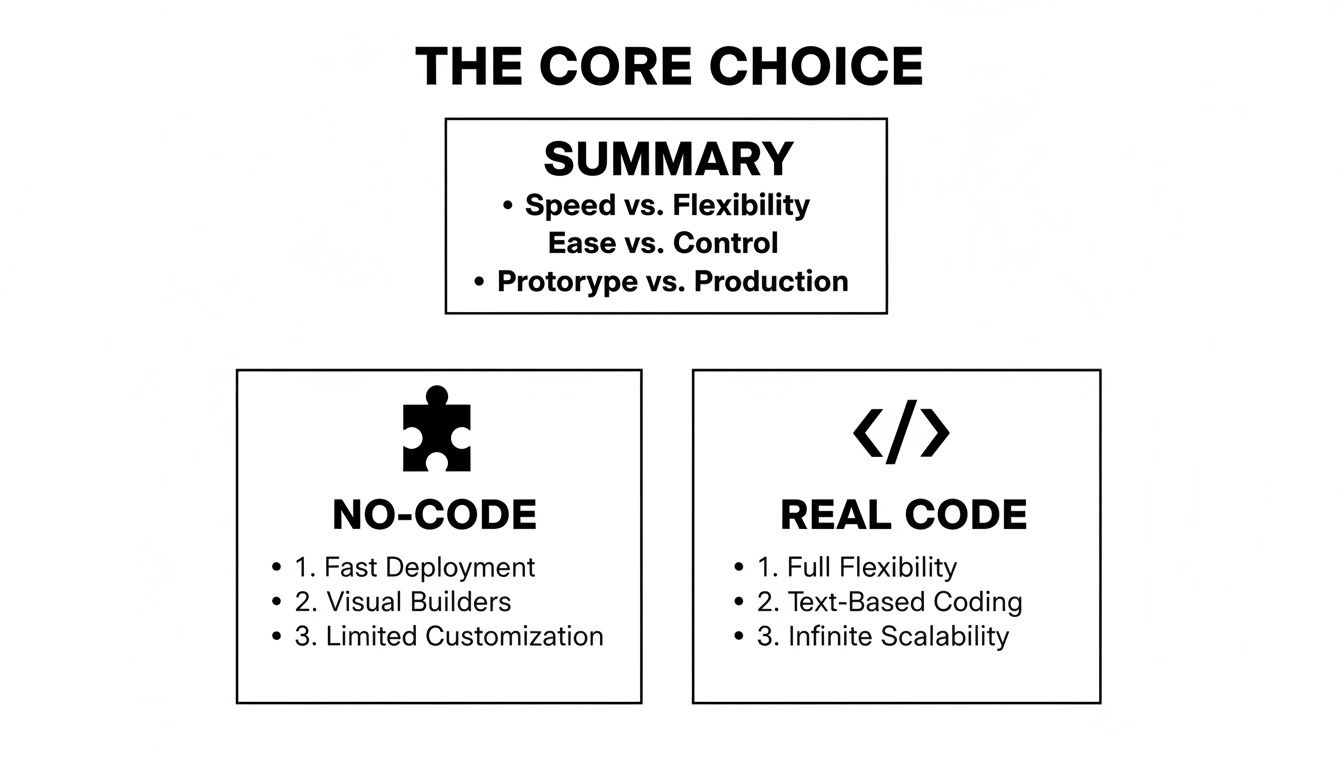
The visual makes the split clear: no-code is all about speed and accessibility by piecing together pre-built blocks. Real code, on the other hand, gives you the deep-level control needed to build something genuinely unique and scalable.
Speed to Market
The most undeniable advantage of no-code is its raw speed. You can assemble a working mobile app from ready-made components in a matter of days or weeks, not months. This lets a founder get a Minimum Viable Product (MVP) into the hands of real users almost immediately, gathering the feedback needed to validate an idea before sinking serious cash into it.
Real code is a more deliberate, methodical process. It's slower because developers have to write, test, and debug everything from the ground up. But that initial time investment is what creates a solid, custom-built foundation that you can build on for years to come.
Use Case: A startup founder with an idea for a "Tinder for dog walkers" can use a no-code tool to build a functional MVP with profiles, swiping, and messaging in two weeks. They can test the idea with 100 local users before writing a single line of real code.
Development Cost
No-code dramatically lowers the financial barrier to entry. Instead of paying for a team of mobile developers, you're looking at a manageable monthly subscription fee for the platform. For a bootstrapped startup, that can be the difference between getting an idea off the ground or never launching at all.
Traditional development is a major capital investment. You're not just paying for a tool; you're paying for highly specialized talent. Developer salaries, benefits, and project overhead make up the vast majority of the cost. A first version of a custom app can easily run into six figures, while a no-code prototype might only set you back a few hundred dollars a month.
Customization and Complexity
This is where the tables turn in favor of real code. No-code platforms operate within a "walled garden." You’re limited to the features, integrations, and design elements the provider offers.
Need to connect to a niche third-party API for a specific industry? Want to create a unique user interaction that’s central to your app’s appeal? You’ll likely hit a hard wall. For example, trying to build a real-time, collaborative document editor like Google Docs is impossible with most no-code tools because the underlying logic is too complex.
Real code means total freedom. If you can dream it, a skilled developer can build it. This absolute control is non-negotiable for apps with complex business logic, proprietary algorithms, or a pixel-perfect user experience designed to stand out from the competition.
Performance and Scalability
No-code apps are generally fine for a limited number of users and moderate data loads. But as your user base starts to climb into the thousands—or millions—performance can become a serious bottleneck. You're completely at the mercy of the platform's underlying infrastructure, with little to no ability to optimize databases or server processes for heavy traffic.
With real code, scalability is part of the architecture from day one. Developers can design efficient databases, fine-tune queries, and deploy the application on powerful, scalable cloud infrastructure like AWS or Google Cloud. This ensures your app stays fast and responsive, even when it's under extreme load. Imagine a photo-sharing app built on no-code; it might work for 500 users, but it would likely crash during a traffic spike if a post went viral.
Team Skill Requirements
The entire no-code movement is a direct response to the global developer shortage. The numbers are staggering: according to Gartner, by 2025, 70% of new enterprise applications will be built using no-code or low-code platforms. This huge shift is driven by a projected 85.2 million worker shortfall by 2030, a talent gap that could cost the global economy trillions. You can explore the full research on this major industry shift to understand its full impact.
This is no-code's superpower: it empowers non-technical founders, designers, and product managers to build and launch apps themselves. A real-code project, in contrast, requires a dedicated team of skilled software engineers, UI/UX designers, and often DevOps specialists to build, deploy, and maintain the application successfully.
No Code vs Real Code Head-to-Head Comparison
To make the choice clearer, here’s a quick-reference table designed to help founders and product managers make faster, more informed decisions based on their specific situation.
| Criterion | No-Code (e.g., Bubble, Adalo) | Real Code (e.g., Swift, Kotlin, React Native) |
|---|---|---|
| Time-to-Market | Extremely Fast. Weeks, sometimes days, for an MVP. | Slower. Months of planning, development, and testing. |
| Initial Cost | Low. Monthly subscription fees, minimal upfront investment. | High. Six-figure+ investment for salaries and overhead. |
| Customization | Limited. Confined to the platform's pre-built components. | Unlimited. Complete freedom to build any feature or design. |
| Scalability | Limited. Dependent on platform infrastructure; can struggle with high traffic. | Highly Scalable. Architected for growth on robust cloud services. |
| Team Skills | Non-technical. Accessible to founders, designers, and PMs. | Highly Technical. Requires experienced software engineers. |
| Data/Code Ownership | Platform-Dependent. You're renting; vendor lock-in is a real risk. | Full Ownership. You own the codebase and intellectual property. |
This side-by-side view really highlights the fundamental trade-off: no-code offers a low-cost, high-speed entry point at the cost of control and long-term scalability. Real code demands a significant upfront investment of time and money but provides the ownership and flexibility needed to build a durable, competitive product.
When to Choose No-Code for Your Mobile App
The big question isn't whether no-code or real code is "better." It's about which approach is the right strategic move for what you need to accomplish right now. No-code platforms shine when speed, early-stage validation, and a tight budget are your top priorities.
Here are the clear signals that a no-code platform isn't just a workaround, but the smartest tool for the job.

Building a Minimum Viable Product for Validation
By far, the most compelling reason to go with no-code is to build a Minimum Viable Product (MVP). You have an app idea, but before you sink tens or even hundreds of thousands of dollars into custom development, you need proof that real people will download, use, and maybe even pay for it.
No-code platforms let you build a functional app in weeks, not months. This gives you a priceless opportunity to test your core assumptions, collect user feedback, and iterate on your concept without breaking the bank.
Real-World Example: A founder wants to create a niche marketplace connecting local artisans with buyers. Instead of assembling a dev team, they use a platform like Bubble or Adalo. In just three weeks, they launch an MVP with user profiles, product listings, and a basic messaging feature. They can now walk into investor meetings with a live product and real user data, making their pitch for seed funding exponentially stronger.
The point of a no-code MVP isn't to build your forever product. It's to build a learning machine—a tool to rapidly figure out what your customers actually want.
Developing Internal Tools to Boost Efficiency
Not every app needs a spot on the App Store. Businesses constantly need custom internal tools to improve operations, automate tasks, or manage data. These projects often get pushed to the bottom of the engineering team's backlog because customer-facing features always take precedence.
This is a perfect opening for no-code. A product manager or operations lead can build exactly what their team needs without siphoning resources from the core product.
Real-World Example: An operations manager at a small e-commerce company is tired of using messy spreadsheets to track inventory. She uses a no-code tool to build a simple mobile app for the warehouse team. Now they can scan barcodes with their phones to update stock levels in real-time, eliminating manual entry errors and saving hours each week.
Launching Simple, Content-Driven Apps
Does your app's main purpose boil down to displaying information? If its core job is content delivery rather than complex, interactive features, no-code is an excellent, budget-friendly choice.
Think about apps for conferences, one-off marketing campaigns, or local community directories. An event organizer, for example, could spin up an app with schedules, speaker bios, and venue maps in a few days using a no-code builders for mobile apps, offering a much richer experience than a mobile website without the heavy investment of real code.
When Real Code Is Your Only Option
While no-code is fantastic for getting ideas off the ground, it has hard limits. Think of it as a sandbox—you can build amazing things, but you can't build outside of it. At a certain point, switching to real code isn't a choice; it's a necessity for building a serious, competitive mobile app.
The conversation has to shift from "How fast can we launch?" to "How deep can we build?" This pivot is everything when your app's core value depends on something truly unique, powerful, or secure.
Building Unique and Complex Features
The biggest wall you'll hit with no-code is its inability to create truly new user experiences. If your app's secret sauce is a feature you can't just buy off a shelf, you need the total creative freedom that only real code provides. This is a fundamental difference in the no code vs real code discussion.
Real-World Example: A startup wants to build a mobile app with a real-time collaborative editing tool, like a pocket-sized Figma. The complex logic needed to handle multiple users editing a design at once, track version history, and keep everything in sync is lightyears beyond what a drag-and-drop builder can handle. This core feature must be custom-built.
When your competitive edge comes from a unique feature, not just a business model, real code is non-negotiable. It’s the only way to build proprietary tech that your competition can't just clone using the same off-the-shelf tools.
Needing High Performance and Massive Scalability
No-code platforms are designed for general-purpose use and can start to show their cracks under heavy load. If your goal is to support hundreds of thousands—or even millions—of active users, you need an architecture built specifically for that kind of pressure.
With real code, your development team can:
- Optimize database queries to pull data in milliseconds, even from millions of records.
- Fine-tune the backend infrastructure to absorb sudden traffic spikes without crashing.
- Implement sophisticated caching strategies that make the app feel snappy and instantaneous for every user.
You simply don't get this level of granular control on a no-code platform. For a social media app, a high-frequency trading platform, or a viral game, the performance you get from custom code is the difference between retaining users and losing them for good.
Integrating with Custom Hardware or Proprietary APIs
Sometimes, your app needs to talk to more than just standard web services. Many modern products rely on deep integrations with highly specialized systems.
Picture these situations:
- A healthcare app that needs to securely connect via Bluetooth to pull data from proprietary medical devices.
- A fintech app that must integrate with legacy banking systems that don't have modern APIs.
- An industrial IoT app designed to control and monitor custom-built machinery on a factory floor.
No-code platforms provide a library of common integrations, but they can't cover every niche or proprietary system. Real code gives developers the power to write custom connectors for any piece of hardware or software. If you're heading down this path, getting familiar with a framework like React Native for app development can give you a better sense of how this custom integration work is done.
Owning Your Intellectual Property
Finally, there’s a crucial business point: ownership. When you build on a no-code platform, you don’t own the engine running your app. Your product’s existence is tied to that platform’s terms and pricing. For many startups, where the codebase is the main asset, this is a risk you can't take.
Building with real code means you own 100% of your intellectual property. This gives you a tangible, defensible asset that's invaluable for raising funds and securing your company's future.
Analyzing the True Cost and ROI of Each Path
When you're weighing no-code vs. real code, it's easy to get fixated on the initial price tag. But to make a smart business decision, you have to look past the upfront bill and think about the total cost of ownership (TCO) and your long-term return on investment (ROI).

Unpacking No-Code Subscription Models
No-code platforms run on predictable subscription models, with monthly fees that seem simple. But the real cost is often buried in the fine print. Many platforms layer usage-based pricing on top of their subscriptions, charging you for things like the number of app users, database records, or workflows you run. As your app starts to take off, these variable costs can climb fast. For a real-world look, you can check out examples like Domino's pricing models.
The hidden cost of no-code isn't just surprise usage fees; it's the strategic price of platform lock-in. If your app outgrows the platform, the cost to rebuild it from scratch on a new system can be absolutely staggering.
The Upfront Investment of Real Code
Real code is the polar opposite. The initial investment is significant, mostly driven by the high cost of skilled engineers. Building a custom mobile app from the ground up requires salaries for developers, designers, and project managers. It’s not uncommon for the budget for a first version to sail past $100,000.
While that number is steep, it’s an investment in an asset you completely own. That upfront cost isn't just for development—it's for creating proprietary intellectual property. Your codebase becomes a tangible, valuable part of your business.
Calculating the Long-Term ROI
The return on investment for each approach depends on your business goals.
-
No-Code ROI: The ROI is all about speed and learning. If you can spend $5,000 on a no-code MVP to validate your market and land a $500,000 seed round, that's an incredible return—even if you end up throwing the first app away.
-
Real-Code ROI: The ROI is calculated over a much longer timeline. It’s about building a scalable, defensible product that can grab serious market share. The steep initial cost is justified by the potential for unlimited growth, better performance, and the freedom to build unique features that competitors using off-the-shelf tools simply can't copy.
The savings with no-code for initial builds can be massive. Some studies show that organizations can save an average of 40% on development costs and get to market 25% faster. One analysis even found that an app that would traditionally cost $300,000 could be built for $75,000 with no-code—a 75% savings. This is possible because no-code sidesteps the need for large development teams and lengthy manual testing.
Ultimately, the choice is a matter of financial strategy. No-code is a low-risk operational expense, perfect for testing the waters. Real code is a high-stakes capital investment aimed at building a lasting, valuable asset.
Your Decision-Making Checklist
Choosing between no-code and real code isn't a technical debate—it's a business strategy decision. This checklist will help you, as a founder or product manager, cut straight to what matters for your project right now.
Answering these questions honestly will light up the most practical path forward.
Define Your Strategic Goals
First things first: what are you actually trying to accomplish with this build?
-
What’s the main goal of this app? Is it an MVP to validate a concept, an internal tool to improve efficiency, or a full product meant to scale to millions of users? A validation goal almost always points to no-code; a market-disrupting product needs real code.
-
What does success look like in six months? Are you shooting for 1,000 beta testers to prove you have something, or gearing up to support 100,000 active users? That short-term number dictates your scalability needs.
Assess Your Resources and Constraints
Every project is boxed in by its resources. The time, money, and talent you have on hand will often make the decision for you.
-
What’s our budget and timeline? If you need something live in under three months for less than $20,000, no-code is probably your only realistic shot. With a longer runway and a six-figure budget, custom development is on the table.
-
What’s the technical expertise on our team? If your team is a product manager and a designer, a no-code platform lets them get building immediately. If you have access to seasoned mobile engineers, you can aim higher with real code.
Evaluate Your Product and Future Needs
Finally, think about the app itself and where it’s going. The features that make your product unique and your plans for growth are huge factors.
The move toward more accessible development is undeniable. By 2025, projections show that 70% of new enterprise apps will be built with no-code or low-code tools. This isn't just a trend; it's driven by real results, with 90.4% of developers reporting that these platforms make them more productive. You can discover more insights into these no-code usage trends.
-
Does our core value hinge on a feature no-code can't handle? If your app’s secret sauce is a custom algorithm, a complex real-time collaboration feature, or a specific hardware integration, then real code is the only way to go.
-
What do we realistically expect for scalability in the next 12–24 months? If you’re planning for explosive user growth, starting with a scalable, real-code foundation will save you from a very expensive and painful migration down the road.
Frequently Asked Questions
When you're weighing no-code against real code, a few key questions always pop up. Here are direct answers to help you make a confident choice.
Can I Switch from a No-Code Platform to Real Code Later?
Yes, but it’s a rebuild, not a simple transfer. You can't just export a no-code project and have it become clean, production-ready source code. The process involves a development team starting from scratch, using your working no-code app as a very detailed, functional blueprint.
This "start with no-code, then rebuild" approach is a very smart strategy. It lets you test your idea and find your market without a massive upfront investment. Once you have real traction (and funding), you can confidently invest in a custom-coded app built for the long haul, knowing you’re building something people already want.
Think of your no-code app as the detailed architectural model for a custom-built house. It proves the layout works and people want to live in it before you ever pour the concrete foundation.
Are No-Code Apps Secure Enough for Sensitive Data?
For many apps, the security built into major no-code platforms is more than enough. Big players like Bubble or Adalo handle server management, data encryption, and user authentication, and often comply with standards like GDPR. They're a solid choice for apps that don't deal with extremely sensitive information like financial records or protected health information (PHI).
However, if your app's main purpose involves specific compliance rules (like HIPAA) or requires unique security protocols, real code is the only way to go. It gives you total control to build custom security layers, implement specialized encryption, and undergo the rigorous third-party audits that aren't possible in a closed no-code ecosystem.
How Do I Know If My App Idea Is Too Complex for No-Code?
Your idea has probably outgrown no-code if its core feature relies on any of these:
- A unique, proprietary algorithm: If the "magic" of your app is a custom matching algorithm, a real-time collaborative tool, or a new kind of user interaction, you'll need the flexibility of real code.
- Deep hardware integration: Need to connect to specialized medical devices, industrial sensors, or other non-standard Bluetooth/NFC hardware? That almost always requires custom development.
- Massive scale from day one: If your plan is to support hundreds of thousands of concurrent users right at launch, you'll need an infrastructure custom-built for that kind of load.
If your app's features follow established patterns—like a marketplace, a social network feed, or a directory app—no-code is likely a fantastic starting point. The real question isn't whether your business idea is unique, but whether the technology needed to power it is.
Ready to bridge the gap between no-code speed and real-code power? RapidNative uses AI to turn your app ideas into production-ready React Native code, giving you an extensible foundation without starting from scratch. Build your UI with plain English and get code you can actually own and scale. Start building with RapidNative today.
Ready to build your app?
Turn your idea into a production-ready React Native app in minutes.
Free tools to get you started
Free AI PRD Generator
Generate a professional product requirements document in seconds. Describe your product idea and get a complete, structured PRD instantly.
Try it freeFree AI App Name Generator
Generate unique, brandable app name ideas with AI. Get creative name suggestions with taglines, brand colors, and monogram previews.
Try it freeFree AI App Icon Generator
Generate beautiful, professional app icons with AI. Describe your app and get multiple icon variations in different styles, ready for App Store and Google Play.
Try it freeFrequently asked questions
What is RapidNative?
RapidNative is an AI-powered mobile app builder. Describe the app you want in plain English and RapidNative generates real, production-ready React Native screens you can preview, edit, and publish to the App Store or Google Play.
Can I export the code?
Yes. RapidNative generates clean React Native and Expo code that you can export at any time. No lock-in, no proprietary format. Hand it to your developers or keep building inside RapidNative.
Is RapidNative free to use?
Yes. You can build apps on the free plan with no credit card required. Paid plans unlock unlimited AI generations, code export, and direct publishing to the App Store and Google Play.
Do I need to know how to code?
No. Most users build apps by describing what they want in plain English. Developers can drop into the code whenever they want more control, but coding is optional.
How long does it take to build an app?
Most users have a working first screen in under a minute. A full MVP usually takes a few hours instead of the weeks or months traditional development requires.