A Founder's Guide to Mobile Development with React
Learn how mobile development react accelerates startup apps, reducing costs and time to market with practical, results-focused guidance.
By Rishav
28th Dec 2025
Last updated: 28th Dec 2025
Got a game-changing idea for a mobile app? Great. Now you face a critical decision: how to build it. You need it on iPhones and you need it on Android devices, and traditionally, that meant building two separate apps. Two teams, two codebases, double the time and cost.
Thankfully, there's a smarter way. Mobile development with React changes the entire playbook, letting you build a high-quality app for both platforms faster and more efficiently than ever before. For founders, product managers, and anyone launching a new digital product, understanding how this works isn't just a technical detail—it's a massive strategic advantage.
Why React Is a Game Changer for Startups
The core idea behind using React for mobile apps is simple and powerful: build once, run anywhere. Instead of your engineers writing one app in Swift for iOS and another in Kotlin for Android, they write a single app using JavaScript and React. That one codebase then powers a true native app on both platforms.
Think of it like having a universal translator for your app's DNA. You write the instructions once (in JavaScript), and the framework translates them perfectly for two different audiences (iOS and Android) in their native tongues. The result is an app that looks, feels, and performs exactly as it should on each device.
The Single Codebase Advantage
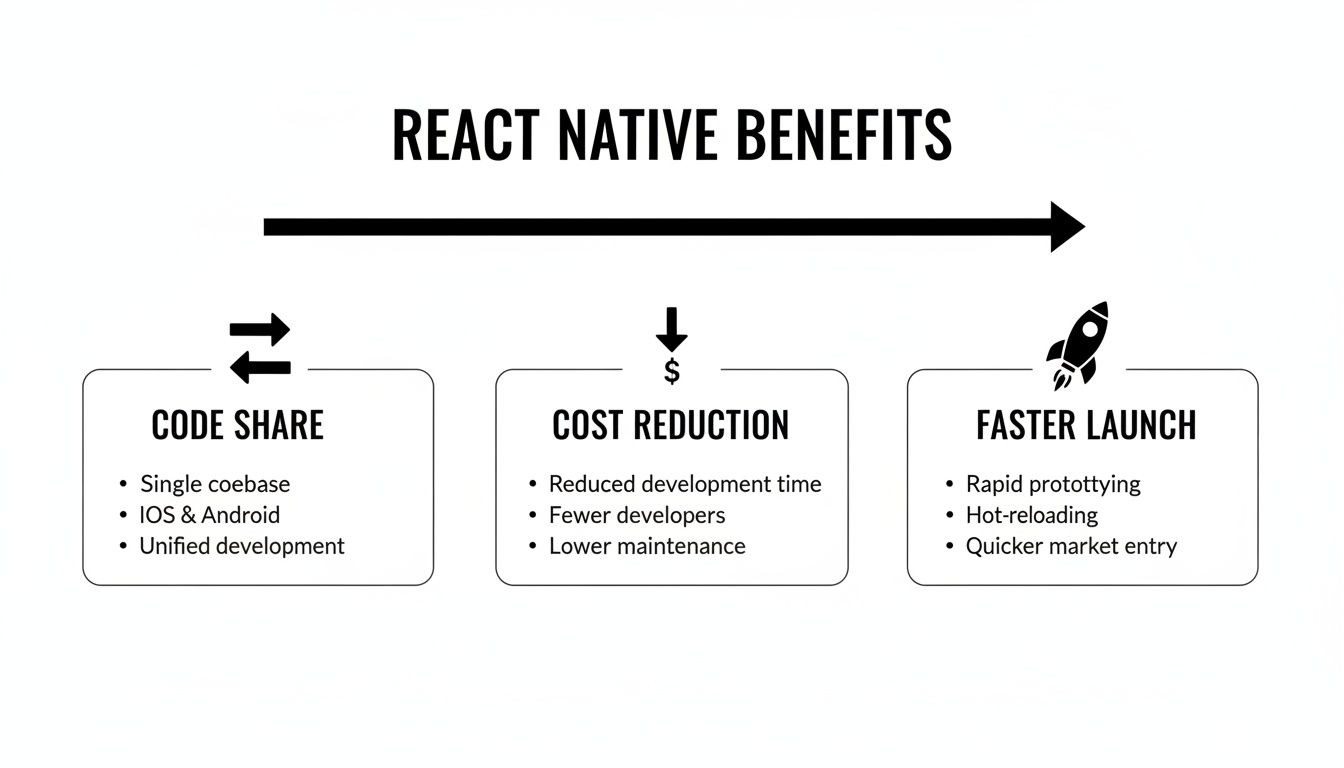
This "universal translator" is a framework called React Native, and it’s a massive win for lean product teams. By sharing the vast majority of your code—often 85% or more—between the iOS and Android versions, you unlock some serious business benefits:
- Launch Faster: Get your app to your entire audience on both platforms at the same time. No more staggered releases or making one user base wait.
- Slash Development Costs: Instead of managing two specialized development teams, you build with one unified team of React developers. This is a direct saving on hiring and resources.
- Effortless Updates: Need to fix a bug or launch a new feature? You make the change once in the shared code, and it rolls out to both your iOS and Android apps simultaneously.
- Consistent Brand Experience: Your app looks and feels the same on every device, creating a seamless and professional experience for all your users.
This approach is called cross-platform development. If you're weighing the pros and cons, our guide to native vs. hybrid app development breaks down the differences in more detail.
The magic of React Native is that it's not a web page crammed into an app. It uses the phone's actual, native UI building blocks. This means your app feels smooth, responsive, and completely at home on the user's device.
Real Native Performance
A common myth is that cross-platform apps are slow or clunky. Early attempts often felt this way, but modern React Native is a different beast.
It works by creating a "bridge" between your JavaScript code and the native UI components of iOS and Android. When someone taps a button in your app, they're not interacting with a web element; they're touching a genuine, native iOS or Android button.
This means your app's performance is virtually indistinguishable from one built the "old-fashioned" way. For founders, product managers, and designers, this is the ultimate win-win: you get the cost and speed benefits of a single codebase without sacrificing the high-quality user experience people expect.
The Core Building Blocks of a React Native App
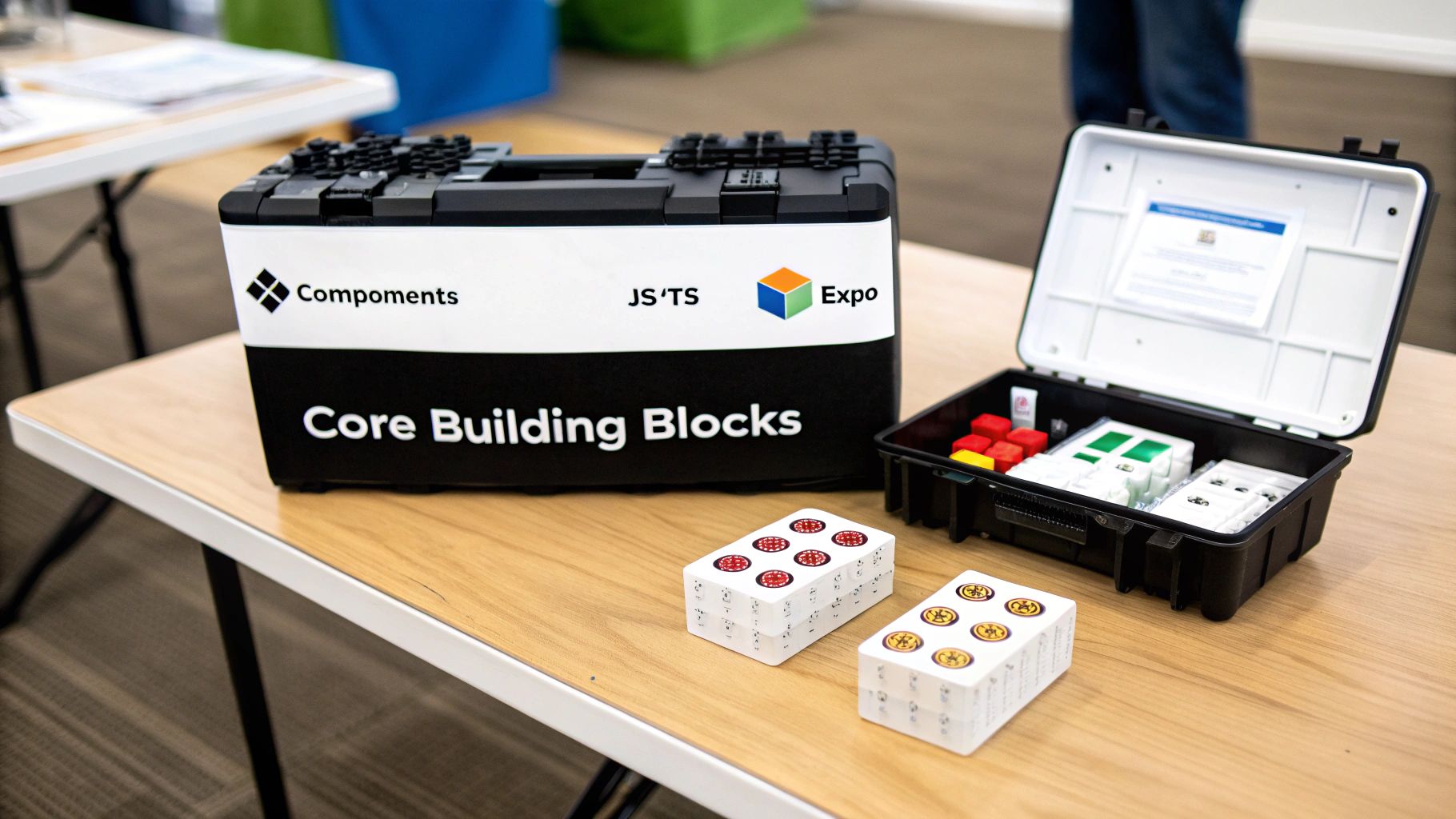
You don’t need to be an engineer to understand what makes mobile development with React so efficient. The best way to think about it is like assembling a high-end LEGO kit. You get a set of instructions, pre-made parts, a complete toolbox, and a few special adapters for unique jobs.
Understanding how these pieces fit together helps bridge the communication gap between product leaders and development teams, turning abstract technical jargon into something tangible and useful for everyone.
JavaScript and TypeScript: The Instructions
At the core of every app are the instructions that tell it what to do. In React Native, these are written in JavaScript, the world's most popular programming language. Its massive popularity means there's a huge community and a deep talent pool, making it easier to find skilled developers.
For larger, more complex apps where stability is critical, many teams use TypeScript. Think of TypeScript as JavaScript with a stricter grammar checker. It helps catch common mistakes before they cause problems, which is a lifesaver as a product grows. Ultimately, both serve the same purpose: they define the logic and behavior of your app.
React Components: The Prefabricated Parts
Imagine building a user interface piece by piece, pixel by pixel. It would take forever. In the world of React Native, we use Components—reusable, self-contained chunks of the user interface. It's like using prefabricated parts in construction.
- A login screen, for example, is assembled from an EmailInput component, a PasswordInput component, and a LoginButton component.
- The key is that the
LoginButtoncomponent can be reused anywhere else in the app—on a signup page, in a checkout flow—without being rebuilt from scratch. - This modular approach makes development incredibly fast and ensures a consistent design across your entire product.
Developers snap these components together to build complex screens with surprising speed. This philosophy is a cornerstone of mobile development with React and a huge part of what makes it so effective.
Expo: The All-In-One Toolbox
Before you start any project, you need to gather your tools. Expo is the pre-packed, all-in-one toolbox for React Native developers.
Expo bundles everything a developer needs to start building, testing, and sharing an app. It handles the tedious setup, so the team can focus on building the product, not configuring tools.
One of its most valuable features for product teams is how it simplifies feedback. A developer can send a working preview of the app directly to a founder's or designer's phone with a simple QR code scan. This creates a tight feedback loop, making it possible to see changes, test features, and make decisions in real-time.
Native Modules: The Specialized Adapters
What happens when your app needs to use the phone's hardware, like the camera, GPS, or fingerprint scanner? This is where Native Modules come in.
Think of them as specialized adapters that let your JavaScript code "plug into" the phone's built-in features. While your app's logic is written in one language, the phone's hardware speaks another (like Swift for iOS or Kotlin for Android). Native modules act as the translator, allowing seamless communication. This is what gives your app the power to feel like a high-performance, truly native application.
The Business Case for Choosing React Native
Let's cut through the technical jargon. For founders, product managers, and anyone making the final call, choosing a tech stack is a business decision. The real story behind mobile development with React is why it's such a smart move, and the answer is radical efficiency.
Imagine you could design one product but sell it in two different stores simultaneously with almost no extra work. That’s the core promise of React Native. By allowing your team to share up to 85% of your codebase between the iOS and Android versions, you unlock a cascade of strategic advantages.
Launch Your MVP Faster
In today's market, speed is everything. Getting your app into the hands of real users before the competition can be the difference between success and failure. This is where React Native shines.
Instead of building two apps from scratch, you build one. This can literally shave months off your development timeline, getting your Minimum Viable Product (MVP) out the door while others are still bogged down in platform-specific code. Faster launches mean faster user feedback, and that feedback is the lifeblood of a successful product. If you're planning your first release, this guide on how to build an MVP is a must-read.
Significantly Reduce Development Costs
The financial logic is simple but powerful. You don't need to hire and manage two separate, specialized teams—one for iOS (Swift) and one for Android (Kotlin). You can build both with a single, unified team of JavaScript/React developers.
This immediately slashes your burn rate:
- Smaller Team Size: You need fewer engineers to build and maintain your app on both platforms.
- Simplified Project Management: One roadmap, one feature backlog, one team. This reduces coordination headaches and administrative overhead.
- Easier Maintenance: When a bug appears, you fix it once in the shared code, and the update applies to both apps.
This efficiency is why the React Native market is booming, and is projected to grow significantly in the coming years. Studies show it can cut development time by 30-40% compared to building two separate native apps. You can dig into more of these numbers in this detailed report on React Native market growth.
For a startup, the choice is clear. React Native lets you invest precious capital in marketing, sales, and growth—not redundant engineering.
Choosing a development path is a critical decision. Here’s a quick comparison to help your team weigh the options.
React Native vs. Native Development: At a Glance
| Factor | React Native | Native Development (iOS/Android) |
|---|---|---|
| Development Speed | Faster. One codebase for two platforms gets you to market sooner. | Slower. Requires building and maintaining two separate codebases. |
| Development Cost | Lower. Smaller, unified team and less engineering time. | Higher. Requires two specialized teams and more management overhead. |
| Code Maintenance | Simpler. Updates and bug fixes are applied once to the shared code. | More Complex. Changes must be implemented and tested on both platforms. |
| Performance | Near-native. Excellent for most apps, but may be less optimal for graphics-heavy 3D games. | Highest Possible. Direct access to platform APIs ensures peak performance. |
| Team Skills | JavaScript/React. Access to a vast pool of web developers. | Swift (iOS) & Kotlin (Android). Requires specialized mobile developers. |
| Ecosystem | Vibrant. Massive open-source community and a rich library of tools. | Mature. Well-established ecosystems backed directly by Apple and Google. |
For most startups and product teams, React Native offers a compelling blend of speed, cost-efficiency, and high-quality results.
Adopted by Industry Leaders
Still not convinced? Look at the companies that have bet on React Native and won. This isn't some experimental tech for side projects; it's a battle-tested framework trusted by some of the biggest names in the business.
- Shopify: The e-commerce giant rebuilt its main mobile app with React Native to unify its engineering teams and ship features faster across both platforms.
- Instagram: An early adopter, Instagram integrated React Native into its existing native app to speed up feature development without a complete rewrite.
- Discord: Known for its real-time performance, Discord relies on React Native to deliver a smooth, consistent experience to millions of users every day.
These companies operate at a scale where performance and reliability are non-negotiable. Their success is powerful proof that mobile development with React isn't a compromise—it's a smart, strategic choice for building world-class apps efficiently.
From Idea to App: A Modern Product Workflow
Taking an idea and turning it into a working app can feel like a daunting journey. However, a modern workflow for mobile development with React breaks the process into clear, collaborative stages.
Forget rigid, old-school development cycles. This is about a flexible, iterative loop built for speed and constant feedback, empowering everyone from the founder with the vision to the designer crafting the UI and the developer writing the code.
From Prompt to Prototype: The Ideation Stage
It all starts with an idea. But today, we can move beyond static wireframes. Imagine describing your app's login screen in a single sentence: "A clean login screen with email and password fields, a 'Sign In' button, and a link for forgotten passwords."
With modern AI-powered tools, that simple prompt can generate a fully functional, interactive UI in seconds. This isn't just a picture; it's a working component built with clean, production-ready React Native code. This ability to instantly translate a concept into a tangible prototype is a game-changer, letting everyone on the team see and feel the app from day one.
Building Out the Logic: The Iteration Phase
Once you have those initial screens, the real iteration begins. Developers take that clean, AI-generated code and start wiring everything up. They connect the UI to databases, integrate third-party services, and build the core business logic that makes your app unique.
Because the foundational UI code is already done, developers can jump straight to the hard stuff—the features that deliver value to your users. This bypasses the hundreds of hours typically spent on tedious UI implementation, dramatically speeding up the development cycle. If your team is still building interfaces from scratch, see how you can streamline the process by turning Figma designs into React Native code.
This workflow completely changes the game. Instead of development happening in a "black box," stakeholders can interact with a real app almost immediately. The feedback loop becomes tighter, faster, and far more effective.
Testing and Gathering Feedback
The final piece is getting feedback. In the past, this was a clunky process involving complex builds and app store approvals just to share a test version. Tools like Expo have made this incredibly simple.
Now, a developer can share a build of the app with anyone, anywhere, using a simple link or QR code. A founder can scan the code with their phone and instantly have the latest version running, ready to test. This creates a real-time feedback channel, allowing the team to spot issues, try out new ideas, and make decisions based on actual experience, not guesswork.
Let's see how this plays out in a common scenario:
- The Ask: A product manager needs a user profile screen. They write a prompt: "Generate a user profile page showing a profile picture, name, email, and a list of settings options."
- The Result: The tool generates the UI. The team loads it on their phones via Expo to review. They decide to add an "Account Security" option.
- Rapid Iteration: A developer adds the new option and pushes an update. The PM can test the new flow, end-to-end, just minutes later.
This entire cycle—from idea to an interactive test—can happen in a single afternoon, not over several weeks. It's a practical, hands-on approach that transforms app development into a dynamic conversation involving the entire team.
How AI Tools Slash Your Product Launch Time
In the startup world, speed isn't just a nice-to-have; it's a survival metric. The gap between a great idea and a working product is where countless ventures stall. For a long time, the biggest roadblock has been the slow, manual process of turning design mockups into functional UI code.
A new wave of AI-powered tools is changing that, especially for teams using mobile development react and React Native. Imagine generating a complete, production-ready screen for your app just by describing it, taking a photo of a whiteboard drawing, or pointing the tool to a Figma design. This isn't science fiction anymore—it's happening now.
This shift isn't about replacing developers. It’s about supercharging the entire product team—founders, designers, and PMs—by automating the most repetitive parts of building an interface. This frees up your engineers to focus on what truly matters: the complex business logic and unique features that will make your product successful.
This Isn't Just Another No-Code Platform
It’s crucial to understand what separates these AI code generators from typical no-code builders. No-code tools are great for simple apps, but they often lock you into their ecosystem. When you hit a technical limit or need to scale, you’re usually stuck with no way to access or customize the underlying code.
AI-driven development tools work differently. They generate real, high-quality source code that you own.
The goal is to produce clean, human-readable React Native code using trusted, industry-standard tools. You get the incredible speed of AI generation without giving up control, flexibility, or the ability to scale your app with a full development team later on.
This "code-first" approach is the key difference. It gives you an accelerated starting point, not a restrictive box. Your product is built on a solid foundation that can grow with your business. It's why many startups cut their MVP time-to-market by 30-40% with this modern stack.
What This Looks Like in the Real World
Let's walk through a common scenario. A founder sketches a simple three-tab navigation flow for a new social app on a whiteboard.
- Capture the Idea: They snap a photo of the whiteboard sketch and upload it to an AI tool.
- Generate the Code: The AI analyzes the image and, within moments, generates the React Native code for a tab navigator with three placeholder screens: "Home," "Discover," and "Profile."
- Export and Build: A developer exports this code, drops it into their project, and can immediately start building out the real features for each screen.
This workflow turns a rough concept into an interactive foundation in minutes. The same logic applies to polished Figma designs. The tool can generate the layout, components, and styling, giving developers a massive head start. If you're looking to integrate this into your process, our guide on AI product development tools offers practical next steps.
Adopting these tools is more than just a tech upgrade—it's a strategic move. By exploring strategies for becoming an AI-first company, your team can build, test, and iterate faster than ever before.
Building an App That Lasts on the React Ecosystem
Choosing a technology isn't just about building your first version; it's a long-term commitment that will define your app's future. When you choose React Native, you’re not just picking a framework; you're investing in a powerful and evolving ecosystem that’s built to last.
One of the most significant recent advancements has been the Fabric architecture—a complete overhaul of React Native's core engine. This new foundation delivers performance so close to native that for the vast majority of apps, your users will never know the difference. It's a crucial update that ensures your app won't hit a performance ceiling as it scales.
A Thriving and Stable Foundation
Beyond the technology itself, you’re also joining a massive, active, and deeply engaged community. This isn't just a "nice to have." In practical terms, it means:
- A larger talent pool of skilled developers to grow your team.
- A vast library of open-source tools and components to accelerate development.
- A huge knowledge base for solving problems quickly.
For founders and investors, the React Native ecosystem provides peace of mind. It's a durable foundation for long-term business success, not just a shortcut for a quick launch.
The data backs this up. The framework boasts 116K stars on GitHub, and with strong developer adoption and high salary benchmarks, it's clear this is a mature and highly valued skill set. You can find more details on React Native's future on esparkinfo.com.
Ultimately, this means you don't have to build from scratch. You get to stand on the shoulders of a powerful and forward-thinking ecosystem, allowing you to build better apps, faster, and with more confidence in their future.
Common Questions We Hear from Founders About React Native
Deciding on the right technology for your mobile app is a big deal. Founders, product leads, and managers need to know what they're getting into. Here are the straightforward answers to the questions we get asked all the time.
Is React Native Really Good Enough for a High-Performance App?
Yes, absolutely. The old myth that React Native is slow is a leftover from its early days. The modern architecture is incredibly fast and responsive, easily handling complex and demanding applications.
But don't just take our word for it. Look at the apps from companies like Shopify, Discord, and Instagram. They use React Native for their core mobile experience, serving millions of people every day. That's proof that mobile development with React can deliver a smooth, top-tier experience at massive scale.
Will I Still Need to Hire Native iOS or Android Developers?
For about 95% of what most apps need to do, a skilled React Native team is all you'll need. They can handle the UI, business logic, server communication—everything.
The only time you might need a native specialist is for very specific, low-level hardware integrations, like connecting to a unique Bluetooth medical device or a specialized camera sensor. In those rare cases, a native developer can build a "native module"—a small bridge that lets your React Native app talk directly to that specific piece of hardware. The framework is designed for this, giving you the best of both worlds when you need it.
How Is an AI Code Generator Different From a No-Code Builder?
This is a critical distinction for any founder thinking about the long game. No-code builders are great for quickly creating simple, standalone apps, but they lock you into their platform. You can't export the code, you can't customize beyond what their tools allow, and you can't hand it over to an engineering team to scale.
An AI code generator is the opposite. It writes clean, standard React Native source code for you. You own it completely. You can give it to any developer, host it anywhere, and extend it however you want. It’s an accelerator to get you started faster, not a walled garden that limits your future.
Can We Add React Native to Our Existing Mobile App?
Yes, and this is one of React Native's biggest strengths. It’s not an all-or-nothing choice. Many companies with established native iOS or Android apps use React Native to build new features. This allows them to get the speed and cross-platform benefits for a new section of their app without having to scrap years of existing, working code.
Ready to turn your app idea into a working prototype in minutes, not months? With RapidNative, you can generate production-ready React Native UI and navigation from a simple text prompt. Stop starting from a blank screen and see how fast you can build at RapidNative's website.
Ready to build your app?
Turn your idea into a production-ready React Native app in minutes.
Free tools to get you started
Free AI PRD Generator
Generate a professional product requirements document in seconds. Describe your product idea and get a complete, structured PRD instantly.
Try it freeFree AI App Name Generator
Generate unique, brandable app name ideas with AI. Get creative name suggestions with taglines, brand colors, and monogram previews.
Try it freeFree AI App Icon Generator
Generate beautiful, professional app icons with AI. Describe your app and get multiple icon variations in different styles, ready for App Store and Google Play.
Try it freeFrequently asked questions
What is RapidNative?
RapidNative is an AI-powered mobile app builder. Describe the app you want in plain English and RapidNative generates real, production-ready React Native screens you can preview, edit, and publish to the App Store or Google Play.
Can I export the code?
Yes. RapidNative generates clean React Native and Expo code that you can export at any time. No lock-in, no proprietary format. Hand it to your developers or keep building inside RapidNative.
Is RapidNative free to use?
Yes. You can build apps on the free plan with no credit card required. Paid plans unlock unlimited AI generations, code export, and direct publishing to the App Store and Google Play.
Do I need to know how to code?
No. Most users build apps by describing what they want in plain English. Developers can drop into the code whenever they want more control, but coding is optional.
How long does it take to build an app?
Most users have a working first screen in under a minute. A full MVP usually takes a few hours instead of the weeks or months traditional development requires.