How to Use an AI App Builder to Launch Your Mobile App Faster
Explore how the ai app builder turns ideas into apps without coding. See real examples, compare tools, and start building today.
By Suraj Ahmed
10th Dec 2025
Last updated: 10th Dec 2025
Ever wished you could build a fully working app just by describing it, almost like you're talking to a design partner? That's the core idea behind an AI app builder. It’s a platform that uses artificial intelligence to turn your ideas, sketches, and plain-English instructions into a real mobile or web application, sidestepping the need for traditional, line-by-line coding.
For founders, PMs, and designers, think of it less as a tool and more as a collaborator—one that translates your vision into the complex language of software development for you.
What Is an AI App Builder and How Does It Work?
At its simplest, an AI app builder is a platform that lets you create software visually. Instead of grappling with programming languages and complex frameworks, you interact with a smart system. You might describe a feature, drag and drop elements onto a screen, or even upload a rough drawing of what you want.
Behind the scenes, the AI gets to work. It interprets your requests, generates the necessary code, sets up the database, and pieces everything together into a functional app. It’s like having an entire development team on standby, ready to build and revise at your command.
The Core Engine Behind the Magic
So, how does this actually happen? It’s not one single piece of technology but a combination of several working in harmony. The AI acts as an interpreter, a designer, and a developer all at once.
For a product team, the process usually breaks down into a few key stages:
- Understanding Your Intent: You start by giving the AI instructions. This could be a text prompt like, "I need a user profile screen with a profile picture, name, and bio," or a visual mockup from Figma.
- Generating the Interface: The AI analyzes your request and figures out which UI components are needed—things like buttons, text fields, and image placeholders. It then arranges them into a logical and user-friendly layout.
- Writing the Code: Once the visual structure is in place, the platform generates the underlying source code. For mobile apps, this is often done in a popular framework like React Native.
- Refining on the Fly: The real power comes from the ability to iterate. You can provide follow-up commands like, "Make the main button green," or "Add a password reset option," and the AI will update the app instantly.
This new way of building software is making a huge impact. It's estimated that 65% of all app development is now happening on low-code or no-code platforms. The result? Teams are seeing launch times that are up to 90% quicker than with traditional methods.
The table below breaks down the key components that make this possible.
Core Components of an AI App Builder
| Component | What It Does (In Simple Terms) | Example in Action |
|---|---|---|
| Natural Language Processing (NLP) | Understands and interprets human language, like your text prompts. | You type, "Create a sign-up form," and it knows you need input fields and a submit button. |
| Computer Vision (CV) | Analyzes images to understand visual information, like sketches or screenshots. | You upload a hand-drawn wireframe, and it converts the shapes into app components. |
| Generative AI & Code Generation | Creates new content, in this case, the actual source code for your app. | Based on the layout, it writes the necessary React Native or web code automatically. |
| Visual Editor / Drag-and-Drop UI | Provides a canvas where you can see and manipulate the app's interface directly. | You can manually adjust the position of a button or change a text element with your mouse. |
These technologies work together to create a seamless experience, translating your high-level ideas into low-level code without you having to touch a single line.
From Idea to App, Minus the Code Barrier
Ultimately, the biggest change brought by AI app builders is that they open up software creation to everyone. The barrier to entry is no longer years of coding experience; it’s simply the strength of your idea.
For founders, product managers, and designers, this is a game-changer. You can go from a sketch on a napkin to a working prototype that users can test in a matter of hours, not months. You’re no longer just directing the process—you’re actively building.
This ability to build and test quickly is crucial. It allows non-technical team members to drive the product development cycle, validate ideas with real users, and gather feedback on a tangible product. You can learn more about this approach by checking out our guide on the AI-native app builder. This shift lets your entire team focus on what really matters: creating something people love to use.
Real-World Examples: What Can You Actually Build with an AI App Builder?
It's one thing to talk about AI app builders in theory, but where do they really shine? The true magic happens when you see them solving real, everyday business headaches. These aren't just for building toy apps or simple prototypes; they're being used right now to create powerful tools that make a tangible difference.
Let's walk through three common scenarios where founders and product managers are putting these platforms to work. Each one tackles a familiar challenge with a smart, AI-driven solution that saves time, boosts revenue, and keeps users happy.
Automated Customer Support Bots
We’ve all been there: customers need answers around the clock, and your support team is stretched thin. The result is a backlog of tickets, frustrated customers, and climbing operational costs. This is a perfect problem for an AI app builder to solve by creating an intelligent, automated support bot.
A small e-commerce startup, for example, can use an AI builder to spin up an app with a built-in support chatbot. You can train this bot on your product catalogs, shipping policies, and all those frequently asked questions that eat up your team's day.
- The Solution: The bot instantly handles routine questions like, "Where is my order?" or "What's your return policy?"
- The Result: The startup can slash its support ticket volume by over 40%. This frees up the human agents to focus on the tricky, high-value conversations that really matter.
The best part? Building a tool like this is no longer a massive, budget-draining project. An AI builder can handle the user interface, connect the dots to a knowledge base, and deploy a working bot in a tiny fraction of the time it would take with traditional coding.
Internal Sales Dashboards with Lead Scoring
Sales teams are often drowning in leads but starved for time. With hundreds or even thousands of prospects to sift through, how do they know where to focus their energy? An AI app builder can create an internal tool that points them directly to the hottest leads.
Picture a B2B software company building a custom mobile dashboard for its sales reps. The app syncs with their CRM and uses a simple AI model to score leads based on signals like company size, recent website activity, or the prospect's job title.
This isn't about replacing a salesperson's gut feeling; it's about giving it superpowers. The AI doesn't just give a score—it shows why a lead is hot, giving reps the context they need to personalize their pitch and close deals faster.
The dashboard can serve up a clean, prioritized list of leads, each with a score from 1 to 100. Reps can see exactly who to call next, making their outreach dramatically more efficient. If you're curious about the mechanics behind this, you can learn more about the architecture of an AI-powered app builder.
Personalized Content Feeds for Media Apps
In the battle for eyeballs, content and media apps face a brutal fight. A generic, one-size-fits-all feed is a recipe for low engagement and users deleting your app. The secret to keeping people coming back is delivering content that feels like it was hand-picked just for them.
This trend is a huge driver behind the growth of the AI app market, as shown in the chart below.
This massive market expansion is fueled by the demand for apps that can intelligently adapt to what each person wants. An AI app builder is the perfect tool for creating a personalized news or video feed. By paying attention to what articles a user reads, which videos they watch, and the topics they follow, the app’s AI learns their unique preferences.
From there, it curates a feed that puts the most relevant content front and center. This directly translates to longer session times and better user retention—the lifeblood of any content-driven business.
Weighing the Pros and Cons of an AI App Builder
Jumping into an AI app builder can feel like hitting the fast-forward button on your product launch, but it’s smart to understand the complete picture. Like any powerful tool, it comes with a unique set of upsides and downsides. Making the right call means looking past the initial excitement and honestly weighing the trade-offs to see if they fit your project's goals, budget, and long-term vision.
The benefits are usually immediate and incredibly appealing, targeting the two biggest roadblocks most teams face: time and money. But the convenience they offer isn't a free pass; certain constraints can pop up as your app gets more complex and your user base starts to grow.
The Advantages: Unlocking Speed and Innovation
By far, the biggest win you get with an AI app builder is the massive acceleration of your development timeline. Work that traditionally takes months of coding, debugging, and back-and-forth can be squeezed into just weeks or even days. This kind of speed is a total game-changer for validating ideas and getting a minimum viable product (MVP) into the hands of real users.
And it’s not just about moving faster. These platforms offer some serious financial perks, too.
- Slashed Development Costs: You can build a fully functional, professional-grade app without having to hire a large, expensive team of specialized developers. That frees up cash to pour into marketing, user acquisition, and other parts of the business that need it.
- Empowering Non-Technical Teams: Suddenly, founders, product managers, and designers aren't just sitting on the sidelines. They can jump in and actively build, test, and tweak their ideas, making sure the final product is exactly what they envisioned without anything getting lost in translation.
- Insanely Fast Iteration Cycles: Found a bug? Want to try out a new feature? Instead of filing a ticket and waiting in line, you can make the changes yourself, right now. This agility lets you respond to user feedback almost instantly and keep making your product better.
The real advantage isn't just building faster; it's about learning faster. When you shorten the feedback loop between an idea and a user's reaction, you can make smarter product decisions and find that perfect market fit much more quickly.
This accessible, rapid-fire approach is changing how software gets made. As of 2025, AI is practically everywhere in app development, with around 87% of companies already using AI tools in their workflows. This trend highlights a major shift, with 71% of tech leaders now saying AI skills are a must-have for new hires. You can get the full story by reading this report on AI's impact on development.
The Limitations: Understanding the Trade-Offs
While the benefits are hard to ignore, an AI app builder isn't a silver bullet for every project. It's critical to be aware of the potential drawbacks, especially as your app begins to scale. Most of these limitations circle around flexibility, performance, and the risk of being too dependent on one platform.
One of the biggest concerns is vendor lock-in. When you build your entire app on someone else's proprietary platform, moving away from it can be a nightmare if your needs change or the provider suddenly hikes their prices.
Here are a few other key limitations to keep in mind:
- Flexibility for Unique Features: These builders are fantastic for common app patterns, but they can hit a wall when you need to build something truly novel. If your app's secret sauce is a brand-new algorithm or a one-of-a-kind user interaction, a builder might not be able to handle it.
- Scalability Ceilings: Many platforms are built for MVPs and small-to-medium-sized user bases. If your app suddenly goes viral and you need to support millions of people at once, you could run into performance issues that a custom-coded solution would be better equipped to handle.
- Granular Control: With traditional development, you have complete control over every single nut and bolt of your application, from the database structure to tiny performance tweaks. With a builder, you're always working within the framework they provide, which can limit your ability to fine-tune things just the way you want.
AI App Builder vs Traditional Development Trade-Offs
To make the best choice, it helps to see the trade-offs side-by-side. Think of it as choosing between a high-performance prefab home and building a custom house from the ground up. Both can be great, but they serve very different needs.
| Factor | AI App Builder | Traditional Development |
|---|---|---|
| Speed to Market | Extremely fast (days/weeks) | Slower (months/years) |
| Upfront Cost | Low to moderate | High |
| Technical Skill | Minimal to none required | Expert developers needed |
| Flexibility | Limited to platform features | Infinite customization |
| Scalability | Good, but has upper limits | Virtually unlimited |
| Maintenance | Handled by the platform | Requires an in-house team |
| Vendor Lock-in | High risk | No lock-in; full ownership |
Ultimately, there's no single "best" answer. The right path depends entirely on your priorities. If getting to market quickly and on a tight budget is your main goal, an AI app builder is an incredible tool. If you need total control and are building a highly unique, massively scalable platform, traditional development is likely the safer long-term bet.
The flowchart below shows a few common use cases where AI app builders really shine, like support bots and internal dashboards.
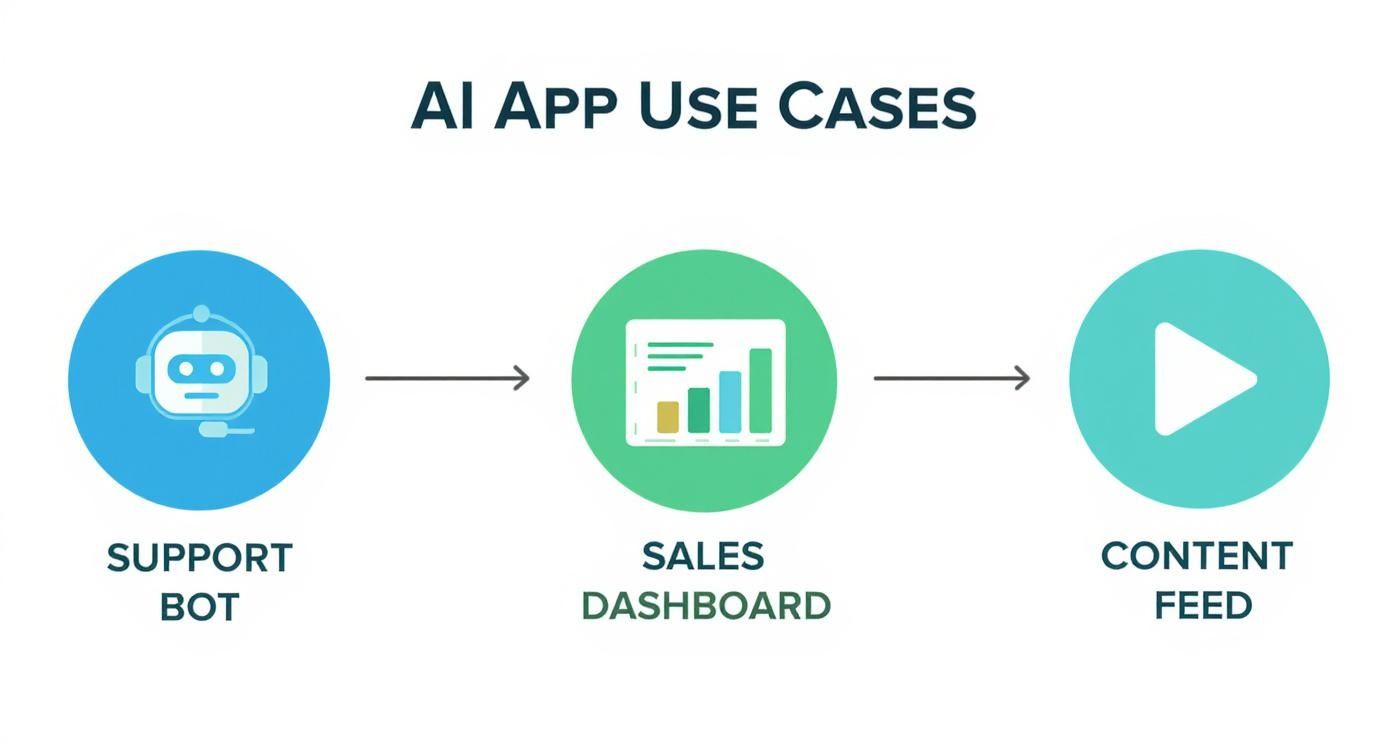
These examples drive home the point: these tools are at their best when creating structured, data-driven apps that help automate business processes. The key is simply matching the tool's strengths to what your project actually needs.
How to Choose the Right AI App Builder

Picking the right AI app builder is easily one of the most important calls you'll make for your project. The platform you choose doesn't just affect development speed; it dictates your ability to scale and adapt later on. It’s a strategic decision, not just a technical one.
The right tool can feel like a superpower, letting you build and test ideas at a breakneck pace. But the wrong one? It's a recipe for frustration, dead ends, and expensive do-overs. This checklist is designed to give your whole team—from founders to developers—a clear framework for making a choice you can stand behind.
Learning Curve and Ease of Use
First things first: how usable is it? You need to know how fast your team can get up and running, especially folks who aren't developers. If a tool has a brutal learning curve, it completely undermines the whole point of using an AI app builder to save time.
Look for a clean interface and good documentation. Some platforms are all about visual drag-and-drop, while others are driven by text prompts. Neither is inherently better—the right one is simply the one that clicks with your team's existing skills.
The goal isn't just to find the most powerful tool, but the most accessible one. A platform your product manager can use to build a working prototype is often more valuable than a more complex system that only a specialist can operate.
Integration Capabilities
Let's be real: no app is an island. Your product will need to talk to your CRM, analytics tools, marketing platforms, and payment gateways. A builder's ability to seamlessly connect with your current tech stack isn't a nice-to-have, it's a dealbreaker.
Before you commit, make a shortlist of your must-have integrations and dig into the platform's documentation.
- API Access: Does the builder have a solid API? Think of this as your get-out-of-jail-free card for connecting to niche services without a pre-built integration.
- Pre-built Connectors: Check for native integrations with the big players like Stripe, Salesforce, or Google Analytics. These can save you hundreds of hours of coding.
- Data Export: How easily can you get your data out? This is critical for backups and for having an exit strategy if you ever decide to switch platforms.
AI Model Power and Diversity
The "AI" in an app builder isn't just marketing fluff; it's the engine that determines what you can actually create. Some platforms offer a limited set of simple, pre-trained models. These are fine for standard tasks but can quickly become a straitjacket.
Others give you more advanced options, like training custom models on your own data or plugging into powerful third-party AI services. To get a better sense of what's out there, check out our deep dive on the best AI app builder. It'll help you map out the different players and what they bring to the table.
Performance Limits and Scalability
You’re probably focused on building your MVP right now, and that's great. But you have to think about what happens when you succeed. If your app suddenly goes viral, can the platform handle the traffic spike from a few hundred users to a few hundred thousand?
Go look for the platform's documented performance limits and scaling options. You need clear answers on their infrastructure, how much data they can handle, and what happens when you hit certain usage caps. A platform that can't grow with you is a ticking time bomb.
Pricing Structure and Total Cost of Ownership
Finally, let's talk about money. You need to understand the full cost, both today and down the road. Pricing models are all over the map, from simple monthly plans to complex usage-based billing. Watch out for hidden fees that can bite you, like charges for extra users, API calls, or data storage.
Try to map out your expected usage over the next 6-12 months and model the costs across your top choices. The cheapest plan now might become a huge expense once you scale. Look for a predictable pricing model that aligns with your growth so you can budget accurately and avoid nasty surprises.
When to Avoid Using an AI App Builder
AI app builders can be a game-changer, helping you get an app off the ground in record time. But they aren't a silver bullet. Knowing when to hit the brakes and opt for traditional, hand-coded development is just as crucial as knowing when to go all-in. If you try to force an app builder to do something it wasn't designed for, you'll likely end up with a mountain of technical debt, costly redos, and a product that just doesn't work.
Recognizing the limits early on is the key to making a smart technology choice. It’s about making sure your development path truly lines up with what your app needs to do, how it needs to perform, and where you want it to go in the long run.
When Your Core IP Is a Novel Algorithm
Here's the biggest red flag: if the secret sauce of your app is a brand-new, proprietary algorithm, an AI app builder is not the right tool. Think about creating a completely original data compression method or a unique machine learning model for spotting diseases. If it’s something the world has never seen before, you need a different approach.
AI app builders are fantastic at assembling applications using well-established patterns and components. They shine when it comes to building user interfaces, handling data, and plugging in standard AI features. What they don't do is invent foundational technology from the ground up.
If your project’s success hinges on a one-of-a-kind algorithm, you need absolute control over every single line of code. Custom development is the only path that lets you protect, fine-tune, and scale that unique IP, keeping it the secure, high-performing heart of your business.
Applications Demanding Ultra-Low Latency
Some apps are all about speed, where a delay of even a few milliseconds can spell disaster. We're talking about high-frequency stock trading platforms, real-time multiplayer games, or control systems for factory robots. In these cases, performance isn't just a nice-to-have; it's the entire point.
AI app builders, despite their development speed, operate with layers of abstraction that can introduce small delays, or latency. That's perfectly fine for the vast majority of business and consumer apps. But for those specialized use cases where every microsecond is critical, that overhead is a deal-breaker. These projects demand a custom software stack built from scratch and optimized for pure, raw speed.
Navigating Complex Regulatory and Compliance Needs
Is your app going to handle sensitive patient data governed by HIPAA? Or do you need to follow a maze of financial regulations across different countries? When you’re working in a heavily regulated field, you need to be able to prove exactly how data is stored, processed, and protected.
An AI app builder can make this tricky. While the best platforms certainly adhere to security best practices, you don't have direct, hands-on control over the underlying infrastructure. A custom-built solution, on the other hand, lets you architect every piece of your app to meet specific, rigorous compliance rules. This gives you the audit trails and granular control that regulators require.
With the AI app market's growth projected to surge by $32.3 billion between 2025 and 2029, you can bet that regulatory scrutiny will only get more intense.
Common Questions About AI App Builders
Once you start seriously considering an AI app builder, the practical, "what if" questions start bubbling up. It’s one thing to see the potential, but it’s another thing entirely to feel confident about what it means for your business on day one and year three.
Let's walk through the most common questions and concerns we hear from founders, product managers, and designers. We’ll cover everything from building something truly unique to managing security and planning for runaway success. Think of this as the final gut-check before you dive in.
Can I Build a Truly Unique App?
The short answer is yes, absolutely. But it's important to know where that uniqueness comes from. You're not inventing a new foundational technology, but you are creating a unique business logic and user experience by how you combine the platform's intelligent building blocks.
I like to think of it like using professional-grade kitchen appliances to create a signature dish. The oven and mixer are standard tools, but the recipe—your specific workflow, your design, and your unique solution to a customer's problem—is all yours.
For the vast majority of business, productivity, and e-commerce apps, the level of customization is more than enough to carve out a distinct space in the market. The only major exception is if your app's core value proposition is a brand-new, proprietary algorithm. For that specific piece, you'll almost certainly need to write custom code.
How Is My Data and My Users' Data Kept Secure?
This is non-negotiable, and any reputable AI app builder makes security a top priority. When you're vetting platforms, look for established security certifications like SOC 2 or ISO 27001 and clear, upfront compliance with data privacy regulations like GDPR.
These platforms should provide the essential tools of the trade: things like data encryption, role-based access controls for your team, and detailed security logs. Your responsibility, then, is to use those tools correctly to protect your information.
Before you commit to any platform, do your homework. Read their security policies and find out exactly where your data is stored. You need to make sure their security standards match your company’s requirements and, just as importantly, your customers' expectations for privacy.
What Happens if My App Becomes Too Big for the Platform?
This is a great question. It gets at two key concerns: "scalability" and the fear of "vendor lock-in." The best platforms are built to grow with you and, crucially, give you a clear exit path if you ever need one.
At a minimum, look for builders that offer robust API access and the ability to export all your data. This is an absolute must-have, as it guarantees you can migrate your data or connect to other services as your app gets more complex.
Some of the more advanced platforms, like RapidNative, take this a step further by letting you export the actual source code. This is the ultimate escape hatch. It gives you a smooth off-ramp to a fully custom-coded solution if and when the time is right. Always dig into a platform's scaling options and exit strategy before you build a single screen.
Do I Still Need a Developer on My Team?
To get started? Not necessarily. One of the main reasons to use a no-code ai app builder is to empower non-technical founders and product managers to build and launch an MVP on their own. You can get your idea into the market and start testing it without writing a line of code.
As you grow, however, a developer becomes an incredible asset. They can handle complex API integrations, write custom scripts if the platform has low-code capabilities, and oversee the technical side of security and performance.
An app builder doesn't replace developers; it makes them more efficient. It frees them up from the repetitive, time-sucking work of building standard UI components so they can focus their brainpower on the high-impact engineering challenges that will truly set your product apart.
Ready to turn your vision into a real, native app without the typical delays and costs? With RapidNative, you can generate production-ready React Native code from simple text prompts. Go from idea to interactive prototype and exportable code in minutes, not months. Start building your app today.
Ready to build your app?
Turn your idea into a production-ready React Native app in minutes.
Free tools to get you started
Free AI PRD Generator
Generate a professional product requirements document in seconds. Describe your product idea and get a complete, structured PRD instantly.
Try it freeFree AI App Name Generator
Generate unique, brandable app name ideas with AI. Get creative name suggestions with taglines, brand colors, and monogram previews.
Try it freeFree AI App Icon Generator
Generate beautiful, professional app icons with AI. Describe your app and get multiple icon variations in different styles, ready for App Store and Google Play.
Try it freeFrequently asked questions
What is RapidNative?
RapidNative is an AI-powered mobile app builder. Describe the app you want in plain English and RapidNative generates real, production-ready React Native screens you can preview, edit, and publish to the App Store or Google Play.
Can I export the code?
Yes. RapidNative generates clean React Native and Expo code that you can export at any time. No lock-in, no proprietary format. Hand it to your developers or keep building inside RapidNative.
Is RapidNative free to use?
Yes. You can build apps on the free plan with no credit card required. Paid plans unlock unlimited AI generations, code export, and direct publishing to the App Store and Google Play.
Do I need to know how to code?
No. Most users build apps by describing what they want in plain English. Developers can drop into the code whenever they want more control, but coding is optional.
How long does it take to build an app?
Most users have a working first screen in under a minute. A full MVP usually takes a few hours instead of the weeks or months traditional development requires.