App Subscription Model Playbook for Product Teams
Design, price, and launch an app subscription model that converts and retains. Practical guide for founders, PMs, and developers building mobile products.
By Riya
13th Oct 2026
Last updated: 13th Oct 2026
You've built a promising mobile MVP, users can complete the core workflow, and the next decision looks deceptively simple: should access cost a recurring fee? The answer isn't found by adding a monthly price to a paywall. An app subscription model changes what your team must build, measure, support, and improve after the first purchase.
The right question is whether your product can deliver recurring value. If customers return for updated content, continuing workflows, cloud-backed functionality, or an evolving service, subscriptions may strengthen the business. If they use the app intensely for one project and then disappear, a conventional monthly plan may create avoidable churn.
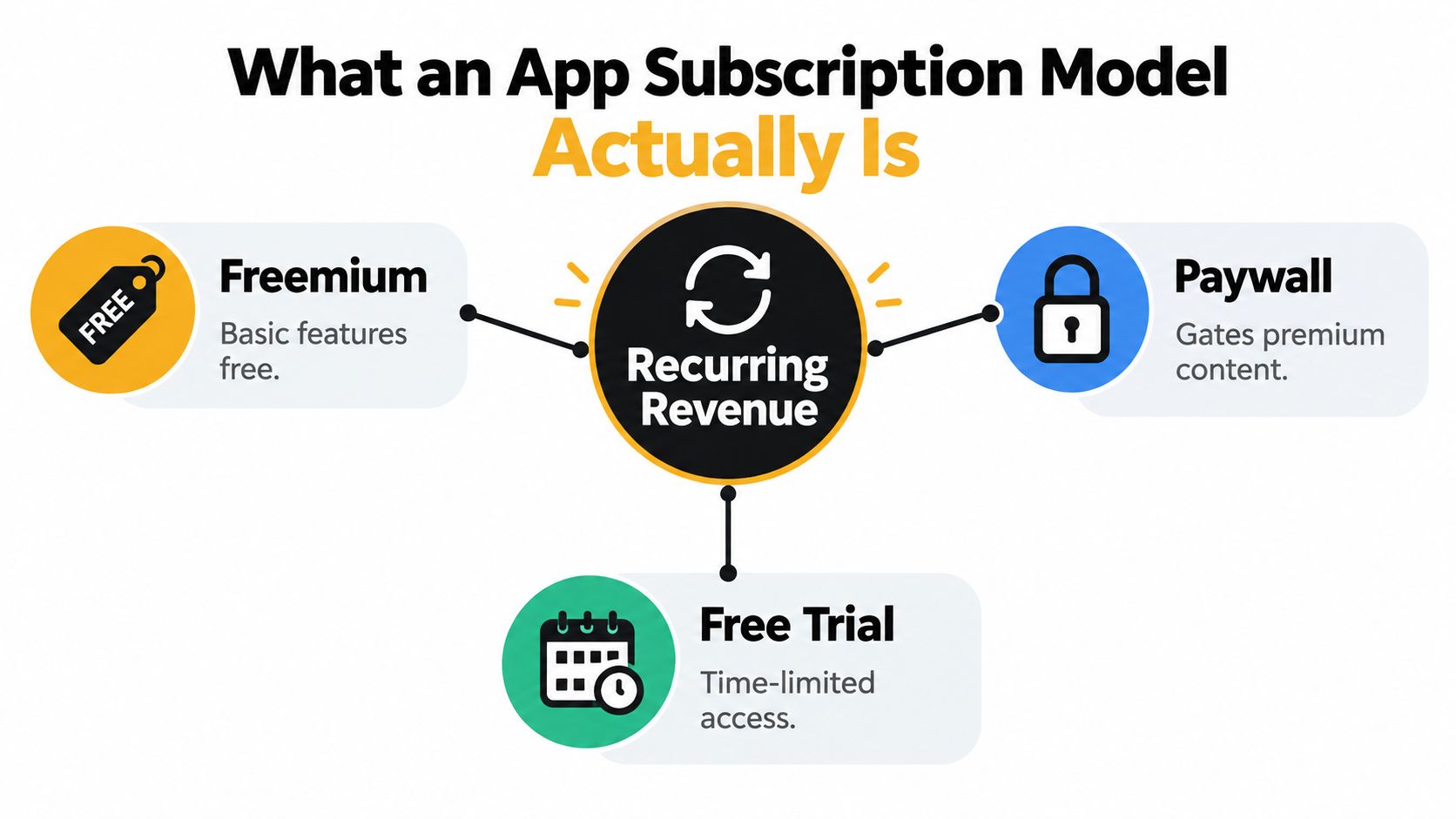
What an App Subscription Model Actually Is
An app subscription model charges users repeatedly for continued access to a product, feature set, service, or content library. The commercial transaction is recurring, but the product obligation is recurring value. Customers need a reason to return before every renewal, not merely a reason to buy once.
That distinction matters for a founder testing an MVP. A habit tracker might justify a subscription through daily routines, progress history, coaching, and continuously expanding programs. A project-planning app may offer ongoing collaboration and storage. A one-time calculator with little reason to revisit probably shouldn't force a recurring payment.
The model differs from several other monetization patterns:
- Auto-renewable subscriptions continue on a selected billing schedule until the customer cancels.
- One-time access grants provide permanent access to a feature or version.
- Consumable in-app purchases are used up, such as credits or extra attempts.
- Lifetime licenses exchange a larger one-time payment for continuing access, usually without promising unlimited future service.
Freemium, paywalls, and trials are packaging mechanisms around the subscription. They don't define the operating model by themselves.
Recurring revenue versus recurring value
A paid download ends much of the commercial relationship at acquisition. A subscription creates a continuing loop:
- Attract the right user.
- Help that user reach a meaningful first outcome.
- Make repeated use easy.
- Deliver enough ongoing value to justify renewal.
- Recover failed payments and learn from cancellations.
That loop makes retention a product responsibility, not just a finance metric. Your roadmap, onboarding, support, analytics, and billing implementation all become part of monetization.
The concentration of revenue helps explain the appeal. By August 2024, subscription-based apps represented only around 4% of mobile applications worldwide, while accounting for approximately 45.4% of total global app revenue during the period examined, according to Statista's subscription revenue distribution data. That doesn't mean every app should subscribe. It means a relatively small group of products captures substantial value when recurring utility, positioning, and retention work together.
Practical rule: Don't ask whether users will pay every month. Ask what they'll receive before the next charge that they couldn't reasonably receive from a one-time product.
The Business Case and Trade-Offs
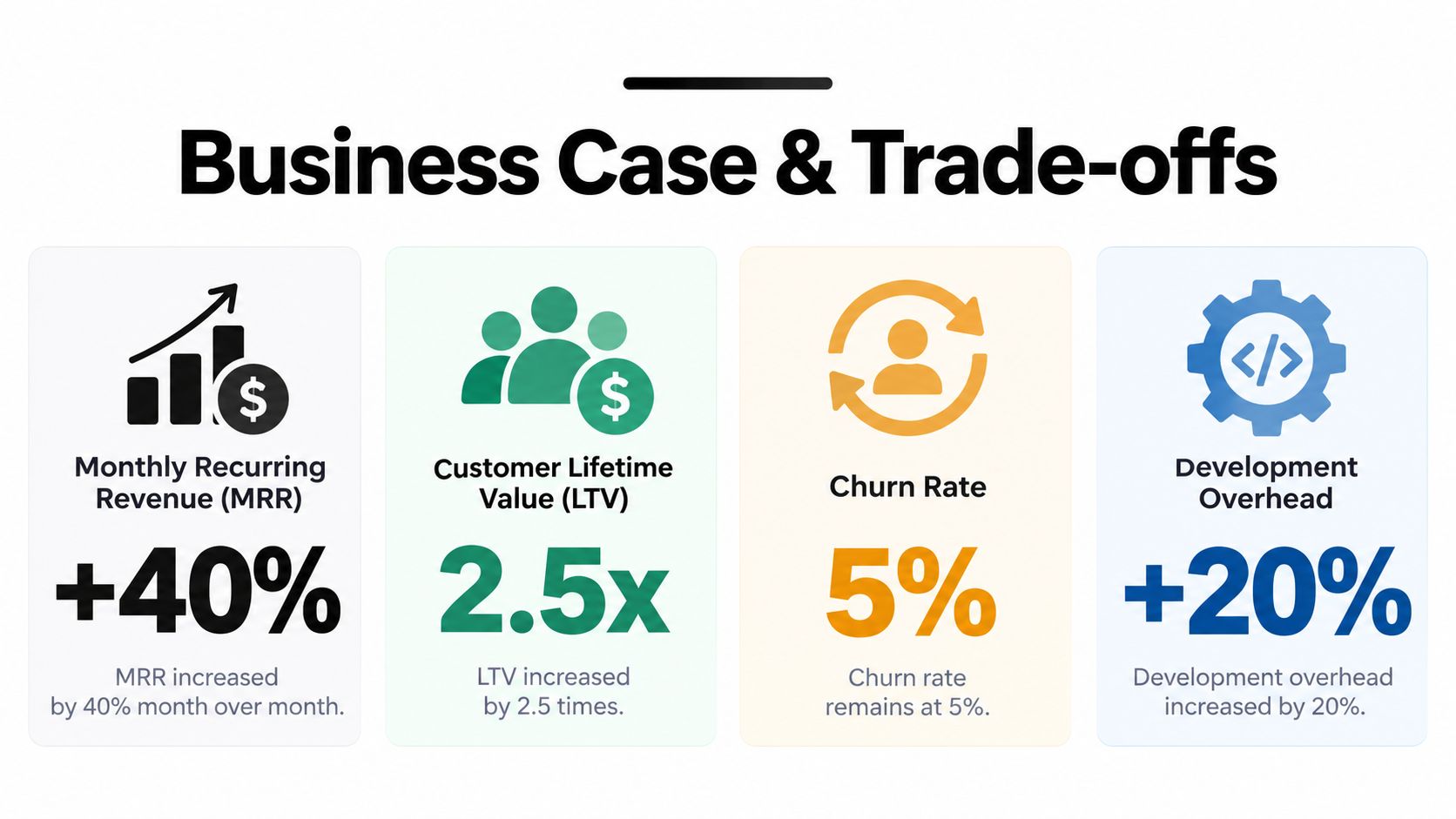
A user subscribes after a strong first session, then cancels before the first renewal because the app never makes the next outcome clear. That failure shows why an app subscription model is an operating model, not only a pricing choice. Revenue depends on activation, repeated value, billing, support, and product delivery working together.
Subscription apps generated approximately $18.3 billion in 2021, representing nearly 41% growth from 2020, according to Statista's subscription apps overview. The commercial appeal is predictable future revenue when customers remain active. That predictability can support spending on infrastructure, content, customer support, and product improvements.
It also changes how teams evaluate performance. Lifetime value measures revenue across the customer relationship, rather than treating the first payment as the full result. A subscription only improves that result when users reach value quickly and have a reason to renew.
The trade-off is an ongoing delivery obligation. Teams must manage cancellations, refunds, entitlements, failed payments, and support requests. If the product stops improving, each renewal can remind customers that they are paying for less value than they expected.
Platform economics change the model
Store distribution affects the opportunity and the unit economics. In the United States during 2021, subscription apps on Apple's App Store generated about $6 billion in consumer spending, while comparable apps on Google Play generated approximately $2.5 billion, according to the US consumer spending comparison by store. The difference reflects audience, geography, purchasing behavior, and category mix. It still supports a practical operating rule: model iOS and Android separately.
Store deductions reduce the amount available for acquisition, infrastructure, support, and margin. Failed payments reduce it further. A plan that looks attractive at its headline price can produce weak contribution after those costs, especially if the first renewal is poorly timed or poorly explained.
When subscriptions help
Subscriptions fit products with:
- Continuous content, such as new lessons, workouts, reports, or media.
- Persistent functionality, including cloud storage, collaboration, automation, or professional workflows.
- Growing utility through updates, integrations, or personalization.
- Repeatable outcomes, where users return to complete the same type of job.
They fit poorly when value arrives in one session, demand is seasonal, or customers leave after completing a project. A lifetime license, credit pack, project pass, or hybrid plan may match those usage patterns better than continuous membership.
Subscription teams should budget for activation work, retention research, cancellation analysis, and billing recovery before judging the model. The operating question is whether the product can earn the next renewal, not just whether it can collect the first payment.
Choosing the Right Paywall Structure
The paywall should match how users discover value. A daily habit product can let people experience a free routine before gating advanced insights. A design tool used for a client project may need a project pass or usage allowance rather than an always-on membership.
Five structures worth comparing
Freemium with feature gates keeps basic functionality free and reserves advanced features for subscribers. It works when the free experience demonstrates the product's purpose while premium capabilities deepen value. It fails when free users can complete the entire job without needing the paid layer.
A free trial gives full or partial access for a limited period before billing begins. It suits products whose value becomes clear through repeated use, such as a learning app or analytics dashboard. The risk is weak activation. A trial that expires before the user reaches a meaningful outcome creates cancellations, refunds, and distrust.
A metered paywall allows a defined amount of usage, then asks the user to subscribe. This is useful for AI-assisted workflows, document exports, design renders, or other actions users can understand as units. The meter must feel connected to value, not like an arbitrary interruption.
A paywall on launch asks for payment before meaningful use. It can work when the product has strong demand, trusted positioning, or a clear professional outcome. It usually performs poorly for unfamiliar consumer apps because users haven't seen enough evidence to evaluate the offer.
A hybrid structure combines approaches. For example, a project-management app might offer free personal boards, meter exports, and gate team collaboration. This structure often reflects a more accurate value map, but it also creates more rules to explain and instrument.
The practical shortlist is narrower than the terminology suggests. Choose one primary conversion moment, one clear paid outcome, and one fallback for users who aren't ready. Don't test five superficial paywall variations when the underlying first-value experience remains unchanged.
A useful implementation comparison looks like this:
| Product situation | Strong starting structure | Main risk |
|---|---|---|
| Daily habit or wellness routine | Freemium with premium guidance | Users stay on the free routine |
| Professional workflow | Trial with full feature access | Value isn't reached before expiry |
| Usage-based creation tool | Metered credits or project pass | Users don't understand the unit |
| Trusted specialist utility | Paywall after a clear promise | High resistance before proof |
| Collaboration product | Hybrid feature and seat gates | Packaging becomes confusing |
The paywall is not the product strategy. It is the point where the product's value story, pricing, and timing meet.
Pricing, Packaging, and Plan Design
Pricing works best when it follows the customer's usage pattern and your delivery cost. Monthly plans reduce commitment and can help users test fit. Annual plans improve cash collection and reduce the number of renewal decisions, but they also create a larger trust hurdle at purchase.
Consider a worked example with a $9.99 monthly plan, a $59.99 annual plan, and a free trial. The annual option has an effective monthly price of about $5.00 before considering taxes, store fees, refunds, or trial effects. A customer choosing the annual plan pays less than the equivalent monthly headline price across a year, while the business receives more commitment upfront.
| Plan | Gross Price | Effective Monthly Price | Trial Window |
|---|---|---|---|
| Monthly | $9.99 | $9.99 | Free trial |
| Annual | $59.99 | About $5.00 | Free trial |
The break-even question isn't only whether the annual plan is cheaper. Compare the expected net revenue from an annual subscriber with the expected number of paid months from a monthly subscriber. If monthly customers commonly cancel before the annual equivalent is reached, the annual offer may improve economics. If users feel trapped or don't understand the renewal, it may increase refunds and complaints instead.
Packaging levers
- Introductory offers can reduce entry friction, but show the post-offer price and renewal terms before purchase.
- Family or team tiers work when value is shared across people, accounts, or seats. Don't add them merely to create more cards on the pricing screen.
- Regional pricing should reflect local purchasing conditions while preserving a coherent value proposition.
- Promotional codes are useful for acquisition partnerships, launches, and win-back campaigns, provided the expiry and subsequent price are clear.
- Lifetime access can fund early development, but it creates a long-term support obligation without recurring revenue from that customer.
Use a SaaS pricing calculator to test price, retention, fees, and acquisition assumptions together. A pricing decision is only meaningful when it survives the full unit-economics model.
The trial itself should correspond to the time required to experience the core outcome. A short trial can work for an immediate utility. A workflow that requires setup, collaboration, or repeated use may need more time. Keep the experiment focused on paid conversion, early cancellation, refunds, and net revenue, not trial starts alone.
Retention, Churn, and the First Renewal
Retention starts before a customer pays. RevenueCat's 2025 analysis reports that 80% of free-trial starts occur on day one, while the majority of users in productivity apps convert on Day 0, with conversion exceeding 60% in most regions, according to the RevenueCat subscription analysis.
That concentration changes how teams should design the funnel. The first session needs to connect the user's problem to a successful outcome, show the paid capability in context, and explain what happens after the trial. A paywall that appears before value feels like a demand. A paywall that appears after the user has completed the free experience may arrive too late.
Instrument the complete journey
Track these events separately:
- Onboarding completion, including the user's selected goal or workflow.
- First-value completion, such as creating a project, finishing a routine, or exporting a result.
- Paywall exposure, including the screen, trigger, and offer shown.
- Trial activation, with platform, country, acquisition source, and plan.
- Subscription purchase, including introductory pricing and billing period.
- Renewal success or failure, not merely active entitlement.
- Cancellation reason, separating price, lack of usage, missing features, and billing problems.
The first renewal deserves its own activation target. A user who starts a trial but never completes the paid workflow isn't an acquisition success. A user who completes the workflow and understands the recurring benefit is more likely to make an informed renewal decision.
Retention principle: Treat the first charge as a product milestone, not a finance event.
Billing failures need a different response from voluntary cancellation. A failed payment calls for recovery messaging, account updates, grace periods, and retry logic. A deliberate cancellation calls for product feedback, pause options, and a clear reactivation path. Teams working through mastering subscription lifecycle management can use that broader lifecycle view to keep purchase, entitlement, renewal, and recovery connected.
For practical cohort implementation, use retention cohort analysis for product teams to compare onboarding variants and acquisition sources. Don't interpret a paywall change without controlling for traffic quality, platform, country, and user intent.
Metrics That Actually Forecast the Model
A useful forecast begins with a retention curve, not a conversion headline. Start with the number of new subscribers in a cohort, then track how many remain active after each billing period. That curve shows whether the product loses users immediately, declines gradually, or stabilizes after an early drop.
From there, estimate lifetime value by summing expected net contribution across the retained periods. Use net subscription revenue after store fees, taxes, refunds, and relevant service costs. Headline ARPU can look healthy while contribution margin remains weak if acquisition or platform deductions consume too much of the payment.
Build the forecast loop
ARPU tells you what the average subscriber generates over a defined period. Calculate it separately for monthly and annual plans, and separate iOS from Android when the economics differ.
Cohort retention shows when users leave. A cohort table should include trial starts, paid conversions, renewals, cancellations, refunds, and failed payments. Look for the period where the decline begins to flatten, then test whether that pattern holds across acquisition channels.
Churn explains the rate of loss, but it needs context. Voluntary cancellation suggests a value, pricing, or usage problem. Involuntary churn points toward payment methods, store recovery, entitlement state, or communication.
CAC payback asks how long net contribution takes to recover acquisition cost. A plan may have strong LTV but still be difficult to fund if payback arrives too late for the business's cash position.
Trial design belongs inside this model. RevenueCat's 2025 benchmark reports that 52% of trials lasted five to nine days, up from 48.5% in 2023, offering a starting range for an experiment in the RevenueCat monetization benchmark. The benchmark doesn't establish an ideal duration for every category. Test the range against first-value completion, paid conversion, cancellation before the first charge, refunds, and revenue per install.
A simple forecast sheet should have one row per cohort and columns for installs, trial starts, paid subscribers, renewal rate, net revenue, refunds, billing failures, CAC, and cumulative contribution. Update it with actual cohorts rather than adjusting assumptions to match a target.
Forecasting rule: Optimize for the subscriber who renews, not the user who taps “start trial.”
App Store and Play Store Billing Rules
Store billing affects both margin and implementation. Treat it as part of the product architecture, not a final integration task.
Apple states that auto-renewable subscriptions generally yield developers 70% of the subscription price during the subscriber's first year and 85% after one year of paid service, excluding applicable taxes. Developers enrolled in Apple's Small Business Program receive 85% at each billing cycle, subject to eligibility. Model the applicable Apple structure for each account and subscriber state rather than applying one universal assumption.
Google Play automatically renewing subscriptions generally carry a 15% service fee, regardless of annual subscription revenue, and Google says more than 99% of developers subject to its service fee are eligible for a rate of 15% or less, according to Google Play's service-fee guidance. Use net revenue in CAC payback and LTV calculations.
Ship a store-aware implementation
- Show the terms before purchase. Display price, billing frequency, trial duration, automatic renewal, and the first paid charge in language users can understand.
- Model entitlements on the server. Client-side flags can be reset, altered, or left stale. Validate receipts or purchase tokens server-side and maintain a canonical entitlement state.
- Handle lifecycle states. Include active, grace period, billing retry, canceled, expired, refunded, and price-change states.
- Separate platforms. Apple and Google Play have different APIs, transaction identifiers, policy details, and user experiences.
- Test restoration. A reinstall, device change, account change, or delayed transaction shouldn't remove valid access.
- Make cancellation visible. Users should know how to manage their subscription through the relevant store.
Google Play subscriptions renew automatically on the selected schedule, and customers may be charged as early as 24 hours before the next billing period begins, according to Google Play's subscription terms. That makes renewal timing and disclosure part of the UX, not a hidden backend concern.
For teams combining store subscriptions with web services or other billing paths, document entitlement ownership and reconciliation carefully. A practical reference for the architecture is subscription API integration with Stripe, especially when app access and external account systems must remain synchronized.
Designing for Intermittent and Project-Based Use
A design studio may subscribe to an app for a client launch, use it heavily during a prototype sprint, then stop until the next engagement. Founders, agencies, developers, and product managers often work in the same pattern. A subscription model built around continuous activity treats that normal cycle as a retention failure.
“Not enough usage” is the leading cancellation reason across categories, accounting for roughly 32% to 47% of cancellations, according to the Mastercard subscription economy report. For intermittent users, cancellation does not necessarily mean the product failed. It may mean recurring billing continued after the project ended.
The operating question is whether the product can preserve the relationship between projects without charging for value the customer is not currently using.
Alternatives to forced continuity
Pause access stops billing while preserving history, settings, and project context. Customers can return without rebuilding their workspace, and the product keeps a credible path to reactivation.
Project passes charge for a defined build or delivery period. They fit tools whose value concentrates around a client engagement, release, or prototype sprint.
Seasonal access suits customers with predictable work cycles. The product can make reactivation straightforward without presenting constant usage as the expected behavior.
Credit rollover carries unused capacity forward within a defined limit. The limit protects unit economics, while rollover reflects the fact that customers rarely consume value evenly every month.
Usage-based billing ties payment to an understandable unit, such as exports, renders, active projects, automation runs, or another measurable action. It can feel fairer during inactive periods, but requires clear limits and reliable forecasting.
Surveyed consumers in the United States and United Kingdom reported that 78% wanted options to pause or swap subscriptions, 70% were open to usage-based pricing, and 58% had paused rather than canceled when a pause option existed, according to the Mastercard report cited above. The practical implication is clear: flexibility can preserve a future customer relationship more effectively than making cancellation difficult.
A project-based example
Consider a mobile app-building product used by teams creating prototypes in concentrated bursts. A monthly plan may produce attractive recurring-revenue figures, but monthly churn does not show whether project-based customers are returning when work resumes. Track the operating signals behind that behavior:
- Revenue per active project
- Projects started per paying account
- Time from project creation to first shareable build
- Reactivation rate after pause
- Credits consumed per completed project
- Support cost per project
- Renewal rate among accounts with an active project
A project pass could include a defined set of build capabilities, collaboration access, and a limited update period. A recurring subscription can remain available for teams with ongoing work. Paused accounts should retain project history and reactivate without rebuilding their workspace.
The trade-offs should remain visible. Usage-based pricing makes revenue less predictable. Credit systems confuse customers when consumption rules are unclear. Pauses reduce current-period revenue. In return, a flexible model can strengthen trust, preserve customer data, and bring users back when the next project begins.
A 30-60-90 launch sequence
Days 1 to 30, define and instrument. Write the first-value statement, map the core workflow, select the primary paywall structure, and document the free-to-paid boundary. Create an event dictionary for onboarding completion, first-value completion, paywall exposure, trial start, purchase, cancellation, and project activation.
Days 31 to 60, integrate and price. Implement the first subscription flow for iOS and Android, establish server-side entitlement validation, and model net revenue by platform. Test monthly and annual packaging, then record trial starts, paid conversion, early cancellations, refunds, and revenue per install.
Days 61 to 90, retain and recover. Add renewal-specific activation metrics, billing-failure recovery, grace-period handling, cancellation reasons, and a pause or reactivation path where intermittent use is common. Review the first renewal by comparing voluntary churn, involuntary churn, active-project status, and net contribution by cohort.
This sequence makes the app subscription model an operating system for customer value. Pricing reflects how work happens, store economics remain visible, access stays reliable, and retention includes the customer's next project rather than only the current billing period.
RapidNative helps product teams turn prompts, sketches, images, and PRDs into shareable React Native apps, so you can validate subscription flows before committing to a full build. Use RapidNative to prototype onboarding, paywalls, project-based packaging, and renewal experiences across iOS, Android, and web, then export clean code for engineering handoff.
Ready to build your app?
Turn your idea into a production-ready React Native app in minutes.
Free tools to get you started
Free AI PRD Generator
Generate a professional product requirements document in seconds. Describe your product idea and get a complete, structured PRD instantly.
Try it freeFree AI App Name Generator
Generate unique, brandable app name ideas with AI. Get creative name suggestions with taglines, brand colors, and monogram previews.
Try it freeFree AI App Icon Generator
Generate beautiful, professional app icons with AI. Describe your app and get multiple icon variations in different styles, ready for App Store and Google Play.
Try it freeFrequently asked questions
What is RapidNative?
RapidNative is an AI-powered mobile app builder. Describe the app you want in plain English and RapidNative generates real, production-ready React Native screens you can preview, edit, and publish to the App Store or Google Play.
Can I export the code?
Yes. RapidNative generates clean React Native and Expo code that you can export at any time. No lock-in, no proprietary format. Hand it to your developers or keep building inside RapidNative.
Is RapidNative free to use?
Yes. You can build apps on the free plan with no credit card required. Paid plans unlock unlimited AI generations, code export, and direct publishing to the App Store and Google Play.
Do I need to know how to code?
No. Most users build apps by describing what they want in plain English. Developers can drop into the code whenever they want more control, but coding is optional.
How long does it take to build an app?
Most users have a working first screen in under a minute. A full MVP usually takes a few hours instead of the weeks or months traditional development requires.