10 Home Business Ideas That Work in 2026
Explore 10 home business ideas that work, with startup costs, validation steps, marketing channels, revenue paths, and practical examples.
By Suraj Ahmed
6th Oct 2026
Last updated: 6th Oct 2026

You're sitting at a kitchen table with a promising app idea, a limited budget, and no interest in spending months building something customers may never use. Perhaps you're a designer who can't find a developer, a consultant who sees the same workflow problem repeatedly, or a small team that needs revenue before it can hire.
The home business ideas that work tend to share a practical structure. They serve a narrow audience, solve a visible problem, and let the founder test demand before taking on major fixed costs. That's especially true for mobile-product businesses, where a working prototype can reveal more than a polished pitch deck.
This list focuses on ten models across services, software, education, templates, and consulting. Each one is evaluated through the questions that matter in practice: who pays, what you can deliver remotely, how quickly you can validate the offer, what makes it scalable, how customers will find you, and where RapidNative can shorten the path from concept to testable app.
The opportunity is substantial, although the category needs careful definition. The U.S. Census Bureau counted 30,427,808 nonemployer establishments in 2023, businesses with no paid employees. They generated nearly $1.8 trillion in receipts, equal to 6.4% of U.S. gross domestic product, and represented 78.4% of all U.S. business establishments. Those figures include businesses that aren't home-based, and receipts aren't owner income, but they show why low-overhead, owner-operated businesses deserve serious consideration.
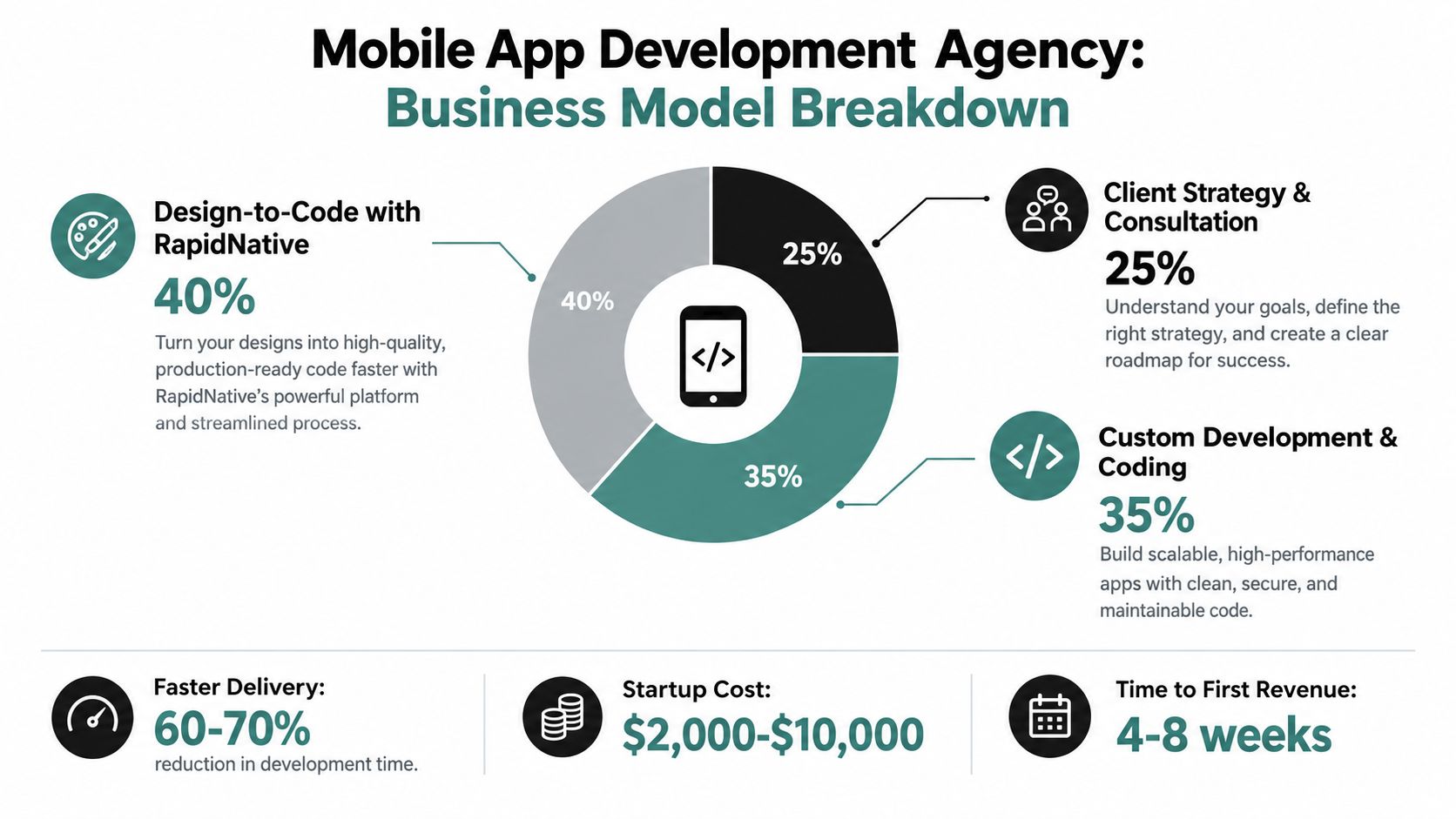
1. Mobile App Development Agency
A home-based mobile app agency sells judgment and delivery, not just code. The buyer might be a founder with a product requirements document, a local business with a manual workflow, or an established agency that needs a mobile specialist for one client project.
The strongest offer is narrow and concrete. Instead of promising to “build any app,” package a discovery call, a clickable prototype, a defined set of user flows, and an engineering handoff. RapidNative can turn prompts, sketches, images, or PRDs into shareable React Native interfaces, so the agency can spend more time on product decisions, customization, testing, and client communication.
The U.S. Chamber's 2025 small-business technology survey reported that 58% of small businesses used generative AI, up from 40% in 2024 and 23% in 2023, while 84% planned to increase their use of technology platforms. That doesn't guarantee demand for an agency, but it indicates that many small businesses are becoming more comfortable with technology implementation.
Make speed a deliverable
A prototype-to-validation package is easier to buy than an open-ended development engagement. Offer a working preview, stakeholder testing through a link or QR code, exported code, documentation, and a short plan for the next technical step.
You can also create recurring revenue through maintenance, usability improvements, analytics reviews, or feature iterations. A vertical focus, such as logistics, fitness, local retail, or professional services, helps you reuse navigation patterns and form components without pretending every customer has the same needs.
Agencies that need to scale ad campaigns faster may also need landing pages, lead capture, or customer portals that connect campaign activity to a usable mobile experience. Test the model by selling one fixed-scope prototype before hiring staff or building an internal platform.
2. No-Code SaaS Product Builder for Specific Verticals
Generic software is difficult to position from a home office. A vertical product is easier to explain because the customer already recognizes the workflow. “Appointment management for independent yoga studios” is more useful than “an all-in-one business platform.”
The buyer pays for a repeatable solution to a narrow operational problem. A salon might need booking, reminders, staff availability, and customer profiles. A fitness coach might need onboarding, plans, check-ins, and payments. A local service company might need job requests, status updates, and proof of completion.
RapidNative can help you explore the interface before committing to a full SaaS backend. Use a prompt, image, or rough workflow to create a realistic mobile preview. Then show it to prospective customers and ask them to walk through the tasks they currently handle with messages, spreadsheets, or disconnected tools.
Validate the workflow before the platform
Speak with potential buyers in one vertical and document their current workaround. Ask what they do, who does it, where errors occur, and what a successful outcome would look like. Don't treat polite interest as validation. A stronger signal is a scheduled pilot, a paid setup, or access to real workflow data.
Start with the smallest useful product. Authentication, one primary workflow, notifications, and a basic admin view may be enough for the first test. Add features only when users repeatedly ask for them or when the missing capability blocks payment.
The trade-off is clear. Vertical SaaS can create recurring revenue and reusable components, but it takes longer to validate than a one-off service. You're not only selling an app. You're taking responsibility for reliability, onboarding, support, privacy, and the customer's daily operations.

3. Freelance Mobile UI/UX Designer with Rapid Prototyping
A conventional UI designer delivers screens. A prototype-focused designer delivers a decision-making tool. That difference matters to early-stage founders who need to test onboarding, booking, checkout, or account creation before paying for full development.
Your customer could be a nontechnical founder, a product manager, or an agency that needs a realistic mobile concept for a pitch. The offer should define the output clearly: a small set of screens, connected navigation, responsive states, an interactive preview, and a limited number of revision rounds.
RapidNative is useful when the client's starting point is incomplete. A hand-drawn sketch, a screenshot reference, a written PRD, or a rough description can become a shareable React Native prototype. The designer can then use the preview in customer interviews instead of asking people to react to static frames.
Sell clarity, not hours
Charge by a defined project scope rather than leaving the buyer to manage an hourly queue. For example, specify the target audience, core task, screens included, feedback process, and handoff format. That protects your time and gives the client a clear decision point.
A useful service sequence looks like this:
- Discover the workflow: Identify the user, the trigger, and the action the prototype must support.
- Build the smallest flow: Avoid designing every possible screen before the main task works.
- Test with intended users: Watch where people hesitate, misunderstand labels, or abandon the flow.
- Prepare the handoff: Include exported code or clear implementation notes for the engineering team.
Nielsen Norman Group recommends testing five users in a qualitative usability study and running multiple small rounds rather than one elaborate study, as explained in its guidance on the number of test users. Use that approach as a practical rhythm, not a rigid rule. After each round, fix the most important usability problem before testing again.
For a deeper productized offer, connect the service to UI and UX prototyping software and show clients how a working preview reduces ambiguity before engineering begins.
4. White-Label Mobile App Solution for Agencies
Many web, branding, and marketing agencies already have customer relationships but don't have mobile expertise in-house. A white-label service lets them sell a mobile deliverable under their own brand while you handle the technical production behind the scenes.
The agency partner pays for dependable execution and margin. You provide the prototype, code workflow, technical guidance, deployment support, and project status. The partner manages the client relationship, creative direction, and commercial packaging.
This model only works when the boundaries are explicit. Decide who owns requirements, who approves scope, who answers support questions, and who handles app-store or backend issues. If every partner expects custom treatment, the business becomes freelance development with an extra layer of communication.
Start with a partner pilot
Work with one or two agencies that already sell adjacent services. Give them a repeatable pitch, sample deliverables, an intake form, and a process for requesting changes. A partner portal can later show project status, billing, support requests, and handoff assets, but a shared workspace may be enough for the first engagement.
RapidNative can support the production layer by generating live React Native interfaces from prompts, images, sketches, or PRDs. The agency can preview the result with its client, while you retain responsibility for code quality and technical decisions.
Partner rule: If your reseller can't explain what happens after the prototype, your offer isn't ready for resale.
Create separate packages for project-based work, ongoing support, and revenue-sharing partnerships. Training also matters. A short workshop can teach agency teams how to gather better requirements, present a prototype, and avoid promising features that aren't in scope. Your white-label app-building guidance for agencies can support that enablement process.
5. Micro SaaS for Mobile-First Tools
A micro SaaS product doesn't need to replace an enterprise suite. It needs to solve one recurring problem well enough that a specific group will pay for continued access.
Good candidates include appointment scheduling for a particular type of solo provider, mobile forms for field inspections, client intake for coaches, or a lightweight analytics view for independent creators. The mobile-product lens changes the test. Instead of asking whether the feature list is impressive, ask whether a user can complete the important task quickly on a phone.
Build around one repeated action
Start with a landing page that describes the audience, the problem, and the promised outcome. A waitlist can indicate curiosity, but conversations and payments provide stronger evidence. Ask interested people to describe the last time they experienced the problem and what they used instead.
RapidNative can help you create the front-end experience before you commit to a large application. Build the core route, form, confirmation state, and account view. Use the prototype to test wording, information order, and whether users understand what happens next.
Mobile performance deserves attention from the first test. Google's mobile page-speed analysis found that when load time rose from one second to ten seconds, the probability of a visitor bouncing increased by 123%. The analysis also found that increasing page elements from 400 to 6,000 reduced the probability of conversion by 95%. Those figures concern mobile websites, not every native app, but they support a practical principle: keep the first mobile experience focused and lightweight.
Don't add dashboards, feeds, integrations, and settings just because they make the product look complete. A narrow tool with a clear paid use case is easier to support than a broad product nobody uses extensively.
6. Mobile App Templates and Component Marketplace
A template marketplace works when it removes repeated product work for a clearly defined buyer. Developers, designers, agencies, and founders pay to avoid the blank-canvas stage, especially when they need a usable starting point for a client project or internal product.
Good assets package more than attractive screens. They include sensible navigation, loading and error behavior, reusable components, clear documentation, and code that can be adapted without rebuilding the application. Common products include fitness onboarding, property listings, subscription checkout, marketplace profiles, and mobile admin components.
Validate demand before creating a large catalogue. Choose one audience, publish a preview of a single cohesive template, and invite developers or agencies to inspect the flow and request changes. Their questions reveal whether the offer solves a real implementation problem. A narrow fitness product template gives buyers a clearer decision than a collection of unrelated screens.
RapidNative can turn a visual concept into modular React Native code with components, routing, and a modern Expo-based workflow. That supports remote delivery of a working asset rather than a static design file. The exported code still needs sensible organization, and customers need instructions that explain setup, routing, component structure, and customization points.
Each release should cover five practical requirements: A defined use case states who should use the template and which problem it addresses. Working states cover loading, empty, error, confirmation, and responsive behavior where relevant. Documentation shows how to install and modify the project. A demonstration lets buyers inspect the experience before purchase. A service path gives customers access to customization when they need implementation help.
Use specific search wording, such as “React Native fitness app template,” only when the asset supports that use case. Tutorials, walkthrough videos, and technical articles can reach people researching the same build. Marketplace income may be uneven, while customization brings faster service revenue and makes the business less passive.
7. Niche App Development Studio
A niche studio wins by understanding an industry that generalist builders treat as a collection of features. In health technology, financial technology, logistics, or real estate, the buyer needs more than a pleasant interface. They need dependable workflows, appropriate permissions, careful data handling, and a team that understands operational risk.
The customer might be a funded startup, a specialist agency, or a traditional business moving a critical process onto mobile. Your domain knowledge becomes the main differentiator. RapidNative can shorten prototyping and iteration, but it doesn't replace compliance review, security work, legal advice, or technical judgment.
Local rules deserve attention before you promise a home-based delivery model. The U.S. Small Business Administration's business-launch guidance notes that location can affect taxes, zoning, and regulations, and local ordinances can restrict particular activities. That consideration applies to the business itself and to the customer's product.
Choose a vertical with a real operating problem
Interview people who perform the work, not only executives who approve budgets. A field technician may need a faster job handoff. A clinic administrator may need better intake. A property manager may need clearer maintenance status. These details shape the product far more than a broad industry label.
Build a small domain kit around the repeated patterns you understand. That might include authentication, role-based navigation, approvals, document capture, payment flows, or audit-friendly status changes. Use partners when the work requires specialist knowledge, such as compliance consultants, lawyers, accountants, or security reviewers.
The trade-off is narrower demand and deeper trust. You may lose prospects outside the vertical, but the right customer can understand your value faster because your questions and recommendations reflect their working reality.
8. Content Creator and Educator Teaching Mobile App Development
A designer with a working wireframe, a founder testing a booking idea, or a beginner building a first project may pay for practical mobile development guidance. Teaching from home turns product knowledge into an offer that can be delivered remotely through public tutorials, paid courses, live workshops, group coaching, sponsorships, affiliate relationships, or a private community.
Revenue depends on a clear learning result and a publishing routine. Recording lessons is only the production task. The harder decisions are choosing the audience, defining what they will build, and showing enough real work to earn trust.
RapidNative gives educators a practical way to demonstrate that process. A lesson can move from a prompt, sketch, or PRD to a working interface, then examine navigation, components, code export, testing, and handoff. That makes the teaching more concrete and gives learners an app they can open and discuss.
A focused promise will sell more clearly than “learn mobile development.” Suitable starting points include building a booking flow with React Native, prototyping a founder's first app, or turning a wireframe into an engineering-ready interface. Learners should finish with something they can test, explain, and improve.
Validate the topic before recording a complete curriculum. Publish a short lesson and track the questions and examples that prompt useful discussion. Offer a live workshop to see where learners get stuck and what they request next. Collect project submissions to check whether the instructions produce understandable results. Sell a small paid product because payment tests commitment more reliably than views alone.
The mobile-product angle also creates room for a second offer. A student may buy implementation help, templates, or consulting after learning the workflow. Those services can raise revenue per customer, but they also reduce the time available for publishing.
Content education usually takes longer to produce dependable income than client work, and it can become a demanding second job. Keep outcome claims modest, show the actual workflow, and make clear which shortcuts RapidNative supports and which engineering decisions, testing, and judgment still belong to the learner.
9. Mobile App Testing and QA Consulting
A founder can approve a polished prototype and still ship a broken product. Enter an unexpected value, lose connectivity, rotate a device, or follow an unfamiliar route, and failures appear quickly. QA consulting gives founders, agencies, and product teams an independent quality gate before release. The buyer pays for reduced risk and clearer release decisions.
Sell an outcome, not hours. A pre-launch package can cover a test plan, selected device and browser coverage, exploratory testing, accessibility checks, performance observations, reproduction steps, and a prioritized defect report. Add regression testing during later iterations. Define the decision clearly: whether the current build is ready for a limited release, what blocks it, and what can wait.
The strongest early clients are:
- Founders and product managers: They need fast feedback before exposing a new app to customers.
- Agencies: They may need a white-label QA partner who can work within their delivery process.
RapidNative helps QA consultants inspect the intended product flow while a team is still working from sketches or a PRD. A quick preview lets you test navigation and interaction assumptions before engineering is complete. It does not make generated output production-ready. Test the actual application, integrations, data handling, permissions, and release build separately.
A practical workflow starts with risk. Ask which user journeys affect revenue or retention, which devices customers use, what data and permissions the app handles, and which failures would block release. Test those paths first, record steps another person can reproduce, and rank defects by user impact rather than volume. This makes a remote engagement concrete and gives the client a usable retest plan.
CB Insights' startup-failure analysis lists “ran out of capital” as a 70% factor in its latest summary, alongside poor product-market fit at 43%, bad timing at 29%, and unsustainable unit economics at 19%. Those figures come from venture-backed startup post-mortems, so they do not predict every home business. They support a practical principle: catch expensive product and quality problems before adding scope.
Use RapidNative's app quality assurance guidance alongside your own procedures. It can inform coverage planning, while your value remains judgment, evidence, and a release recommendation.
10. Product Strategy and Mobile-First Consulting for Non-Tech Founders
A nontechnical founder often doesn't need another developer first. They need help deciding what to build, who it's for, which workflow matters, and how to learn before spending heavily.
A home-based consultant can sell product discovery, audience interviews, workflow mapping, prioritization, prototype reviews, roadmap decisions, and stakeholder facilitation. The buyer might be a traditional business considering a mobile service or a founder with a strong idea but no way to evaluate it.
This model rewards communication and judgment. You need to explain technical trade-offs in plain language, challenge assumptions without derailing momentum, and distinguish a useful experiment from a disguised full build. RapidNative can make those conversations concrete by turning a rough concept into a working preview that customers and stakeholders can react to.
Start with the customer's current workaround
Don't begin with features. Ask who experiences the problem, how often it occurs, what they do today, and what the workaround costs in time, missed opportunities, or frustration. A narrow audience also reduces the risk of building a product for everyone and resonating with no one.
CB Insights' analysis identifies poor product-market fit or “no market need” as a leading failure cause, appearing in roughly 35% to 43% of cases across published updates, as summarized by Startups.com's startup-failure analysis. The evidence doesn't prove that specialization guarantees success, but it supports testing one buyer type and one painful use case before broadening the product.
A strong consulting engagement ends with evidence, not a larger feature list. Deliver a validated problem statement, a prioritized flow, a prototype, a customer-test plan, and a decision about what to do next. If the evidence is weak, the right outcome may be to change the audience or stop.
Top 10 Mobile App Home-Business Ideas: Quick Comparison
| Item | Implementation complexity | Resource requirements | Expected outcomes | Ideal use cases | Key advantages | Scalability |
|---|---|---|---|---|---|---|
| Mobile App Development Agency | Medium, client projects + React Native customization | Small team (devs, designers, sales), RapidNative, $2k–$10k startup | Project-based revenue; faster delivery; first revenue in 4–8 weeks | Startups, SMBs, vertical clients (fintech, e‑commerce) | Faster delivery; higher margins; code ownership; easy demos | High, scales with team and client volume |
| No‑Code SaaS Product Builder for Specific Verticals | High, product, multi‑tenant, onboarding & billing | Dev team, hosting, marketing, $5k–$30k startup | Recurring subscription/licensing revenue; 3–6 months to first revenue | Industry-specific businesses (salons, fitness, local services) | Recurring MRR; low marginal cost per customer; productized offering | Very high, large ARR potential |
| Freelance Mobile UI/UX Designer with Rapid Prototyping | Low–Medium, design + prototype/code fluency | Solo operator, design tools, RapidNative, $500–$2k startup | Premium project fees; rapid turnaround; 2–4 weeks to first revenue | Early-stage founders, agencies needing clickable prototypes | Higher perceived value; faster feedback; portfolio differentiation | Medium, limited by billable hours unless scaled |
| White‑Label Mobile App Solution for Agencies | Medium, white‑label infra, partner workflows | Devops, support, partner materials, $3k–$15k startup | Partner-driven recurring/project revenue; 6–12 weeks to revenue | Web/marketing agencies wanting mobile offerings | Lower CAC via partners; recurring partner revenue; scalable channel | High, add partners without linear hires |
| Micro SaaS for Mobile‑First Tools | Medium, focused MVP and iterative shipping | Small dev or solo founder, hosting, marketing, $1k–$5k startup | Low‑price subscriptions; 6–12 weeks to first revenue | Solopreneurs, small teams needing single-purpose tools | Fast validation; low competition in niches; achievable profitability | Medium‑High, can grow to $10k–$50k MRR |
| Mobile App Templates & Component Marketplace | Low, build reusable assets and docs | Designer/dev, marketplace fees, $500–$2k startup | Passive or semi‑passive sales; 1–2 weeks to first revenue | Developers/founders seeking starter code or UI kits | Passive income; low marginal cost; portfolio building | Medium, depends on market demand and updates |
| Niche App Development Studio (FinTech, HealthTech) | High, domain expertise, compliance, integrations | Specialized team, compliance resources, $5k–$20k startup | Premium contracts and retainers; 2–4 months to first revenue | Regulated verticals with funded founders (fintech, healthtech) | Higher pricing; faster sales in verticals; domain moat | High, premium pricing + referrals scale ARR |
| Content Creator / Educator Teaching Mobile App Development | Low, content production and audience building | Camera/mic, editing, hosting, $200–$1k startup | Multiple revenue streams (courses, sponsorships); 3–6 months to start | Developers/designers with teaching skill or audience | Scalable reach; passive income; brand opportunities | Very high, recorded content scales widely |
| Mobile App Testing & QA Consulting | Medium, testing processes, automation, device matrix | Devices, BrowserStack, QA tools, testers, $2k–$5k startup | Retainers or per‑project fees; 4–8 weeks to revenue | Agencies and startups needing release quality assurance | Recurring retainers; harder to offshore; automation leverage | Medium‑High, grows via retainers and tooling |
| Product Strategy & Mobile‑First Consulting for Non‑Tech Founders | Medium, business strategy + prototyping | Senior consultants, research tools, workshop materials | High‑value advisory fees ($10k–$50k engagements); longer sales cycle | Non‑technical founders, enterprises, digital transformation | High hourly rates; strategic impact; retainer potential | Low–Medium, limited by advisor bandwidth unless productized |
Start With the Fastest Credible Test
The best home business isn't automatically the one with the lowest startup cost. It's the one that fits your existing advantage and lets you learn quickly without creating obligations you can't support.
Choose a service model if you already have a skill and a network. An app agency, prototype design practice, or QA consultancy can produce revenue from a small number of customers before you invest in software infrastructure. The trade-off is capacity. You'll exchange time for money until you standardize delivery, subcontract responsibly, or convert repeated work into templates and product features.
Choose SaaS when you've found a sharply defined customer problem that occurs often enough to support ongoing use. A narrow scheduling tool or vertical workflow product can scale beyond your personal hours, but it also creates support, reliability, privacy, and retention responsibilities. Don't build the platform first and search for users afterward.
Choose templates or education when you have reusable expertise. A component marketplace can turn repeated design work into an asset. A course or content business can build trust and create several revenue paths. Both require strong distribution, clear documentation, and patience. A good asset that nobody discovers won't create a business.
Choose consulting when your advantage is domain knowledge, facilitation, or decision-making. This is especially useful for nontechnical founders who need to test a mobile concept without hiring a complete product team. Consulting can lead naturally into prototype work, implementation partnerships, or a productized service.
Use a small validation sequence:
- Select one audience: Name the buyer precisely, such as independent coaches, local service operators, or early-stage product teams.
- Define one paid offer: State the deliverable, the problem it addresses, and what the customer receives at the end.
- Create a narrow sample: Build one workflow, one template, one audit, or one short lesson that demonstrates the value.
- Contact relevant prospects: Use direct outreach, professional communities, referrals, partnerships, or a focused content channel.
- Ask for evidence: Look for a paid pilot, a scheduled commitment, access to a real workflow, or detailed objections.
- Decide with discipline: Continue when customers confirm the problem and the economics make sense. Change direction when they don't.
RapidNative can accelerate the mobile part of this process. It can turn prompts, sketches, images, whiteboards, or PRDs into shareable React Native apps with screens, navigation, and reusable components. Teams can preview a concept by link or QR code, collaborate in the browser, and export code for continued engineering work.
It isn't a substitute for customer research, product strategy, technical review, security, QA, or domain expertise. It is a practical way to make an idea tangible sooner, which helps founders replace speculation with conversations and observed behavior.
RapidNative turns prompts, sketches, images, and PRDs into shareable React Native app prototypes that teams can test across mobile and web. Use it to explore one focused home-business offer, gather feedback, and hand clean code to engineering by visiting RapidNative.
Ready to build your app?
Turn your idea into a production-ready React Native app in minutes.
Free tools to get you started
Free AI PRD Generator
Generate a professional product requirements document in seconds. Describe your product idea and get a complete, structured PRD instantly.
Try it freeFree AI App Name Generator
Generate unique, brandable app name ideas with AI. Get creative name suggestions with taglines, brand colors, and monogram previews.
Try it freeFree AI App Icon Generator
Generate beautiful, professional app icons with AI. Describe your app and get multiple icon variations in different styles, ready for App Store and Google Play.
Try it freeFrequently asked questions
What is RapidNative?
RapidNative is an AI-powered mobile app builder. Describe the app you want in plain English and RapidNative generates real, production-ready React Native screens you can preview, edit, and publish to the App Store or Google Play.
Can I export the code?
Yes. RapidNative generates clean React Native and Expo code that you can export at any time. No lock-in, no proprietary format. Hand it to your developers or keep building inside RapidNative.
Is RapidNative free to use?
Yes. You can build apps on the free plan with no credit card required. Paid plans unlock unlimited AI generations, code export, and direct publishing to the App Store and Google Play.
Do I need to know how to code?
No. Most users build apps by describing what they want in plain English. Developers can drop into the code whenever they want more control, but coding is optional.
How long does it take to build an app?
Most users have a working first screen in under a minute. A full MVP usually takes a few hours instead of the weeks or months traditional development requires.