MVP Development Process for Mobile Apps That Actually Ship
Learn the MVP development process for mobile apps — from planning and validation to shipping, measuring, and iterating with a real product team.
By Riya
3rd Oct 2026
Last updated: 3rd Oct 2026
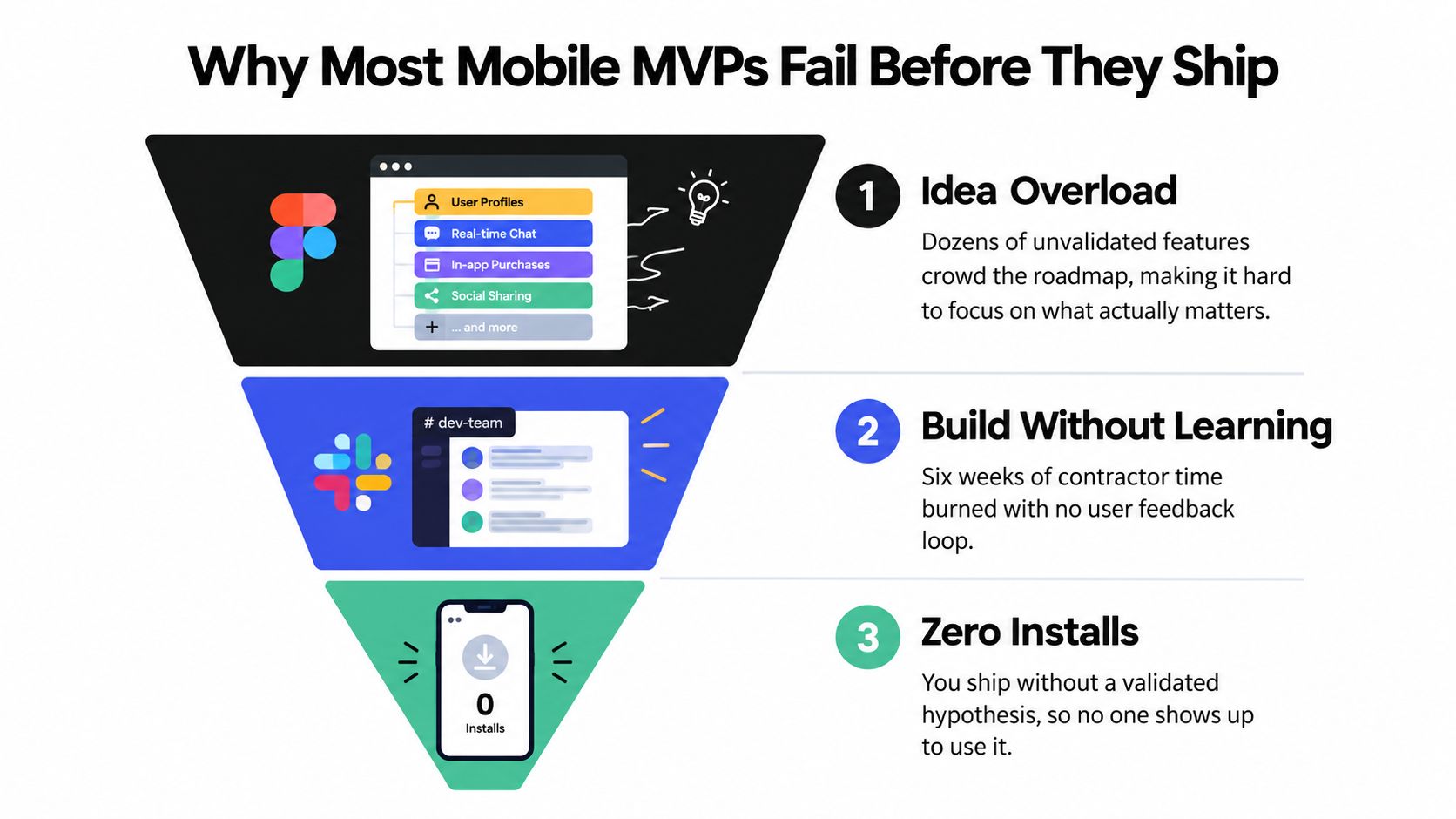
A founder opens a Figma board and sees a polished onboarding flow, a dashboard, push notifications, social login, subscriptions, and a feature card for every idea discussed in the team Slack channel. Six weeks of contractor time are already gone. The app still has zero installs, and nobody can answer the basic question, “Which user problem are we proving?”
That situation is common in mobile product work because teams confuse a smaller product with a learning product. A useful MVP isn't a compressed version of the final app. It's the smallest working experience that tests a meaningful assumption with real people, then gives the team enough evidence to decide what happens next.
Why Most Mobile MVPs Fail Before They Ship
The failure usually starts before engineering opens the repository. A founder describes the solution, the designer turns it into screens, and the team debates native versus cross-platform implementation before anyone has established whether the target user urgently needs the outcome. Each decision feels productive, but none of them reduces the central uncertainty.
A mobile MVP built this way becomes a container for opinions. The founder wants a marketplace, the sales lead wants accounts and referrals, the designer wants a complete brand system, and the engineer wants a clean architecture that can support every possible future. The team keeps adding because no one has written down the single assumption that the release must test.
The expensive mistakes happen upstream
The historical MVP development process was shaped to counter this exact behavior. Frank Robinson introduced the term “minimum viable product” in 2001, Steve Blank amplified the customer development approach in 2005, and Eric Ries popularized the method through The Lean Startup in 2011. This evolution matters because MVP thinking was designed as a structured way to validate assumptions before a team commits to scale, not as permission to ship an unfinished product. This historical account of the MVP strategy also connects the approach to the recurring market-need problem, with large startup analyses finding that about 42% of startups fail because they build something the market doesn't need.
Four patterns create most pre-launch waste:
- Solution-first thinking: The team starts with screens and feature requests instead of a painful, observable user problem.
- Audience guessing: Feedback comes from friends, internal stakeholders, or broad survey answers rather than people who regularly experience the problem.
- Platform-first decisions: Native, cross-platform, or no-code choices get debated before the team knows which workflow deserves investment.
- Speed worship: A fast build is treated as a successful build, even when it produces no useful learning.
Practical rule: Before code starts, write the assumption, the target user, the behavior that would confirm it, and the evidence that would disprove it.
The alternative is a five-phase loop: discovery, scope, build, measure, and iterate. Discovery finds the problem. Scope narrows the release to one meaningful journey. Build creates a usable test. Measurement reveals behavior. Iteration turns that evidence into a product decision.
A twelve-week roadmap can make this rhythm concrete, but only if the team protects learning from feature pressure. The right question isn't “How quickly can we finish the app?” It's “How quickly can we produce trustworthy evidence about whether this app should exist?”
Validating the Problem Before You Write a Line of Code
Start with one sentence that describes the user, the situation, and the unresolved problem. “Freelance designers need a faster way to approve client changes while traveling” is testable. “We're building a better collaboration platform” isn't.
Recruit people who match the target profile and ask them to describe what they do today. A practical interview can take around half an hour, but the important variable is the quality of the conversation, not the calendar slot. The mobile MVP discovery guidance recommends direct interviews with 15 to 20 people in the target profile and usability tests with 5 to 7 people. A separate benchmark reports that teams conducting 10 or more user interviews before building reached product-market fit within 12 months at a 41% rate, compared with 11% for assumption-based builds, a 3.7x difference. The benchmark on validation depth and MVP outcomes supports a simple operating principle: discovery isn't a ceremonial step. It changes the quality of the decisions that follow.
Ask about behavior, not approval
Desirability questions uncover urgency and existing behavior:
- “When did this problem last occur?”
- “What did you do instead?”
- “What made that workaround frustrating?”
- “How often does this situation interrupt your work?”
- “Who else is affected when it goes unresolved?”
Feasibility questions come later. They concern integrations, permissions, offline behavior, data sources, device constraints, and operational limits. Don't lead with “Would you use an app that does this?” People are generous with hypothetical approval and much less generous with repeated behavior.
Score each interview signal against two dimensions, severity and frequency. A problem that is severe but rare may support a specialist product. A frequent but minor annoyance may not justify switching behavior. Look for repeated stories, current workarounds, budget ownership, and evidence that users have already spent time or money trying to solve the issue.
Turn evidence into a falsifiable hypothesis
A useful hypothesis has four parts:
- User: the narrow early-adopter group.
- Problem: the situation they repeatedly encounter.
- Behavior: the action your MVP expects them to take.
- Success signal: the observable response that would justify another cycle.
For example: “Independent designers who review work on mobile will complete a client-approval flow without switching to email, and repeated use will indicate that the workflow solves a real coordination problem.” The team can then define its own activation and retention expectations before implementation, rather than moving the goalposts after launch.
| Discovery Input | Decision Output |
|---|---|
| Repeated user stories | A narrowly framed problem |
| Existing workarounds | Evidence of current demand and friction |
| Severity and frequency scores | A ranked pain point |
| Feasibility concerns | Constraints for the first workflow |
| User behavior the MVP should change | A measurable hypothesis |
| Evidence that would disprove the idea | A stop, pivot, or proceed condition |
The hypothesis becomes the filter for every later choice. If a feature doesn't help the target user experience the proposed value or help the team measure the assumption, it belongs outside the first release. That discipline prevents the mobile MVP development process from drifting back toward a full product plan.
Choosing What to Build and What to Cut
Scope discipline isn't a cost-cutting exercise. It's a way to keep cause and effect visible. If the first release contains several journeys, multiple audiences, and a long list of integrations, a weak result won't tell you what failed. A narrow release gives the team a cleaner interpretation of user behavior.
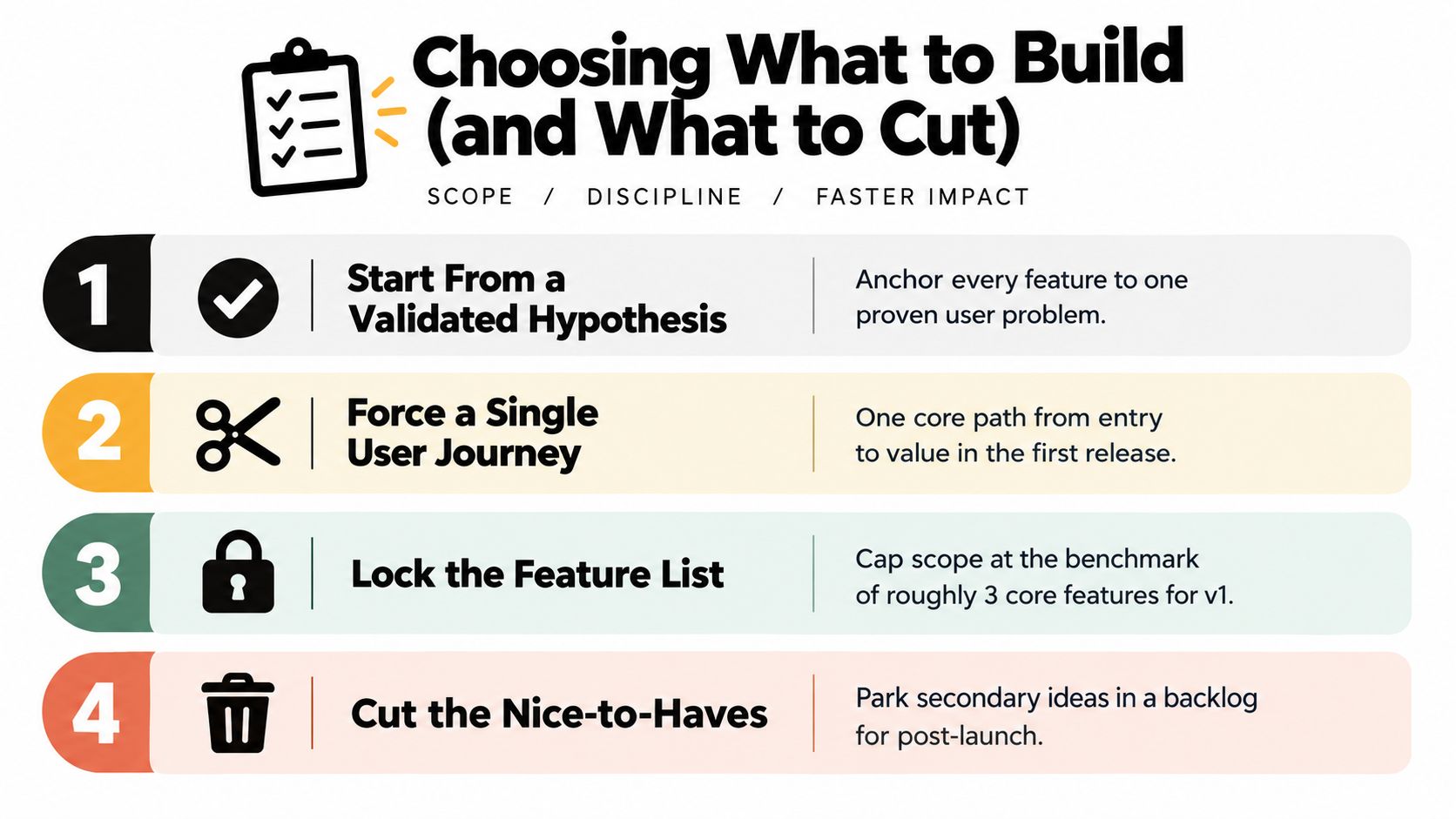
Start with the validated hypothesis and draw one journey from entry to value. For a meal-planning app, that might be “choose dietary constraints, receive a plan, save one meal, and generate a shopping list.” Community profiles, creator follows, referral rewards, and a recipe marketplace may all be plausible later. They don't belong in the first path unless the hypothesis depends on them.
The available benchmark data points in the same direction. Launches constrained to 8 or fewer core features reached product-market fit at 34%, compared with 18% for launches with 15 to 25 features and 12% for launches with 25 or more features. The same source reports that 60 to 70% of features in initial MVPs are never used by customers. The feature-scope benchmark is a useful corrective to the belief that a crowded first release looks more credible.
Use a ruthless prioritization test
MoSCoW works well when every category is tied to the hypothesis:
- Must have: Without it, the user can't complete the core journey or the team can't measure the result.
- Should have: It improves clarity or reduces friction, but the workflow can still produce learning without it.
- Could have: It adds convenience, polish, or personalization.
- Won't have now: It may be valuable later, but it competes with the current learning goal.
Then run a love-it-or-cut-it review. Ask the feature owner to explain exactly which user behavior it changes and which metric or interview question it informs. “Users asked for it” isn't enough. Users often request familiar features because they don't yet understand a new workflow, while the team has limited evidence that the feature changes adoption.
A written “not now” list protects the build. It lets the team preserve good ideas without allowing them to enter the sprint through casual Slack conversations. The first release should have a small, single-digit feature set, and every retained feature should map to a learning goal.
Use a scope calculator such as the RapidNative MVP scope calculator as a forcing function, not as a substitute for product judgment. The useful output isn't a perfect estimate. It's a visible conversation about what the team is choosing not to build.
A feature earns its place when removing it would prevent the team from testing the core assumption.
Once the list is locked, convert each retained item into a story, acceptance condition, analytics event, and test case. That turns scope into a sprint backlog rather than a wish list.
Building the Mobile MVP With the Right Team and Tools
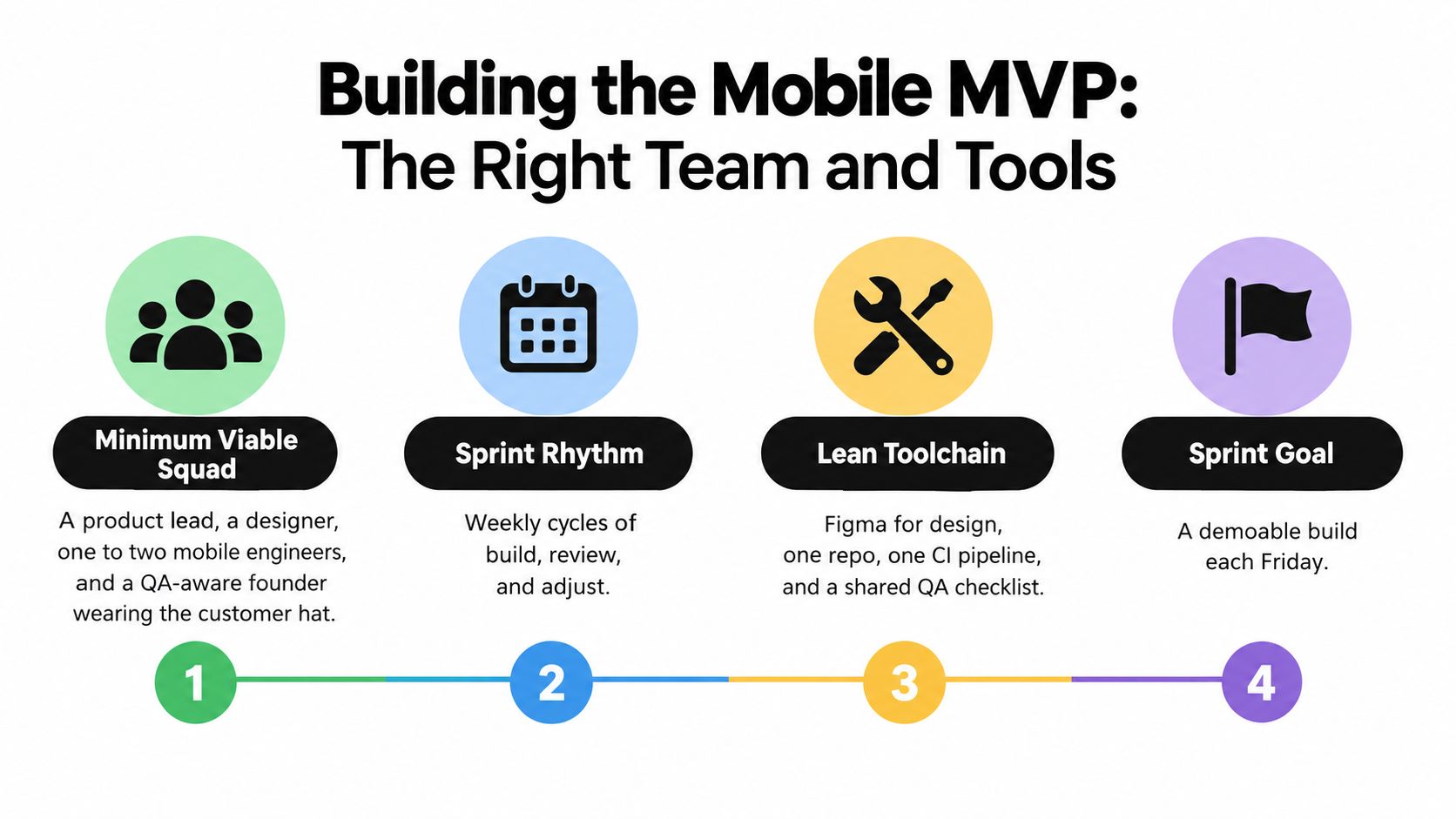
A lean mobile squad needs clear ownership more than it needs a large headcount. The minimum viable shape is a product lead who owns the hypothesis and decisions, a designer who owns the flows and interaction model, one or two mobile engineers who own implementation and technical trade-offs, and a founder who stays close to users and treats quality assurance as part of customer discovery.
The product lead should maintain the story map and decide when new requests are rejected. The designer should turn the single journey into a Figma flow with empty, loading, error, and success states. Engineers should agree on API contracts, data boundaries, authentication, analytics events, and the first TestFlight build before polishing secondary screens. The founder should test the app as a customer would, not just confirm that buttons technically work.
Structure the build as a working sprint
A focused build can run across four to eight weeks when discovery and scope are already settled:
- Scaffolding: Set up the repository, navigation, design tokens, authentication approach, environments, error logging, and analytics foundations.
- Vertical feature delivery: Build the riskiest end-to-end journey, including the interface, API behavior, persistence, empty states, and failure handling.
- Reliability and soft-launch preparation: Test on representative devices, resolve blockers, complete store materials, verify instrumentation, and prepare a controlled release.
Don't organize the work as “all screens first, backend later.” A vertical slice exposes integration and usability problems while the team can still change direction. Weekly cycles should end with a working build, a short review, and a decision about what changes in the next cycle.
Choose tools around reversibility
Native development with Swift for iOS or Jetpack Compose for Android gives deep platform control and can be the right choice when device capabilities, performance, or platform-specific behavior form part of the product risk. The trade-off is maintaining separate implementation paths when the team needs both platforms.
Cross-platform development with React Native or Flutter can reduce duplicated interface work and simplify a shared product surface. It still requires engineering judgment around native modules, build pipelines, permissions, performance, and store releases. Cross-platform doesn't remove complexity. It moves where that complexity appears.
AI-native builders are useful when the team needs to test interaction design before committing significant engineering time. RapidNative can turn a prompt, sketch, image, or PRD into an interactive React Native app flow, with exportable code for a team that wants to continue in its own repository. That makes it a prototyping and early-build option rather than a reason to abandon code ownership.
For teams that need additional engineering capacity, a curated resource such as Hire Developers can help founders compare developers and find support for the specific stack and stage they have selected. The hiring decision should follow the product risk, not precede it.
The mobile app development guide for startups is also useful for aligning product, design, and engineering around a constrained first release. Keep the toolchain lean: Figma, one source repository, one CI pipeline, one issue tracker, and a shared QA checklist are usually easier to manage than a collection of disconnected systems.
Measuring Learning and Iterating After Launch
Launch day doesn't validate the product. It creates the conditions for validation. The team needs instrumentation that connects a user's first meaningful action to later behavior, plus enough qualitative context to explain why people stop.
A practical mobile MVP dashboard should include:
- Activation rate: The share of new users who complete the first value-producing action.
- Day 1 and Day 7 retention: Whether users return after the first experience and after the first week.
- Session length and core-action frequency: Whether users engage with the workflow rather than merely opening the app.
- Crash-free sessions: Whether technical failures prevent the intended behavior.
- Early cohort revenue: Whether the target users show willingness to pay, when monetization is part of the hypothesis.
The guidance on actionable Lean Startup metrics recommends engagement, retention, conversion, and cohort analysis rather than vanity totals such as overall users or page views. Instrument the core journey before adding a broad event taxonomy. Session replay, a short in-app survey, support conversations, and follow-up interviews can explain a retention drop that analytics alone can't diagnose.
Set decisions before the numbers arrive
A threshold should be specific to the hypothesis and written before launch. Rather than borrowing a universal benchmark, define what “healthy enough to continue” means for this audience, what would trigger a scope change, and what result would make the team stop or pivot.
| Metric | Definition | Healthy MVP Threshold | Action if Below |
|---|---|---|---|
| Activation rate | New users completing the core value action | A predefined level that shows the first journey is understandable | Review onboarding, first-run friction, and the value proposition |
| Day 1 retention | Users returning after the initial session | A predefined signal of immediate usefulness | Interview activated and inactive users separately |
| Day 7 retention | Users returning after the first week | A predefined signal of repeated value | Test whether the problem is recurring or only situational |
| Session length | Time spent completing the intended workflow | Enough time to finish the task without avoidable friction | Inspect task completion and confusing screens |
| Crash-free sessions | Sessions without a crash | Stable enough that failures don't distort learning | Fix release blockers before changing product scope |
| Early cohort revenue | Revenue associated with an identified user cohort | Evidence consistent with the monetization hypothesis | Revisit pricing, payment friction, or willingness to pay |
Review the dashboard weekly, maintain a hypothesis log, and change one meaningful scope area at a time. The user feedback integration approach can support a tighter connection between in-app feedback and the product decisions that follow.
The alternative is “ship and pray.” The team checks dashboards for months, collects disconnected feature requests, and makes no explicit decision. The Build, Measure, Learn loop works only when measurement ends in a choice to improve, change, stop, pivot, or persevere. Tilburg University's Lean Startup toolbox describes this repeated cycle as a way to tune a product and validate or kill ideas in weeks rather than months.
A Realistic 12-Week Mobile MVP Roadmap
A useful roadmap protects the order of decisions. Discovery comes before scope, scope before implementation, and instrumentation before launch. If the team reverses that order, later weeks become expensive attempts to recover missing evidence.
Weeks 1 and 2 for discovery
Interview the target users, document current workarounds, write the problem statement, and identify the behavior that would confirm the opportunity. End this phase with a written hypothesis, a target user definition, and a clear condition for proceeding.
Weeks 3 and 4 for scope
Map the single user journey, cut the feature list to 8 or fewer core features, and create the essential flows in Figma. Resolve the riskiest usability questions with clickable prototypes. Anything that doesn't support the hypothesis goes into the not-now list.
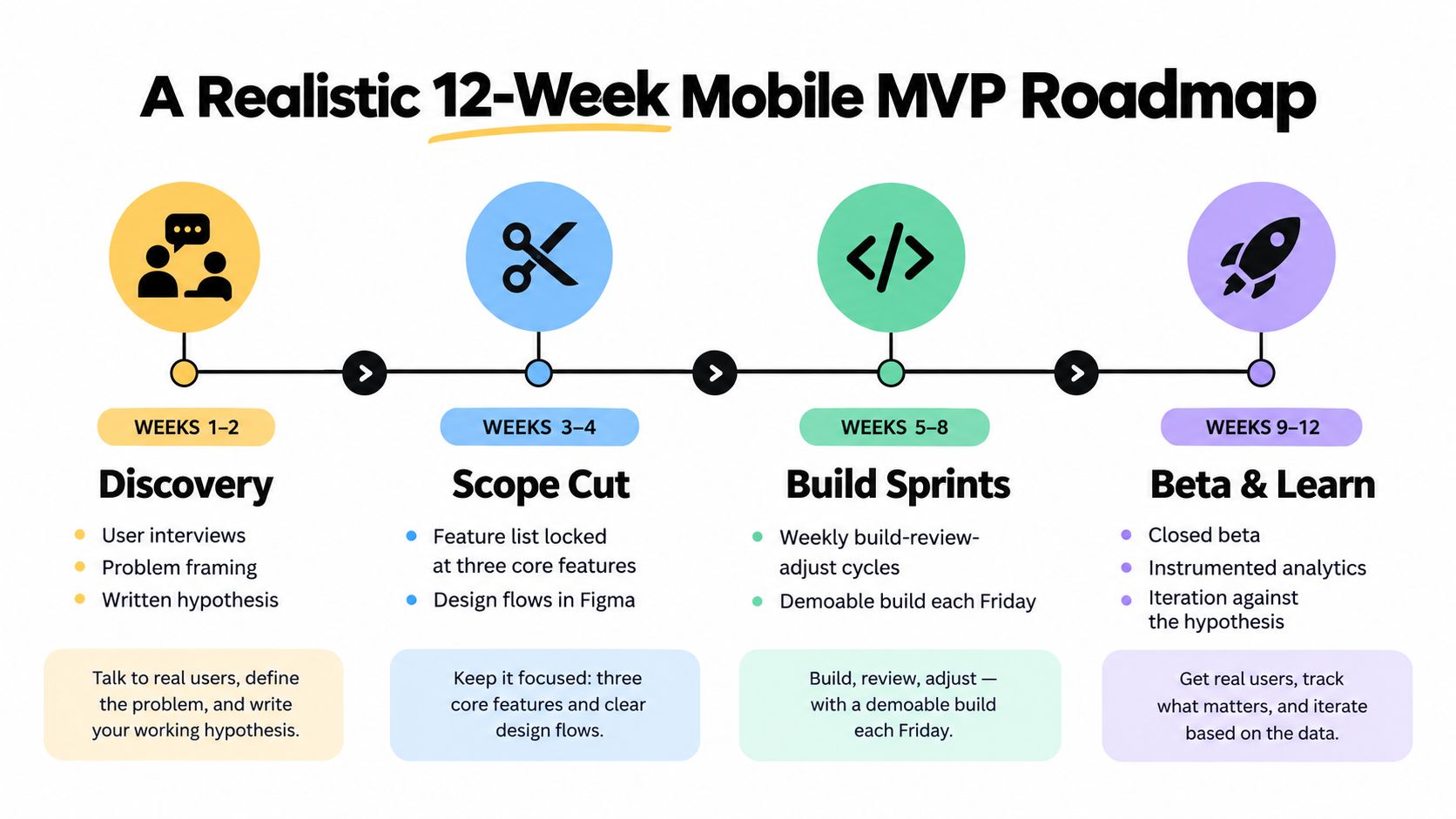
Weeks 5 through 8 for build sprints
Set up the chosen stack, build the highest-risk vertical flow, and review a usable build every week. Use RapidNative to prototype the riskiest interaction before committing native engineering time when that can expose a design or workflow problem earlier. Keep API contracts, analytics events, error states, and device testing in the sprint rather than leaving them for the final week.
Weeks 9 and 10 for dogfooding
Put the app through internal use, distribute a TestFlight build, verify the analytics events, and test the complete core journey on representative devices. Fix crashes, blocked tasks, misleading copy, and broken recovery states before inviting external users.
Week 11 for a controlled soft launch
Release to a deliberately selected early-user cohort that matches the target profile. Watch activation, retention, technical stability, qualitative feedback, and any monetization signal tied to the hypothesis. Don't broaden distribution merely because the store build is available.
Week 12 for the decision
Review the cohorts, replay the key sessions, compare results with the prewritten thresholds, and document a go or no-go decision. The next cycle might improve the existing journey, change the hypothesis, narrow the audience, or end the product. Each is a valid outcome when the team can explain what the evidence means.
The strongest MVP teams don't measure success by how many features reached production. They measure whether each cycle removed uncertainty and produced a sharper product decision.
RapidNative lets you turn a prompt, sketch, image, or PRD into an interactive React Native flow, preview it with teammates, and export modular code for continued engineering work. Use RapidNative to prototype the riskiest mobile journey early, test it with real users, and keep the twelve-week MVP roadmap focused on learning rather than feature accumulation.
Ready to build your app?
Turn your idea into a production-ready React Native app in minutes.
Free tools to get you started
Free AI PRD Generator
Generate a professional product requirements document in seconds. Describe your product idea and get a complete, structured PRD instantly.
Try it freeFree AI App Name Generator
Generate unique, brandable app name ideas with AI. Get creative name suggestions with taglines, brand colors, and monogram previews.
Try it freeFree AI App Icon Generator
Generate beautiful, professional app icons with AI. Describe your app and get multiple icon variations in different styles, ready for App Store and Google Play.
Try it freeFrequently asked questions
What is RapidNative?
RapidNative is an AI-powered mobile app builder. Describe the app you want in plain English and RapidNative generates real, production-ready React Native screens you can preview, edit, and publish to the App Store or Google Play.
Can I export the code?
Yes. RapidNative generates clean React Native and Expo code that you can export at any time. No lock-in, no proprietary format. Hand it to your developers or keep building inside RapidNative.
Is RapidNative free to use?
Yes. You can build apps on the free plan with no credit card required. Paid plans unlock unlimited AI generations, code export, and direct publishing to the App Store and Google Play.
Do I need to know how to code?
No. Most users build apps by describing what they want in plain English. Developers can drop into the code whenever they want more control, but coding is optional.
How long does it take to build an app?
Most users have a working first screen in under a minute. A full MVP usually takes a few hours instead of the weeks or months traditional development requires.