MVP vs Prototype vs POC Explained for Product Teams
Confused by mvp vs prototype vs poc? Compare definitions, goals, and when to use each to validate your mobile product faster with less risk.
By Sanket Sahu
17th Sep 2026
Last updated: 17th Sep 2026
You're deciding what to build for a mobile product, and the terminology is already slowing the team down. A developer wants to test an integration, a designer wants to validate the onboarding flow, and a founder wants evidence that customers will use the app. Someone suggests building an MVP, but nobody has agreed on which risk needs an answer first.
That's where MVP vs prototype vs PoC becomes a practical product decision rather than a vocabulary exercise. A proof of concept tests whether the technology can work, a prototype tests how the experience works, and an MVP tests whether real customers will adopt the product. The right choice is the smallest artifact that answers your most dangerous unanswered question.
Why Teams Confuse POC Prototype and MVP
A founder can spend weeks building a polished mobile MVP before discovering that a critical payment, identity, mapping, or AI integration won't behave reliably. Another team can produce a beautiful clickable prototype, present it to stakeholders, and mistake positive reactions for evidence that customers will return to the product. Both teams have built something, but neither has tested the assumption that could still kill the idea.
The confusion happens because all three artifacts can look like “an early version of the app.” A PoC might contain working code, a prototype might run on a phone, and an MVP might still have rough edges. Visual appearance and technical sophistication don't tell you which category an artifact belongs to. The intended learning does.
For mobile teams, the cost of choosing badly appears in different ways:
- An overbuilt PoC creates throwaway code that nobody needs to polish.
- An overpolished prototype absorbs design and engineering time without producing live adoption evidence.
- An under-scoped MVP reaches users before the core technical or experience risks are understood.
- A feature-heavy MVP delays the feedback that justified building it in the first place.
Independent software-project research cited by DesignRush reports that 31.1% of software projects fail and 52.7% go over budget, figures that help explain why teams use early validation to reduce technical and execution risk. The broader lesson isn't that every project must follow a rigid sequence. It's that each investment should buy a specific kind of evidence. (DesignRush's overview of proof-of-concept development)
Practical rule: Don't ask, “Should we build a PoC, prototype, or MVP?” Ask, “What could make this product fail, and what is the cheapest credible way to test it?”
For a mobile product, that question might point to a small API experiment, a clickable onboarding flow, or a limited live release. The sections below use that decision lens, with comparisons and concrete scenarios that work for founders, product managers, designers, and developers.
What POC Prototype and MVP Really Mean
A mobile team deciding what to build first should begin with the riskiest question, not a fixed sequence. The right artifact depends on the evidence needed for the next decision.
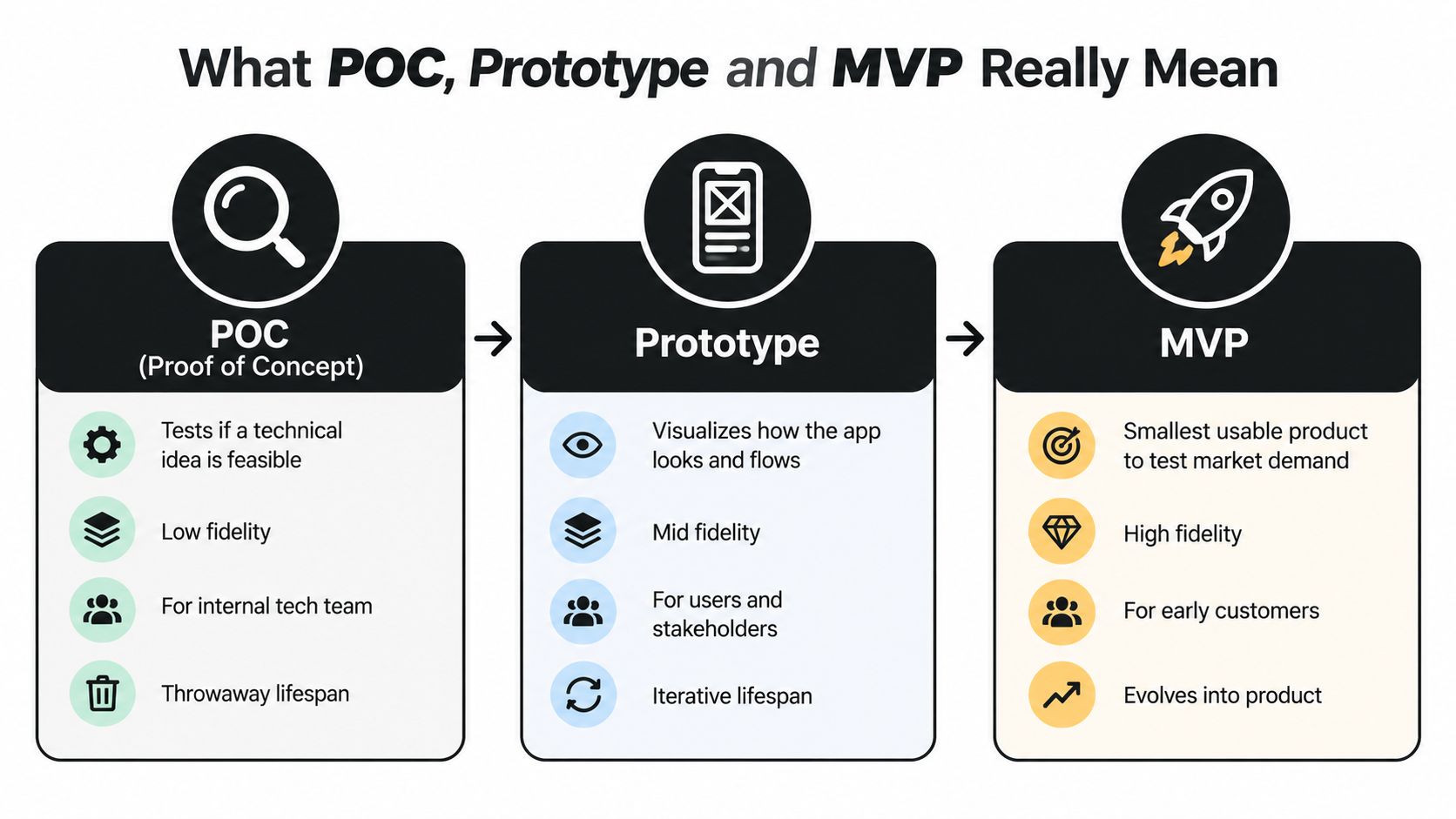
A proof of concept, or PoC, tests technical feasibility. It answers, “Can this specific approach work at all?” The output may be a script, narrow integration, or minimal code with no user-facing polish. For a mobile app, a developer might test whether a phone can stream sensor data to a backend, whether an AI service can classify an image, or whether two external systems can exchange the required data. A PoC can save weeks by exposing a technical limitation before the team builds the surrounding product.
A prototype tests the product experience. It asks, “Can people understand and use this idea?” A prototype is often a clickable set of mobile screens using simulated data, with little or no backend. Founders, product teams, stakeholders, or selected users review it, then the team changes screens and flows based on what they learn. Its value lies in testing interaction decisions quickly, not in supporting real customer operations.
An MVP, or minimum viable product, tests market demand through a usable release. It answers, “Will real customers use this solution, and does it create business value?” The product needs enough working functionality for users to complete the core task. It can be deliberately limited, but it cannot be only screens or a technical demo. (TechMagic's comparison of PoC, prototype, and MVP)
Why MVP means more than version one
The modern MVP concept was coined in 2001 by Frank Robinson and later popularized by Eric Ries. Ries's 2011 book The Lean Startup made MVP part of the “build-measure-learn” practice for testing market demand with limited effort. That history separates an MVP from a prototype. An MVP learns from actual customers, while a prototype explores feasibility, interface decisions, or both. (Minimum viable product history and definition)
The distinction affects planning. Calling a clickable Figma flow an MVP can make stakeholders expect market evidence it cannot produce. Calling a live functional release a prototype can lead the team to underinvest in reliability, support, analytics, and the operational work required by real users.
Use this shorthand:
- PoC: Can we build the risky technical part?
- Prototype: Can users understand and use the proposed experience?
- MVP: Will real users adopt the smallest useful product?
These are risk-based choices, not mandatory stages. If an artifact cannot produce the signal required for the decision, its polish does not make it the right artifact.
Detailed Comparison Across Goals Timeline and Fidelity
The right artifact depends on the evidence the team needs next. A PoC, prototype, and MVP can all support product learning, but each exposes a different risk and creates a different level of responsibility.
POC vs Prototype vs MVP Comparison Matrix
| Criteria | POC | Prototype | MVP |
|---|---|---|---|
| Primary goal | Validate technical feasibility | Validate interaction, usability, and flow | Validate demand, adoption, and business value |
| Question answered | Can this be built? | Will users understand how it works? | Will real customers use it? |
| Typical fidelity | Low, often minimal or throwaway code | Low to medium, often clickable or simplified screens | High enough to support a real customer task |
| Backend and integrations | Only the narrow technical element under investigation | Often simulated or incomplete | Core production-like functionality is live |
| Main audience | Developers and technical stakeholders | Designers, PMs, founders, stakeholders, and test users | Early customers in a live environment |
| Typical lifespan | Short-lived experiment | Iterative design artifact | Evolves into the product or is replaced |
| Success signal | Feasibility evidence or a clear technical limitation | Usability and experience feedback | Usage behavior, adoption, retention, conversion, or repeat use |
A PoC is optimized for feasibility validation. It usually has no user-facing polish because the team is testing whether a difficult technical element can work. A prototype focuses on interaction and usability, often through clickable or simplified screens with little or no backend. An MVP is a production-like release that delivers core functionality to real users and measures adoption and business value. See TechMagic's technical distinction between the three artifacts for a concise comparison.
Fidelity is a decision tool, not a quality score. A high-fidelity prototype may help test a complicated onboarding experience, while rough screens may be enough to compare navigation patterns. A polished PoC can still miss its purpose if visual work distracts from the technical hypothesis. An MVP can remain visually simple while giving users a complete way to finish the core task.
The signal determines the artifact. Feasibility evidence comes from a PoC, experience evidence comes from a prototype, and real-use evidence comes from an MVP.
Timeline follows scope rather than the label. A narrow PoC may be quick, while a complex integration can require careful testing across permissions, data handling, and failure cases. A prototype can move quickly when it includes only the screens needed for a specific decision. An MVP takes on more responsibility because customers rely on it to complete a real job.
The main trade-off is commitment. A PoC limits technical commitment, a prototype limits product-design commitment, and an MVP accepts enough technical and operational commitment to support live usage. Those commitments should match the uncertainty being tested. Building an MVP to answer a feasibility question creates avoidable work. Using a prototype to claim market demand produces weak evidence.
For a mobile-focused comparison of these choices, read this guide to proof of concept versus prototype. RapidNative can also compress the path from an interaction idea to a testable mobile build, but the team still needs to choose the artifact based on its riskiest assumption.
Real World Use Cases for Mobile Product Teams
Mobile product decisions become clearer when the artifact is attached to a concrete risk. The following scenarios show what each choice can reveal, and where it becomes unnecessary.

Use a PoC for a risky integration
Suppose a wellness app needs to combine phone motion data with a third-party health platform. The product team doesn't yet know whether the required permissions, data format, and synchronization behavior will work together. Building the full app would hide the important question beneath navigation, profile screens, settings, and visual design.
A focused PoC should test only the integration path. The developer can request the relevant permission, retrieve a representative data point, send it through the intended service, and inspect the response. The output might be a small demo or a written limitation, not a shippable mobile experience. If the connection fails, the team has avoided committing to a product architecture built around an unavailable capability.
The same logic applies to an AI feature that needs to process images from a phone camera. The PoC should test the model call, response shape, latency, and failure handling that could affect feasibility. It doesn't need onboarding, polished empty states, or a complete account system.
Use a prototype for a confusing flow
Consider a medication-tracking app with reminders, schedules, refill status, and records. The technical stack may be familiar, but the team doesn't know whether users will understand how to add a medication and confirm a dose. A clickable prototype can represent the screens and relationships between app components without requiring the full backend.
That structure is particularly useful on mobile, where navigation, touch targets, permission prompts, and limited screen space shape the experience. Prototypes are often clickable screens that show relationships between app components and represent features, while PoCs focus on whether the chosen technology stack can implement the intended functionality. (GeeksforGeeks' mobile-focused comparison)
The prototype succeeds when users reveal that a label is unclear, a flow has too many decisions, or the primary action is hard to find. It's overkill when the user journey is already well understood and the only unresolved issue is whether a backend service can support it.
Use an MVP for adoption uncertainty
Now take a local services app that helps customers request one specific type of appointment. The core market question is whether people will complete the request and return when they need the service. A prototype can demonstrate the experience, but only a functional MVP can expose the product to actual usage and show whether the service solves a meaningful problem.
The MVP should support the smallest complete journey, such as account creation, service selection, appointment request, and confirmation. It doesn't need every provider category, notification preference, or administrative feature. It does need a trustworthy path from intent to outcome, because broken core functionality produces noise instead of useful market learning.
You can find more concrete patterns in these mobile MVP examples, but the operating principle stays the same. Match the artifact to the risk, then remove anything that doesn't help answer it.
How to Choose the Right Artifact for Your Riskiest Assumption
Begin with the assumption that would invalidate the product fastest. Not every unknown deserves a separate artifact, and not every team needs to complete the classic sequence in order.
Ask three questions:
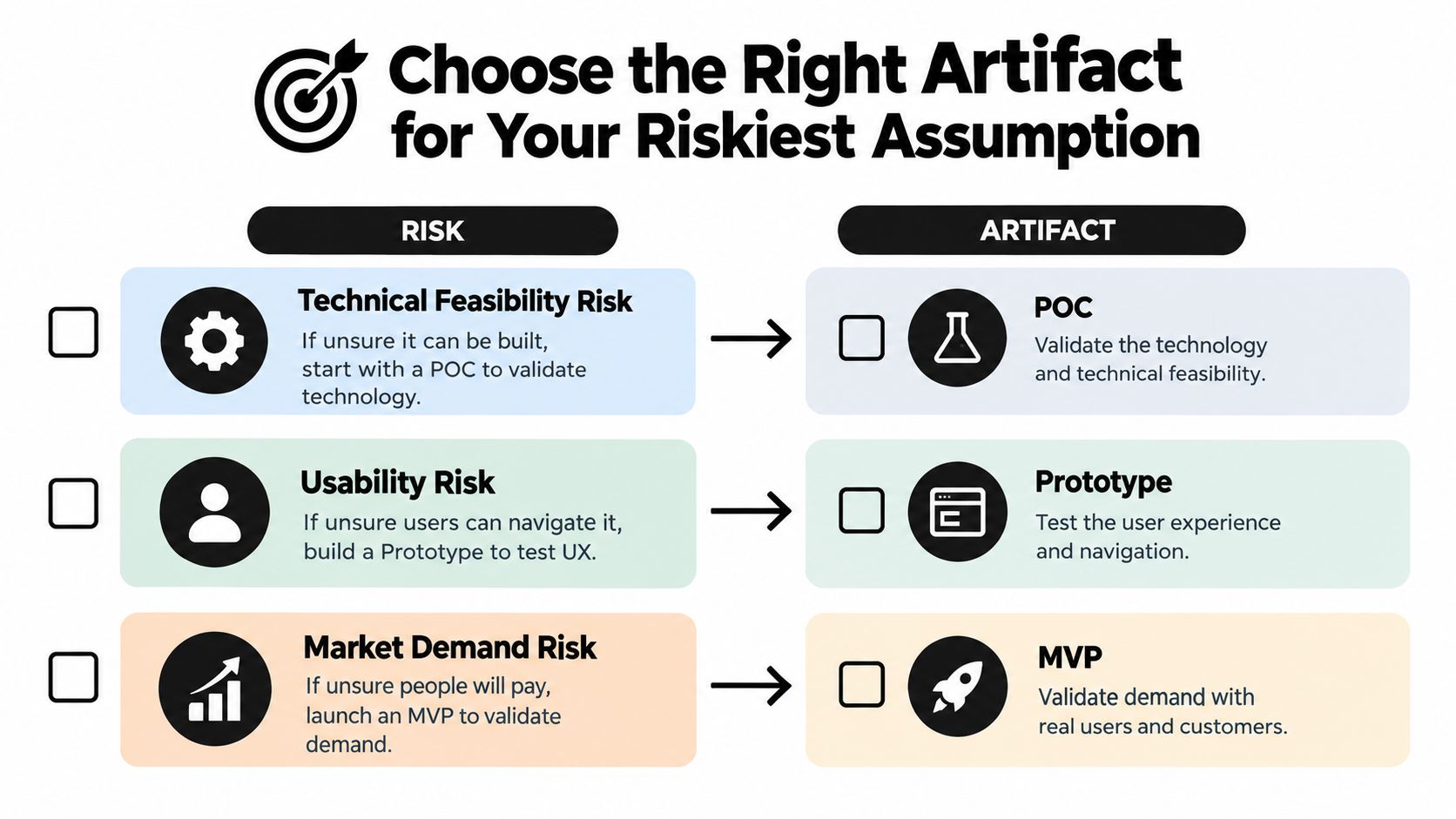
- Technical feasibility: Are we unsure that a key integration, algorithm, device capability, or infrastructure approach can work?
- Usability: Are we unsure that users will understand the workflow, navigation, or value proposition?
- Market demand: Are we unsure that real customers will use, pay for, or return to the product?
The answer maps to the minimum useful artifact. Technical uncertainty points to a PoC. Experience uncertainty points to a prototype. Demand uncertainty points to an MVP. If two risks are equally severe, combine only the parts needed to test both. Don't build a complete product merely because the risks overlap.
A practical decision filter
Use this checklist before assigning work:
- Name the assumption: Write the belief in one sentence, such as “The phone can send usable location data while the app runs.”
- Define the evidence: Decide what result would support continuing and what result would stop or change the approach.
- Remove unrelated scope: Exclude branding, secondary settings, extra screens, and edge cases that don't affect the test.
- Choose the audience: Developers for a PoC, stakeholders or test users for a prototype, and real customers for an MVP.
- Set the next decision: Decide what you'll do if the artifact succeeds, fails, or produces ambiguous feedback.
The classic PoC to prototype to MVP sequence can break down in AI-native product work. A prototype may be partially functional, a PoC may be user-facing, and an MVP may need live integrations from the first release. Recent product-validation guidance highlights that teams may need all three signals earlier because AI-native builders compress the time between idea, code, design, and feedback. (Pharos on PoC, prototype, and MVP for AI-native product work)
That doesn't make the terms useless. It makes the risk test more important than the label. A mobile team might build a functional AI interaction inside a prototype to test trust and comprehension, then retain that interaction in an MVP while the team continues validating reliability. The artifact can serve multiple purposes, but its success criteria must stay explicit.
Build the smallest thing that can falsify your riskiest assumption.
Accelerating Each Stage With RapidNative
The fastest workflow isn't always “skip straight to MVP.” It's reduce the cost of learning at each stage while keeping the evidence honest.
For a PoC, keep the technical experiment narrow. A developer can test a single integration or capability without building the full navigation system. The team should record what worked, what failed, and what constraints the production implementation would need.
For a prototype, start with the experience that carries the most usability risk. A product manager or designer can describe the mobile flow, provide a sketch or screenshot, or turn a product requirements document into an interactive starting point. The team can then review navigation, screen hierarchy, and component behavior before asking engineers to harden the implementation.
RapidNative supports prompt-to-app, image-to-app, PRD-to-app, and whiteboard-to-app workflows for generating shareable React Native interfaces. It uses React Native, Expo, and NativeWind, renders screens and navigation in a live preview, supports link or QR sharing, and allows clean code export for engineering handoff. That makes it applicable to interactive prototype work and to an MVP foundation when the generated flows include the functionality the team needs to validate.
Use the workflow deliberately:
- Start from the risk. Describe the one flow or capability that needs evidence.
- Generate the narrowest useful app. Keep unrelated screens out of the first iteration.
- Share the live preview. Let teammates and selected testers interact with the same mobile flow.
- Capture decisions. Convert feedback into specific changes, not a general request to “make it better.”
- Export and hand off. Preserve the React Native code when the experiment becomes engineering work.
The tool can compress the path from a sketch to a working interface, but it doesn't turn a prototype into market evidence automatically. Users must still interact with a live MVP, and the team must still interpret the resulting behavior.
Recommendations and Next Steps for Founders PMs and Developers
Founders should start with the assumption that could eliminate the business. If the question is whether customers want the solution, plan an MVP. If a novel technical dependency could block delivery, fund a focused PoC first. Don't use a polished prototype as a substitute for customer behavior.
Product managers should write the learning objective beside every artifact in the roadmap. A prototype milestone should produce decisions about flow and usability. An MVP milestone should produce evidence from real usage. That distinction keeps teams from measuring the wrong outcome.
Designers should prototype the moments where comprehension matters most, especially onboarding, permissions, search, checkout, or the first successful task. Developers should challenge hidden feasibility assumptions early and make the handoff explicit, including which parts are exploratory and which parts are intended to survive into the product.
The operational split is straightforward. A PoC produces feasibility evidence, a prototype produces experience evidence, and an MVP produces real-use evidence. Prototypes generally support internal or stakeholder feedback, while MVPs run in live environments where teams can examine behavior such as retention, conversion, and repeat use. This makes the MVP the only one of the three intended to expose product decisions to real usage metrics. (Designveloper's validation-signal comparison)
Choose one artifact this week. Write the riskiest assumption, define the evidence that would change your plan, and remove every feature that doesn't contribute to that test. Then assign ownership, share the result with the right audience, and make the next product decision while the learning is still fresh.
RapidNative helps product teams turn prompts, sketches, images, whiteboards, or PRDs into shareable React Native apps for prototyping and MVP validation. Visit RapidNative to create a focused mobile flow, preview it with your team, and export clean code when the experiment is ready for engineering.
Ready to build your app?
Turn your idea into a production-ready React Native app in minutes.
Free tools to get you started
Free AI PRD Generator
Generate a professional product requirements document in seconds. Describe your product idea and get a complete, structured PRD instantly.
Try it freeFree AI App Name Generator
Generate unique, brandable app name ideas with AI. Get creative name suggestions with taglines, brand colors, and monogram previews.
Try it freeFree AI App Icon Generator
Generate beautiful, professional app icons with AI. Describe your app and get multiple icon variations in different styles, ready for App Store and Google Play.
Try it freeFrequently asked questions
What is RapidNative?
RapidNative is an AI-powered mobile app builder. Describe the app you want in plain English and RapidNative generates real, production-ready React Native screens you can preview, edit, and publish to the App Store or Google Play.
Can I export the code?
Yes. RapidNative generates clean React Native and Expo code that you can export at any time. No lock-in, no proprietary format. Hand it to your developers or keep building inside RapidNative.
Is RapidNative free to use?
Yes. You can build apps on the free plan with no credit card required. Paid plans unlock unlimited AI generations, code export, and direct publishing to the App Store and Google Play.
Do I need to know how to code?
No. Most users build apps by describing what they want in plain English. Developers can drop into the code whenever they want more control, but coding is optional.
How long does it take to build an app?
Most users have a working first screen in under a minute. A full MVP usually takes a few hours instead of the weeks or months traditional development requires.