What is React Native? A Founder's Guide to Building Mobile Apps Faster
what is react native? Discover how this framework lets you write once for iOS and Android, its advantages, drawbacks, and when to choose it.
By Sanket Sahu
11th Feb 2026
Last updated: 11th Feb 2026
So, what exactly is React Native? In simple terms, it's a game-changing framework from Meta that lets your team build a mobile app for both iOS and Android from a single codebase. The magic is that it uses a language many web developers already know: JavaScript.
This "write once, run anywhere" approach means you can create an app that looks and feels completely at home on an iPhone or an Android device without the cost and complexity of managing two separate development projects.
Building Native Apps Without Writing Native Code
Imagine you're building a new product. Traditionally, you’d need two separate teams: one that speaks Swift (for Apple's iOS) and another that speaks Kotlin (for Google's Android). They would use different tools and work independently, essentially doubling your cost, effort, and time to launch.
React Native acts as a universal translator. Your team writes one set of instructions in JavaScript, and React Native translates those instructions into the genuine building blocks that iOS and Android understand. The result isn't a clunky website squeezed into an app; it's a real, high-performance mobile application that users will love.
Here’s a quick breakdown of what React Native offers.
React Native at a Glance
| Attribute | Description |
|---|---|
| Core Language | JavaScript (using the popular React library) |
| Target Platforms | iOS & Android (from a single codebase) |
| Developed By | Meta (Facebook) |
| User Interface | Renders to real native UI components, not slow web views |
| Key Benefit | Faster time-to-market, lower development costs |
| Community | Massive, active open-source community for support |
This table captures the core value for any team looking to build and scale a mobile product efficiently.
The Strategic Advantage for Product Teams
For founders, product managers, and designers, this unified approach is a massive strategic advantage. It means you can design, build, and launch on both the Apple App Store and Google Play Store simultaneously, dramatically shortening your time-to-market. This isn't just a niche tactic; it’s a dominant force in the industry.
As of 2025, React Native commands a 41.6% adoption rate among professional developers and sees a staggering 22 million weekly downloads. Its credibility is also clear on GitHub, where its repository has over 207,000 stars, making it one of the platform's most-followed projects. If you want to dive deeper, check out this comprehensive analysis of React Native statistics.
The core benefit is simple but powerful: one team, one codebase, two platforms. This leads to faster development cycles, lower costs, and a more consistent user experience across devices.
This unified process empowers your entire team. It simplifies development, streamlines testing, and shrinks the timeline from idea to a finished product in your users' hands. It's a key reason why so many companies rely on mobile cross-platform development for their app strategy. For any team looking to build efficiently, understanding React Native is the perfect starting point.
How React Native Actually Works Under the Hood
To really grasp React Native's value, you need a quick look at how it operates. The framework is essentially a brilliant translator, taking the JavaScript code your team writes and making it speak fluently to both iOS and Android. So, how does that conversation happen?
Originally, everything relied on something called the JavaScript Bridge. Imagine a single messenger running back and forth over a bridge. On one side, you have your app's logic written in JavaScript. On the other, you have the phone’s native components—the camera, GPS, or the UI elements that make an app feel like it belongs on that device.
Whenever your app needed to render a button, the JavaScript side would send a message across the bridge. The native side would perform the action and send a message back. It worked, but this back-and-forth could create traffic jams, slowing things down, especially with complex animations.
The Modern, Faster Architecture
Thankfully, React Native has evolved. Meta introduced a new architecture that replaces the old bridge with a much more direct and efficient system.
- JavaScript Interface (JSI): Instead of a messenger, think of the JSI as a shared workspace. It allows JavaScript and the native side to communicate directly and instantly. This eliminates the message-passing delay, making apps feel incredibly snappy and responsive.
- Hermes Engine: This is a custom JavaScript engine from Meta, designed specifically for React Native. It helps your app start faster, use less memory, and run your code with maximum efficiency on mobile devices.
The new architecture is a game-changer. By opening a direct line of communication, React Native delivers an experience that feels virtually indistinguishable from a fully native app built by separate teams.
This concept map illustrates the core value: one set of code instructions produces two distinct, native applications.
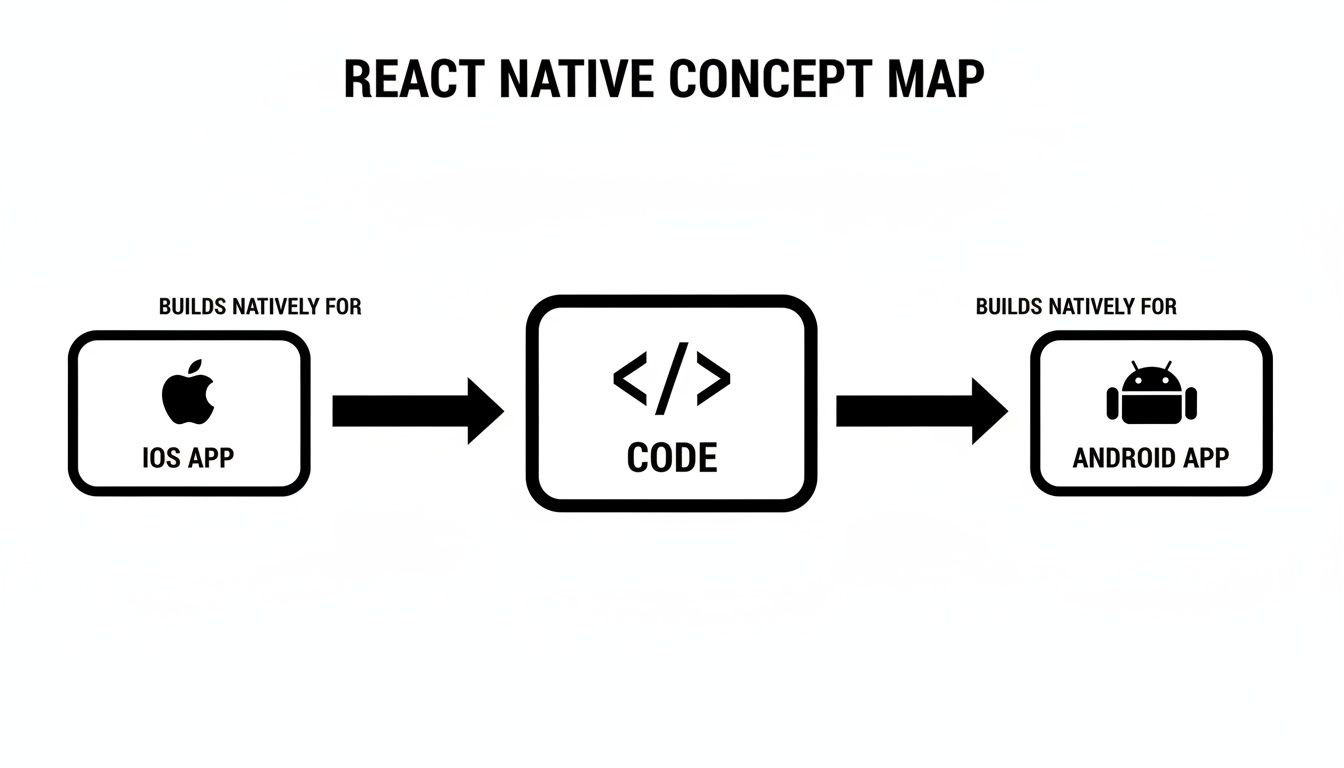
It’s a clear visualization of the "write once, run anywhere" philosophy in action.
Simplifying the Workflow with Expo
While the core technology is powerful, getting a project started used to involve wrestling with complex native tools like Xcode and Android Studio. This is the problem Expo solves.
Expo is a platform built on top of React Native that smooths out the entire development process. It bundles everything you need—from a massive library of pre-built native modules to a simple cloud build service—into one cohesive workflow.
Using Expo, your team can build, share, and test an app without ever touching a line of native code or complex configuration files. This makes React Native app development incredibly accessible, allowing teams to focus on what matters: building a great product.
Real-World Examples of React Native in Action
Theory is one thing, but seeing technology trusted by industry giants gives you the confidence to bet on it. React Native isn’t just for small startups; it's a battle-tested framework that powers some of the most-used apps on the planet.
These companies made a calculated business decision to use React Native to unify development, ship features faster, and deliver a consistent user experience to millions of people.

Why Top Companies Bet on React Native
Let's look at the business reasons why these companies chose React Native. Their stories show how the framework solves real problems at a massive scale.
-
Discord: The popular communication app is a classic success story. By adopting React Native, their relatively small mobile team managed to share an incredible 98% of their code between the iOS and Android apps. This is the kind of efficiency that lets you build a complex, high-performance product without a huge engineering team.
-
Shopify: As a global e-commerce leader, reliability is everything. Shopify relies on React Native for its main mobile commerce platform—the app that millions of merchants use to run their businesses every day. This proves the framework can handle mission-critical functions where performance and stability directly impact revenue.
-
Meta: The creators of React Native use it extensively in their own flagship apps, including Instagram and Facebook. This shows how seamlessly the framework can be integrated into massive, existing apps to build new features quickly and deliver smooth experiences to billions of users.
When the biggest names in tech embrace a framework, it sends a clear signal. React Native is a mature, enterprise-ready solution that can handle complex, large-scale apps without compromising on quality or performance.
Trusted Across Every Industry
React Native’s appeal isn't limited to tech and e-commerce. Its wide adoption proves its value in building production-grade applications at scale, with a verified user base of over 18,800 companies.
Big players like Amazon, Microsoft, Walmart, and IBM all have React Native in their tech stacks. This solidifies its place as a go-to choice for building modern mobile experiences. You can dive deeper into the data and see a full list of companies using the framework on data.landbase.com's React Native page.
This broad trust is the ultimate social proof. Whether you're a founder launching an MVP or a product manager scaling an established app, you can be confident that React Native is a solid foundation for your mobile strategy.
No tool is perfect, and making the right call means taking an honest look at where React Native shines and where you might need something else. For anyone steering a product, this balanced perspective is critical.
Let's break down the real-world trade-offs you'll be making, so you can see if React Native fits what you're trying to build.
The Clear Advantages of React Native
The biggest win with React Native is its core promise: build for both iOS and Android from a single codebase. This is a massive strategic advantage. For a startup launching an MVP, it means hitting both App Stores at once instead of leaving half the market waiting.
This core benefit leads to several others:
- Faster Development Speed: When you aren't writing every feature twice, you move faster. In a world where speed to market is everything, this is a huge deal.
- Significant Cost Savings: The math is simple: one development team instead of two. One codebase to maintain. This means fewer salaries and less overhead, directly impacting your bottom line.
- Larger Talent Pool: Finding developers is always a challenge, but the pool of JavaScript and React talent is massive. In fact, there are roughly 1.4 React Native developers for every Flutter developer. This makes hiring easier and gives you more options when you need to bring in contractors or an agency. You can dig deeper into how the talent markets compare for more context.
The core value proposition is efficiency. React Native lets you do more with less—less code, fewer developers, and a shorter timeline from concept to launch.
And this efficiency doesn't mean you're shipping a clunky app. Because React Native uses the device's actual UI building blocks, the final product looks and feels right at home on both iPhones and Android devices.
Potential Downsides and Considerations
Of course, there are trade-offs. For the vast majority of apps—like e-commerce, social media, or productivity tools—React Native’s performance is excellent. Your users won't notice a difference.
But if your app is graphically intense, like a 3D game or a complex augmented reality tool, you might feel the constraints. React Native wasn't built for that kind of heavy, continuous rendering in the way a dedicated game engine is.
You also have to consider highly custom features. While the ecosystem is huge, sometimes you need a deep integration with a specific piece of hardware. In those rare cases, you'll need an iOS or Android developer to write a small piece of native code to bridge the gap.
Finally, like any technology, it's always evolving. Major upgrades can sometimes require your team to set aside time to update dependencies. It’s a manageable part of the process, but something to be aware of when planning your roadmap.
React Native vs. Native vs. Flutter: A Quick Comparison
To put it all in perspective, here's how React Native stacks up against its main alternatives: building natively and Google's competitor, Flutter. Each brings a different set of trade-offs to the table.
| Criteria | React Native | Native (iOS/Android) | Flutter |
|---|---|---|---|
| Performance | Excellent for most apps, but can be slower for intense graphics. | The best possible. Direct access to all device capabilities. | Very high performance, compiles to native machine code. |
| Development Speed | Fast. One codebase means quicker feature releases. | Slower. Requires separate teams and code for iOS and Android. | Fast. Similar to React Native with a single codebase. |
| UI/UX | Feels native by using native UI components. | Flawless native look and feel, tailored to each OS. | Consistent UI across platforms, but not using native components. |
| Codebase | Single JavaScript/TypeScript codebase for both platforms. | Two separate codebases (Swift/Kotlin). | Single Dart codebase for all platforms. |
| Talent Pool | Huge. Leverages the massive community of React/JS developers. | Strong, but siloed into iOS and Android specialists. | Growing fast, but smaller than the JavaScript ecosystem. |
| Ecosystem | Mature and vast with a massive library of packages. | Mature ecosystems specific to iOS and Android. | Robust and growing quickly, backed by Google. |
Ultimately, the choice isn't about which technology is "best." It's about which set of trade-offs makes the most sense for your team, your budget, and your product's specific needs.
When to Choose React Native for Your Project
Picking the right technology for your mobile app is a major business decision, not just a technical one. React Native offers incredible speed and efficiency, but is it the right tool for your product? The key is to match the framework's strengths with your project's goals.
Think of it like choosing a vehicle. For a cross-country road trip where you need versatility and efficiency, an SUV is a great bet. For a high-speed race, you’d want a Formula 1 car. React Native is that versatile SUV—it’s the perfect choice for a huge range of common app development journeys.
Where React Native Shines Brightest
React Native is the clear winner in several common scenarios. If your project fits into one of these buckets, you can be confident it's the right choice.
-
Speed-Focused MVPs and Prototypes: Is your main goal to ship a functional product fast, test an idea, and get real user feedback? Nothing beats React Native here. Launching on both iOS and Android from one codebase literally cuts your time-to-market in half.
-
Content-Driven Applications: For apps that are all about displaying information—like social media feeds, news articles, e-commerce storefronts, or event listings—React Native is a perfect fit. These apps are built on standard UI components that the framework handles with ease.
-
Internal Business Tools: Need to build an app for your sales team or an inventory management tool for the warehouse? React Native’s consistency and straightforward maintenance make it an excellent choice for internal apps that just need to work reliably on everyone's device.
When to Consider a Fully Native Approach
Of course, no tool is perfect for every job. There are situations where the raw power of native development—writing in Swift for iOS and Kotlin for Android—is the smarter play.
Choosing the right framework isn't about finding the 'best' one, but the best one for your use case. Acknowledging React Native's limits is just as important as celebrating its strengths.
You should probably stick with a fully native approach if your app relies heavily on:
- Complex Hardware Integrations: Think apps that need advanced, low-level control over specific hardware, like custom camera filters, intricate communication with Bluetooth devices, or processing complex sensor data.
- High-Performance Graphics: For anything graphically demanding like 3D games, high-fidelity animation tools, or augmented reality experiences that need every last frame per second, native is the way to go.
- Intensive Background Processing: If your app needs to perform complex, long-running tasks in the background—like audio processing or continuous location tracking—a native approach usually offers more stability and control.
From Idea to App Faster Than Ever Before
React Native is a huge accelerator for mobile development, but there's often a bottleneck that slows things down: the handoff between design, product, and engineering. This friction point is now being eliminated by new AI-native builders that can generate clean React Native code directly.
Imagine turning product specs, wireframes, or even a simple text prompt into a working app UI in minutes. That’s what these tools are starting to deliver.

Supercharging the Entire Product Team
This isn't about replacing developers; it's about giving the entire product team superpowers. These tools let product managers, designers, and founders build and test high-fidelity prototypes that generate real, production-ready code.
By translating ideas directly into code, teams can validate concepts, refine user flows, and build interfaces at unprecedented speed, collapsing the traditional design-to-development cycle.
This shift is transformative. Instead of waiting weeks for engineering to build one UI concept, you can test five different approaches in a single afternoon. The process moves from a slow, linear handoff to a fast, collaborative workflow.
If you're curious about what this modern process looks like, our guide on how to build a mobile app breaks it down. This new approach makes building mobile UIs faster and ensures the final product is perfectly aligned with the team's vision from day one.
Common Questions About React Native
Once teams understand the basics of React Native, a few practical questions almost always come up. Here are answers to the most common ones.
Are React Native and React the Same Thing?
Not exactly, but they are closely related. React (or ReactJS) is a JavaScript library for building user interfaces on the web. React Native takes the core ideas of React and applies them to building mobile apps for iOS and Android.
Think of it this way: React provides the blueprint for creating a user interface. React Native gives you the specialized tools to construct that UI on a mobile phone.
Will My App Actually Feel Native to Users?
Yes, and this is a crucial point. React Native doesn't just wrap a website in a mobile app shell (a "webview"). It translates your code into the genuine, native UI components for each platform.
When your code calls for a button, React Native renders a real native
UIButtonon an iPhone and a nativeButtonwidget on an Android device. Your users interact with the real deal, giving them the fluid performance and familiar feel they expect.
How Difficult Is It to Hire React Native Developers?
It's typically much easier than staffing two separate native development teams. The talent pool is massive because React Native is built on JavaScript and React, which are among the most popular technologies on the planet.
This means you can find experienced developers or partner with a skilled agency more quickly. Trying to hire dedicated, expert-level Swift and Kotlin developers is a significantly bigger challenge and often more expensive.
Ready to see how quickly your ideas can become a real, working mobile app? RapidNative is an AI-native builder that generates production-ready React Native code from simple prompts, sketches, or product specs. Build, share, and test your app in minutes, not months. Start prototyping for free at https://www.rapidnative.com.
Ready to build your app?
Turn your idea into a production-ready React Native app in minutes.
Free tools to get you started
Free AI PRD Generator
Generate a professional product requirements document in seconds. Describe your product idea and get a complete, structured PRD instantly.
Try it freeFree AI App Name Generator
Generate unique, brandable app name ideas with AI. Get creative name suggestions with taglines, brand colors, and monogram previews.
Try it freeFree AI App Icon Generator
Generate beautiful, professional app icons with AI. Describe your app and get multiple icon variations in different styles, ready for App Store and Google Play.
Try it freeFrequently asked questions
What is RapidNative?
RapidNative is an AI-powered mobile app builder. Describe the app you want in plain English and RapidNative generates real, production-ready React Native screens you can preview, edit, and publish to the App Store or Google Play.
Can I export the code?
Yes. RapidNative generates clean React Native and Expo code that you can export at any time. No lock-in, no proprietary format. Hand it to your developers or keep building inside RapidNative.
Is RapidNative free to use?
Yes. You can build apps on the free plan with no credit card required. Paid plans unlock unlimited AI generations, code export, and direct publishing to the App Store and Google Play.
Do I need to know how to code?
No. Most users build apps by describing what they want in plain English. Developers can drop into the code whenever they want more control, but coding is optional.
How long does it take to build an app?
Most users have a working first screen in under a minute. A full MVP usually takes a few hours instead of the weeks or months traditional development requires.