RapidNative Enterprise · by GeekyAnts: Build apps, dashboards and internal tools with AI
One enterprise platform: on your brand, inside your network, connected to your systems. Your teams build what they need; engineering keeps review and release.
I trialed 10 different App builders, and RapidNative by far was my favorite, with its user friendly building techniques. It's a must try, if you are new to building apps. Now, they are working with me on the backend for this professional App idea I have, assisting me with Google and Apple play stores – and they are responsive, experienced, and an EXTREMELY knowledgeable team!
Tom K
James Trading Group USA
Every team is building its own AI prototype
Teams open Lovable, Emergent, Bolt or v0 and build what they need. The energy is good. The result is a pile of apps nobody can ship.
Off-brand
Every AI-built app invents its own look. None of them use your design system.
Data leaves
Prompts, schemas and sometimes customer data go to outside AI clouds.
Disconnected
Mock data and throwaway databases instead of your systems of record.
Security gaps
Exposed keys, missing access rules, and no review before people use it.
Dead ends
No path to production, so engineering rebuilds each one from scratch.
No visibility
IT can’t see who is building what, or where the data went.
Apps, dashboards and internal tools
Give your teams one governed platform instead of banning AI builders and pushing the work into shadow IT.
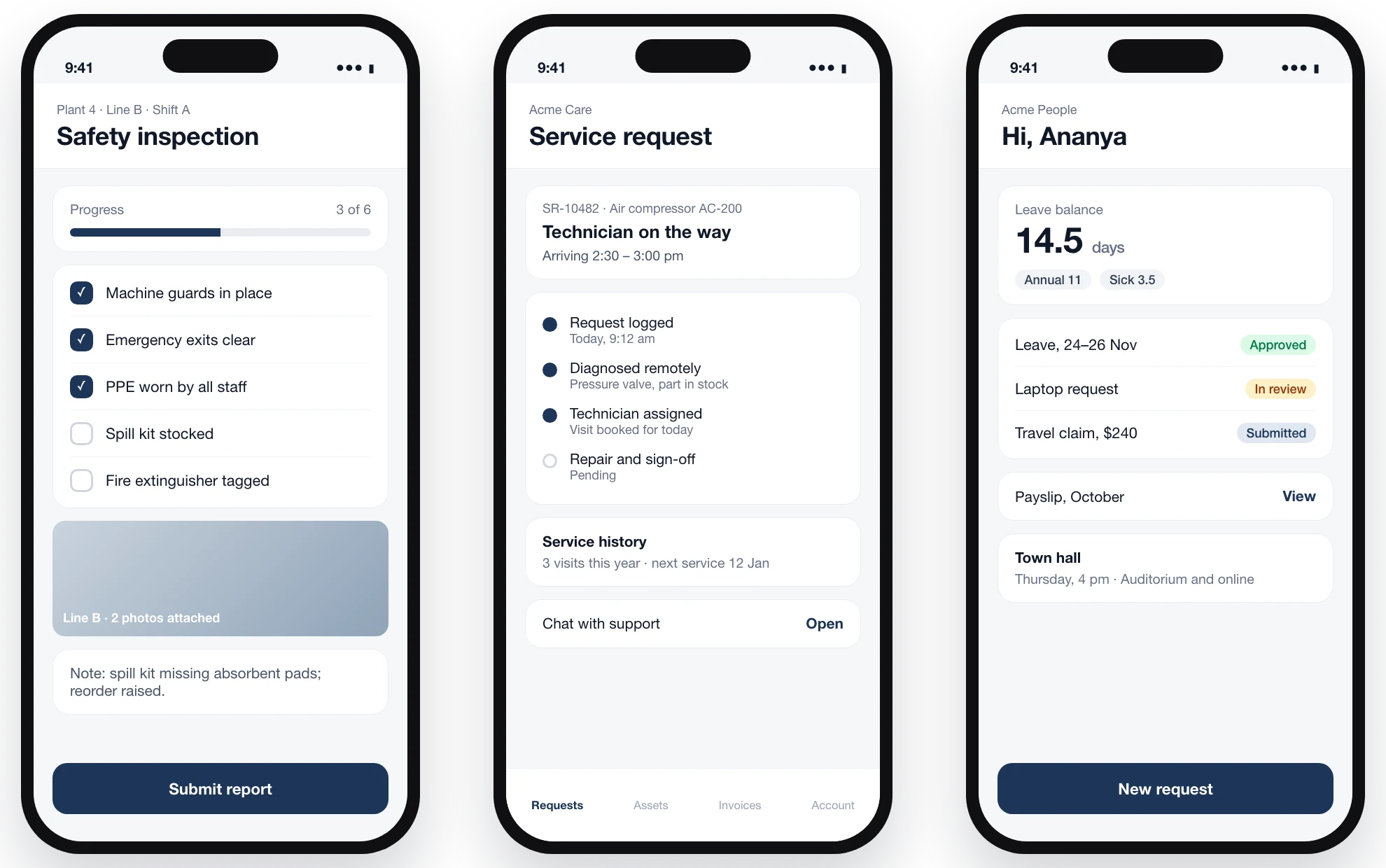
Apps
Native iOS and Android apps today, with web portals from the same project coming to the enterprise edition.
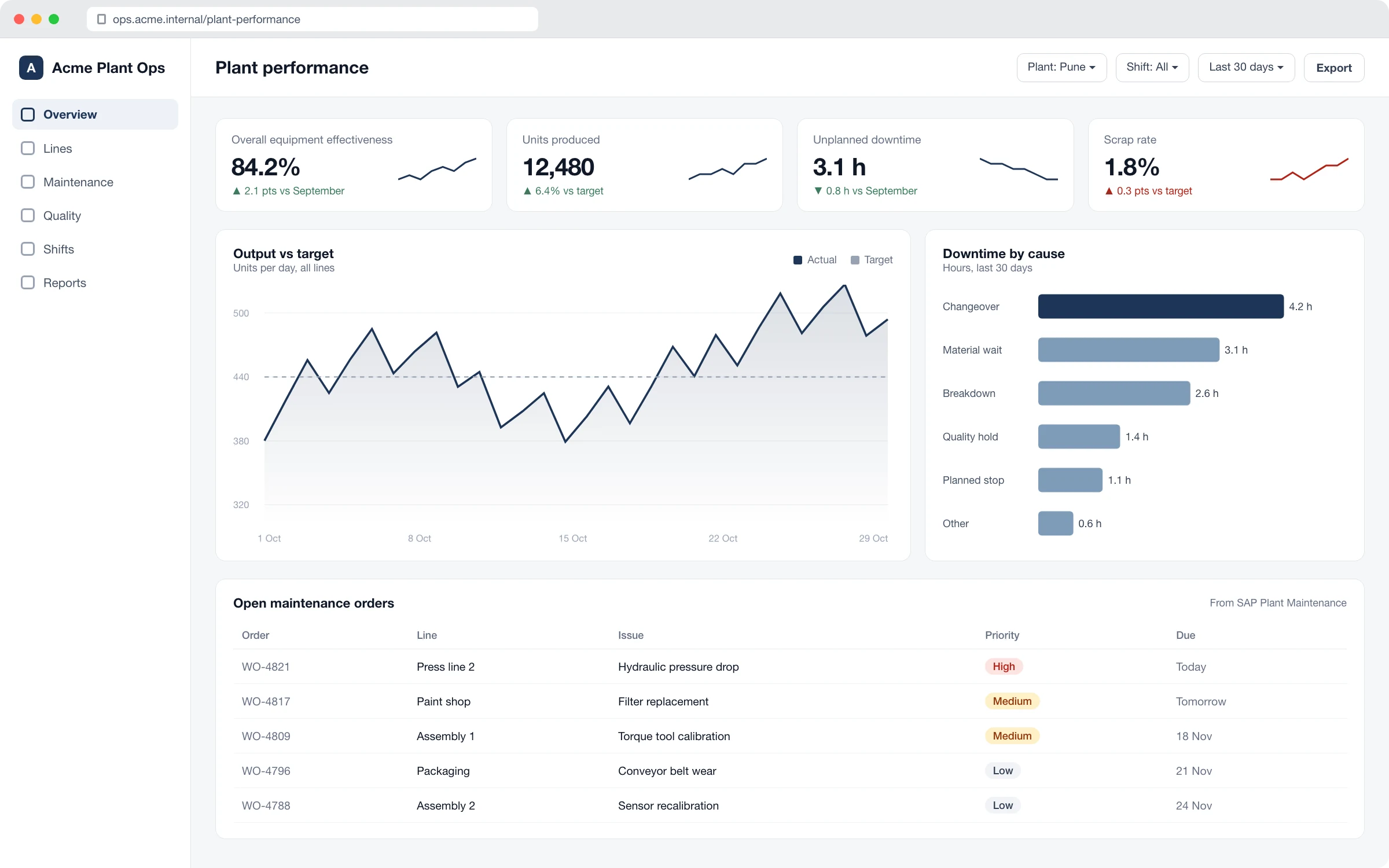
Dashboards
KPIs and reports on your databases, warehouse and APIs, with access by role.
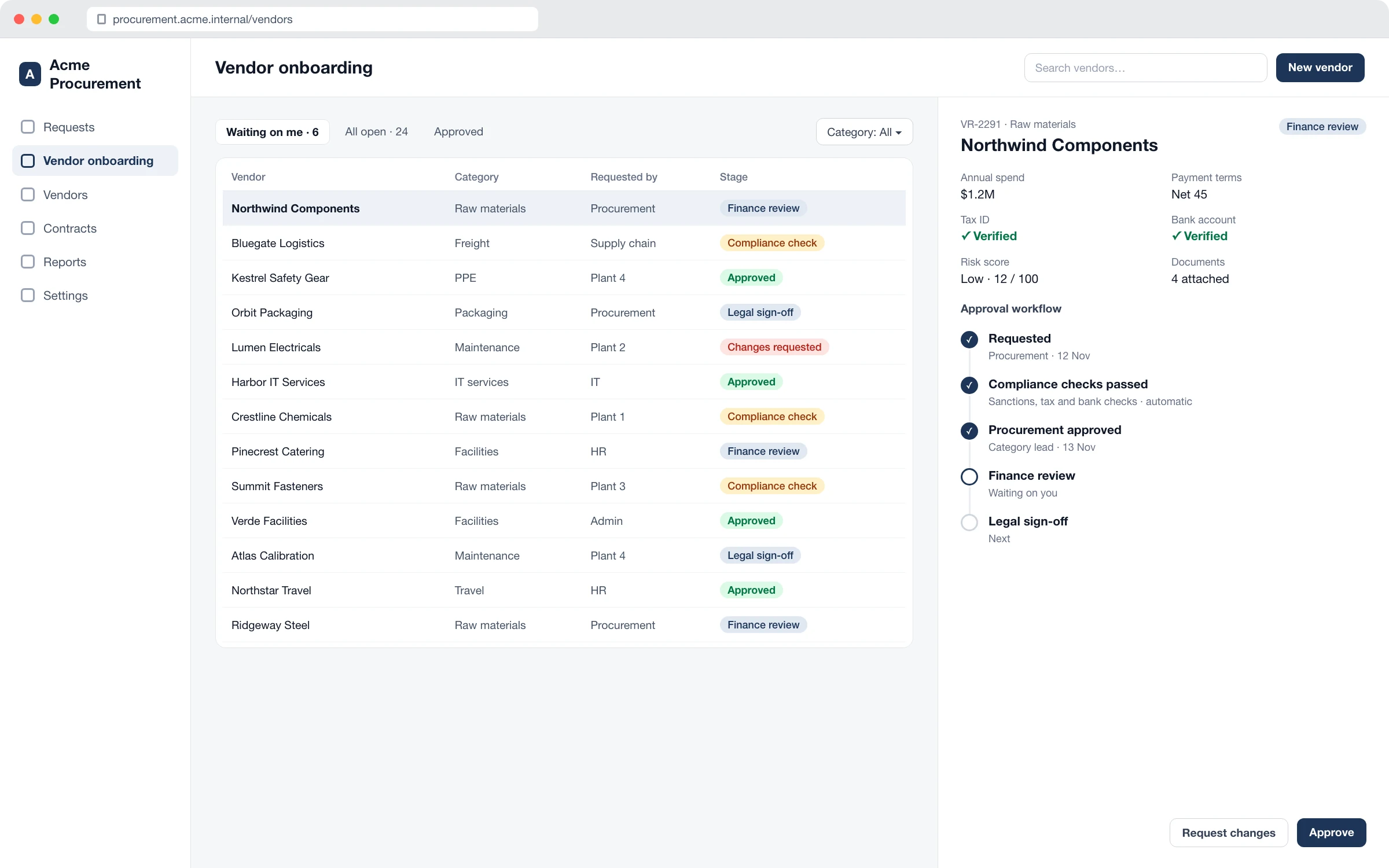
Internal tools
Approvals, admin panels and workflows over your systems of record.
Apps for customers, partners and frontline teams
Native on iOS and Android
Camera, location and push notifications, distributed through your MDM or the app stores.
Web portals too
Customer and partner portals from the same project, backend and design system.
Connected and governed
Every action writes to your systems, under your SSO and access rules.
Live dashboards on your data, for every role
Your data, live
Postgres, Snowflake, SAP and your APIs, queried in place. No copies in someone else’s cloud.
Access by role
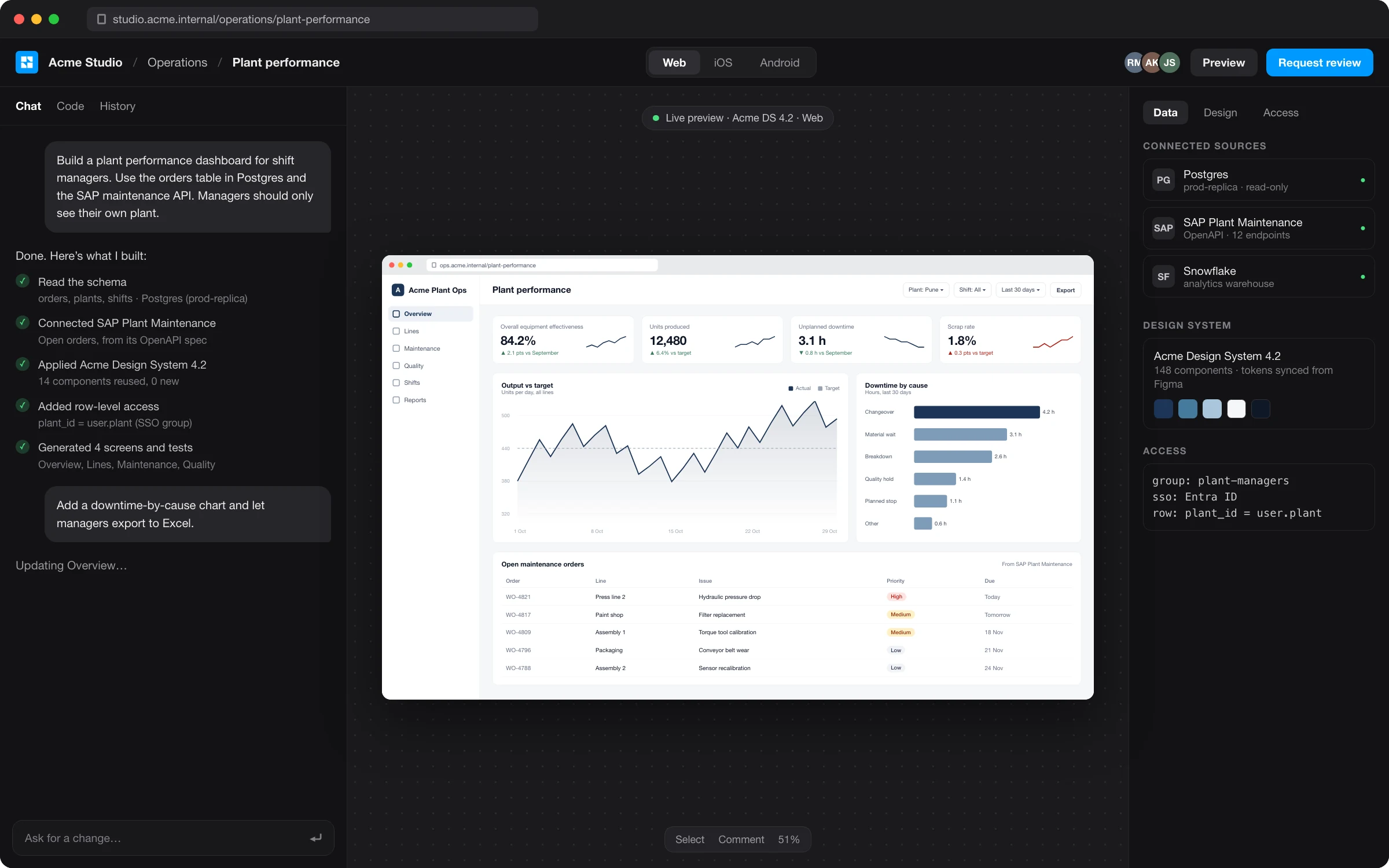
Managers see their plant, executives see every plant, straight from your SSO groups.
Change it by asking
Add a chart, a filter or an Excel export by describing it.
Internal tools with real workflows, not just forms
Approvals and workflows
Multi-step approvals, automatic checks and an audit trail on every decision.
On your systems of record
Reads and writes through your ERP, CRM and HR APIs.
Retool-class, no lock-in
Standard code in your Git, with no per-user licence for the people who use it.
Describe it, connect your data, ship it
The engine is live today: watch it build a full mobile app from one prompt, run it on a phone and share it with the team.
- 01
Describe
A prompt, a Figma file, a spreadsheet or a requirements document.
- 02
Connect
Your databases, warehouse and APIs, read through your own access rules.
- 03
Generate
Screens in your design system, with tests, for iOS and Android, and for the web next.
- 04
Ship
Review, approve and release through your Git and your pipeline.
What’s live today, and what’s coming
We mark everything plainly. Enterprise items are part of an enterprise agreement; coming-soon items are open to enterprise pilots first.
| Capability | Status |
|---|---|
| Native iOS and Android apps from a prompt, Figma design, screenshot or document | Available today |
| Database, sign-in, storage and realtime with every app | Available today |
| Calls to your existing APIs, or your own Supabase | Available today |
| Export standard React Native, Expo and TypeScript code | Available today |
| Real-time collaboration, shared chat and a browser code editor | Available today |
| Design-system and component skills, so the AI reuses your components | Available today |
| Publish to the App Store and Google Play | Available today |
| SSO, custom credit tiers and dedicated support | Enterprise |
| Figma MCP and custom component libraries | Enterprise |
| Deployment in your cloud or on-premises, with self-hosted models | Enterprise |
| Web apps and customer portals | Coming soon |
| Dashboards on your databases and warehouse | Coming soon |
| Internal tools with approval workflows | Coming soon |
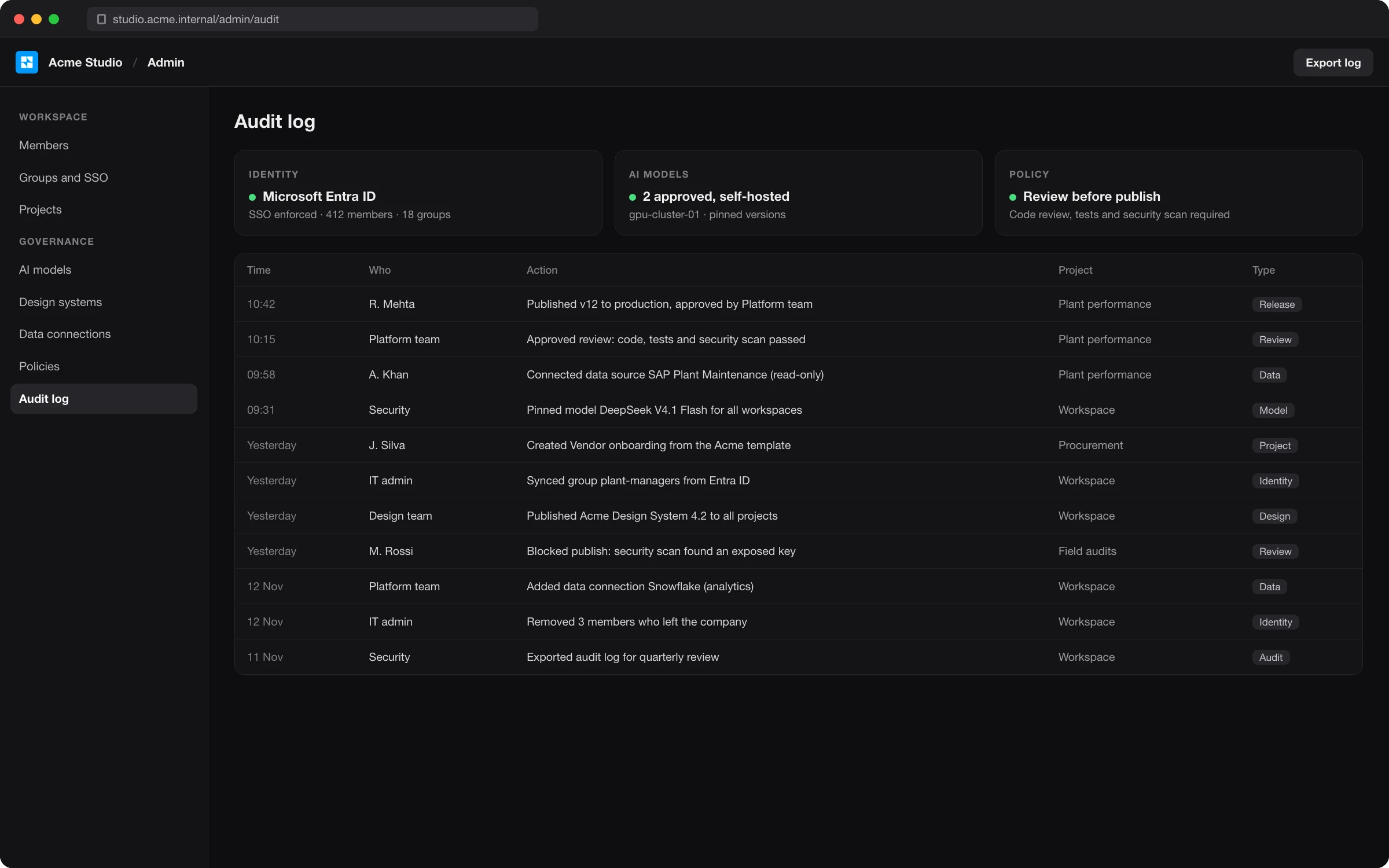
| Admin console: audit log, model and publish policies | Coming soon |
Start where your security policy allows
Training, design-system skills and integrations carry over as you move from one option to the next.
RapidNative cloud
Hosted, with frontier AI models. No servers or GPUs. Good for open work, or a pilot this month.
- Platform:
- RapidNative cloud
- AI:
- Hosted frontier models
Your network, dedicated GPUs
The platform runs inside your network. AI runs on single-tenant GPUs in a data centre you choose.
- Platform:
- Your servers
- AI:
- Dedicated GPUs, not shared
Fully on-premises
Platform and AI on hardware you own. Nothing leaves your network.
- Platform:
- Your servers
- AI:
- Your own GPUs
Built to pass your security review
Identity and audit
SSO with your identity provider, roles by team, and a log of every change.
Your data
Prompts, designs and code stay in your network. Never used to train shared or public models.
Your code
Standard code with no proprietary runtime. Your SonarQube, tests and VAPT keep working.
Your models and policies
Open-weights models you approve, pinned. Review required before anything is published.
For the tools that outgrow Retool and Power Apps
Simple forms over a database, for a few desk users? A platform is fine. RapidNative is for the tools that strain.
| Aspect | Internal tools platforms | Built with RapidNative |
|---|---|---|
| Cost as usage grows | Licences grow with every app user | Seats for builders, not for app users |
| Mobile and portals | Desk-first; external users cost extra | Native mobile apps and customer portals |
| Dashboards | Basic charts inside the platform | Full dashboards, live on your data |
| Look and feel | The platform’s components | Your design system |
| Ownership | Logic lives in the platform | Code in your Git, on your cloud |
| Who builds | Developers, in its own editor | Business teams, reviewed by engineers |
Prove it on one real app family, inside your environment
Go / no-go gates at each step: export and build, design-system fidelity, API integration, security scan, code review, AI quality and cost.
Discover
Map infrastructure, data flows, approved models, APIs and security needs.
Weeks 1–2 · 5–10 people
Prove value
Install in your environment and build one app family: an app, a dashboard and a tool.
Weeks 3–6 · 15–25 users
Department pilot
Your branding, trained champions, and the release workflow in place.
Weeks 7–10 · about 100 users
Scale
Expand seat by seat, tracking adoption, code quality and inference cost.
Week 11 onward
Guides for enterprise teams
What is shadow AI?
Real examples by department, the risks, and how to govern AI-built apps without a ban.
Internal tool builders in 2026
Retool, Power Apps, open-source builders and AI builders compared, and when to own the code.
AI dashboard builders
BI copilots, spreadsheet AI and generated dashboard apps, and what to check before you choose.
On-premise AI app builders
Private AI for building apps inside your network: models, GPUs, costs and vendor questions.
Enterprise mobile app development: a buyer's guide
The four ways enterprises build mobile apps, the main platforms compared, and the checklist IT will bring.
What is a mobile app development platform (MADP)?
How the category went from MEAP to MADP to low-code to AI, and eight questions to ask any vendor.
MADP, MEAP, MBaaS, LCAP: the terms explained
A plain-English glossary of the acronyms in enterprise mobile RFPs, from MDM and MAM to OTA updates.
Enterprise FAQs
What can RapidNative Enterprise build?
Native iOS and Android apps today, from prompts, Figma designs, screenshots or documents, with a database, sign-in and storage included. The enterprise edition adds web apps and portals, dashboards on your data, and internal tools with approval workflows; those are coming soon and available to enterprise pilots first.
Can it run inside our network?
Yes. Enterprise deployments run in your cloud account or fully on-premises. AI runs on open-weights models served on GPUs you control, so prompts, designs, data and code never reach a third-party AI API. A hosted option is available for unrestricted work or a quick pilot.
Which AI models does it use?
It is not tied to one model. On-premises, you approve and pin open-weights models such as DeepSeek, GLM, Qwen, Devstral or gpt-oss, and can switch between them without changing the platform. The hosted cloud uses frontier models from providers whose terms exclude training on your data.
Do we need to rebuild our design system?
No. Bring your Figma designs, component libraries and tokens. Design-system and component skills teach the AI to reuse what you already have, so generated screens look like your brand instead of a generic AI app.
Is RapidNative an alternative to Retool or Power Apps?
For the tools that strain on those platforms, yes: mobile and frontline apps, customer-facing portals, dashboards that need more than basic charts, and tools where licence cost or code ownership matter. What you build is standard code in your Git, so the people who use it need no platform seat. For simple forms over a database with a few desk users, an internal tools platform is fine.
Who owns what we build?
You do. Generated apps are standard React Native, Expo and TypeScript code that builds without RapidNative. Your Git, CI, code review, security scans and release approvals stay in charge.
Is RapidNative a mobile app development platform (MADP)?
Yes, an AI-first one. It covers building native iOS and Android apps, testing them on real phones and publishing them to the App Store and Google Play. Unlike low-code platforms, there is no proprietary runtime: the output is standard React Native and Expo code that you export and own.
Start with two weeks of discovery
We map your infrastructure, models, design system and a first app family, then come back with a scoped proof of value on your own infrastructure.