8 Startup MVP Examples Worth Studying
Explore 8 startup MVP examples, from Dropbox-style waitlists to B2B APIs, with traction lessons, pitfalls, tech choices, and RapidNative tactics.
By Sanket Sahu
7th Oct 2026
Last updated: 7th Oct 2026

The popular advice says an MVP should be a smaller version of the finished product. That framing often sends teams in the wrong direction. A smaller product can still contain the wrong features, the wrong audience, and the wrong technical assumptions. The better question is simpler: what is the riskiest assumption, and what is the cheapest credible way to test it?
These startup MVP examples cover different answers. A prototype can test navigation and interaction quality. A landing page can test demand and messaging. A functional mobile app can test repeat usage. A concierge service can test whether people value an outcome before automation exists. Pre-orders test willingness to pay, a productized service tests operational feasibility, an API-first product tests integration adoption, and a live workshop tests community demand.
Each example focuses on the problem, the smallest useful feature set, the launch approach, the evidence that matters, the likely technology shape, and the failure risks. The mobile replication notes also show where RapidNative can help with fast React Native prototyping, collaboration, testing, and handoff. Teams exploring broader launch planning can also use this playbook for pipeline growth to connect validation with distribution.
“Choose the MVP that tests your riskiest assumption, not the MVP that merely looks most complete.”
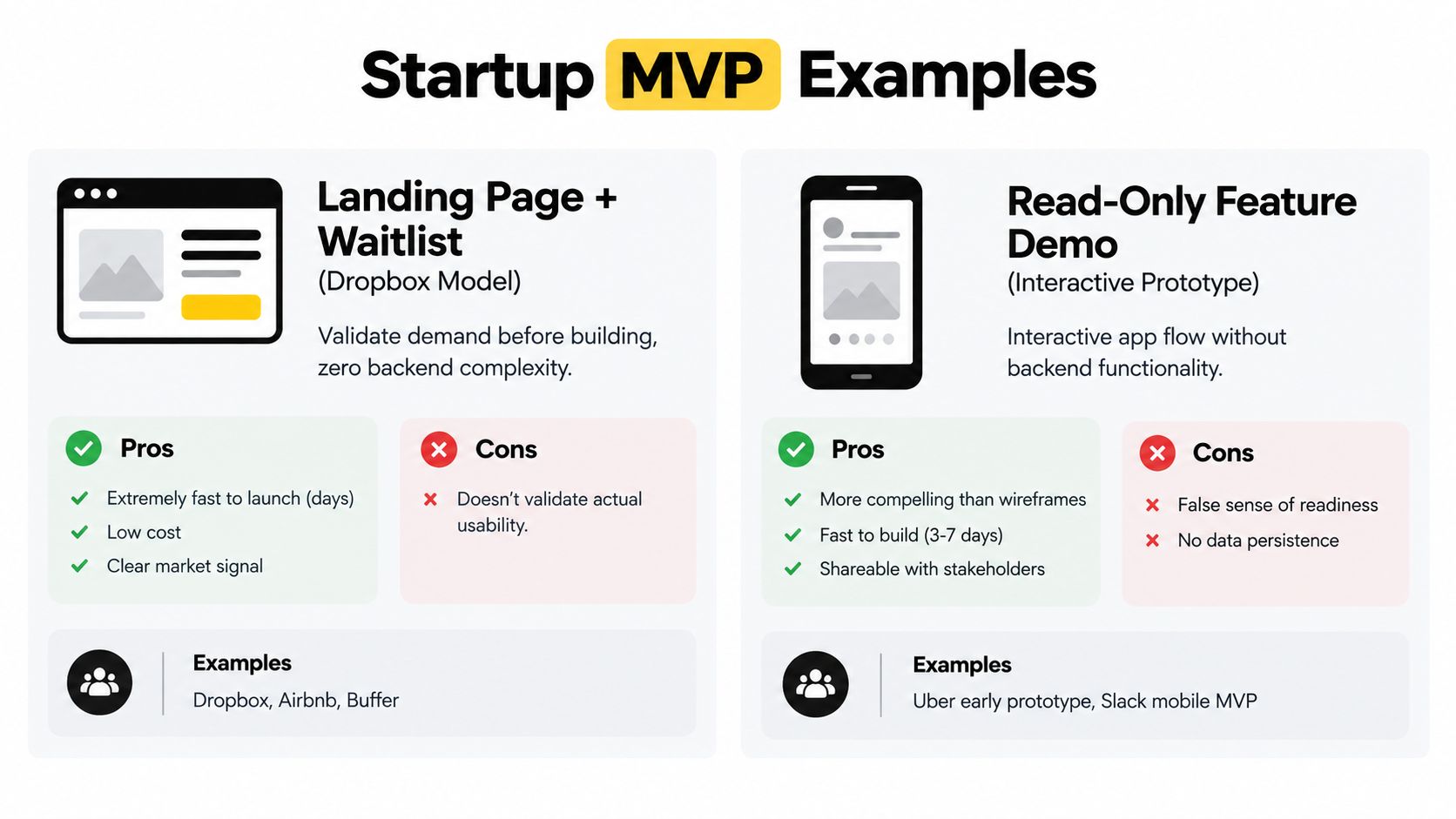
1. Landing Page + Waitlist
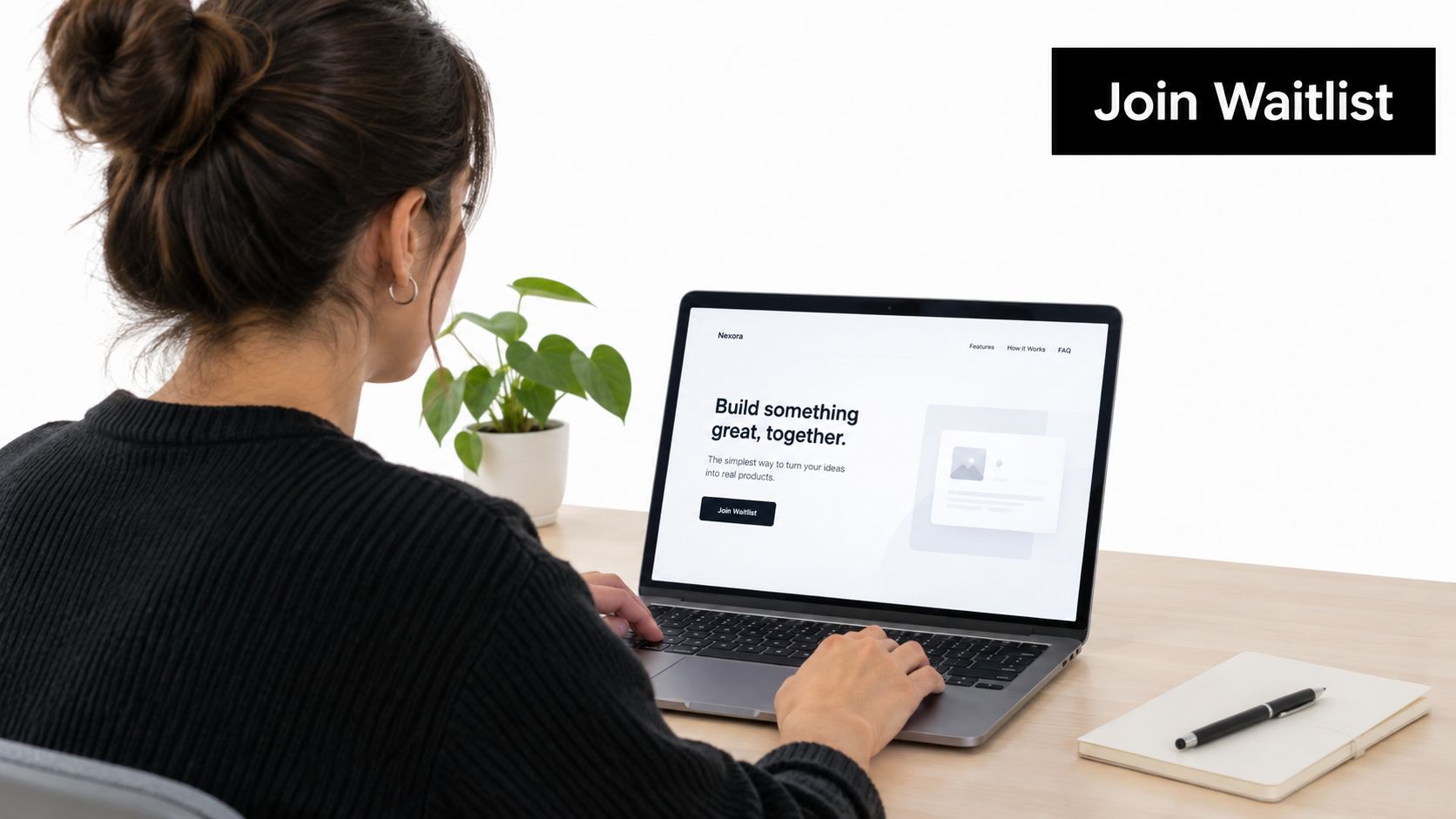
A landing page is the right MVP when the central uncertainty is whether a clearly defined audience cares enough to raise its hand. It doesn't prove that the product works, and it doesn't prove that people will keep using it. It tests the message, the problem framing, and the strength of initial interest before a team builds a backend.
Buffer is a useful model because its early test used a simple two-page website. One page explained the proposed scheduling product, while another presented pricing and a signup path. That structure is more informative than a generic “coming soon” page because visitors can reveal whether they understand the value and want to move toward a commercial decision. Dropbox also used a product demonstration and a waitlist to explain a technical concept before the complete product was widely available, while Airbnb's earliest website supported a narrow test of whether travelers would pay to stay in a private home.
For a mobile product, keep the page tied to one audience, one problem, and one primary action. A founder testing a medication reminder for caregivers shouldn't also promote wellness tracking, family chat, and appointment booking. Those additions make it harder to identify which promise attracted signups.
Mobile replication checklist
- State the job clearly: Write a headline that describes the outcome for one target user.
- Show the intended experience: Use a responsive screen mockup or short product walkthrough rather than a broad feature catalogue.
- Make signup primary: Use one email capture action, then ask a small number of follow-up questions that help segment interest.
- Test the message: Compare different problem statements qualitatively, while keeping the audience and CTA consistent.
- Close the feedback loop: Send useful progress updates and ask waitlist members what they currently do instead.
RapidNative can help a team turn a sketch, prompt, or product description into a responsive interface for the page and the underlying mobile flow. The distinction matters, however. A polished screen may improve comprehension, but only a real signup or conversation with the target audience provides demand evidence. For practical guidance on separating acquisition pages from product pages, see this landing page comparison for product teams.
2. Read-Only Feature Demo
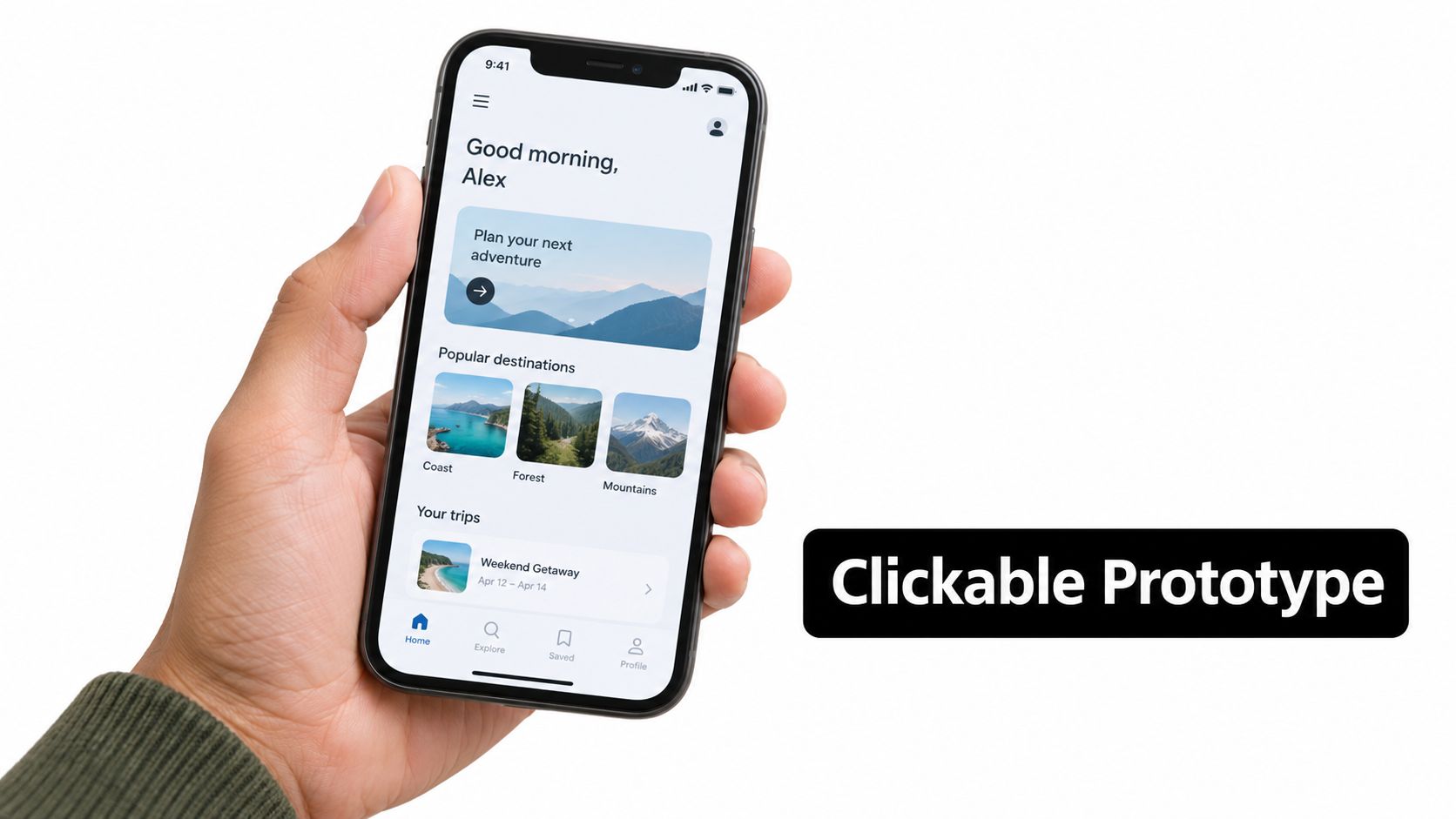
A read-only interactive prototype tests usability risk before implementation risk. Users can move through the core journey, but the team doesn't need to build authentication, persistence, payments, notifications, or production integrations. This makes the format useful when stakeholders disagree about how a mobile experience should work.
The prototype should represent one complete journey. For a travel app, that might include destination discovery, selecting an itinerary, reviewing a detail screen, and reaching a saved-plan confirmation. The confirmation isn't real, so the team can't claim that demand has been validated. It can still reveal whether users understand the navigation, notice the primary action, and recover from an empty or error state.
Use realistic content. Placeholder copy and identical image blocks hide comprehension problems because users can't judge whether the screen contains the information they need. Include loading, empty, unavailable, and error states where those states are central to the proposed experience. A team can place the prototype on a phone or distribute it through a QR code so founders, designers, developers, and non-technical stakeholders evaluate the same flow.
What to observe
Don't ask only whether participants like the design. Give them a task and observe where they hesitate, what they tap first, and whether they can explain what will happen next. A usability test described in the supplied research recruited participants near Georgia Tech and compared a revised checkout flow, reporting a conversion increase and reduced abandonment. Those figures are useful because the test connected a design change to a consequential action, rather than treating general approval as validation. The mobile prototyping workflow should support that same discipline.
A RapidNative build can give the team shareable React Native screens, navigation, realistic states, and a collaborative review surface. Developers should still treat the result as a test instrument, not as proof that the production architecture is ready. If participants cannot complete the core task in the prototype, adding backend complexity won't solve the interaction problem.
3. Single-Feature Deep Dive
A focused functional MVP tests real usage and early product value. Unlike a read-only demo, it lets a user complete the core action with working data or a working service behind it. Unlike a broad first release, it refuses to test several unrelated assumptions at once.
The expense-tracking example in the supplied evidence illustrates the discipline. The MVP centered on entering expenses, categorizing them, and viewing daily summaries. Testing found that users repeatedly used expense entry, while requests for monthly summaries shaped the next prioritization decision. The useful lesson isn't that every expense app should add monthly reports. It's that observed behavior should decide which adjacent feature earns engineering time.
Define the core action before designing the screens. A mobile founder might describe it as, “A new customer records one expense and understands today's spending.” That sentence gives the team a testable path through onboarding, entry, categorization, and summary. Anything that doesn't support that path belongs outside the first release unless it addresses a more important risk.
Build only what completes the loop
Use a modest backend such as Firebase, Supabase, or Railway when it fits the security and data requirements. The point isn't to avoid engineering quality. It's to avoid building secondary systems before the team knows whether the primary action creates value.
Track events such as onboarding completion, core action started, core action completed, and return session. The validation evidence recommends combining product analytics with qualitative feedback because high signup volume can coexist with very weak retention after the first week. A strong first session with poor later return suggests a value or habit problem, while failure during the core action points more directly to workflow friction. That distinction changes what the team should fix.
A narrow React Native app built with RapidNative can provide production-like navigation, realistic states, and a shareable build while the team validates the flow. Developers should keep components modular and define the event schema before launch. If users complete the core action but repeatedly ask for one missing capability, add it only when the request supports the same product loop.
4. Concierge MVP
A concierge MVP tests whether users value an outcome enough to accept a human-delivered service. The founder performs the work manually instead of hiding a fragile process behind unfinished automation. This is especially effective when the technical system would be expensive to build but the underlying service can be delivered directly.
Airbnb's first experiment is a strong example. In October 2007, Brian Chesky and Joe Gebbia photographed their San Francisco apartment after nearby hotels sold out around a design conference. They created a basic “Air Bed & Breakfast” listing site and hosted three paying guests on air mattresses. The test answered one narrow question, whether travelers would pay to stay in a private home instead of choosing a hotel, before the company had broad host coverage, advanced booking infrastructure, reviews, or a mobile application. Later accounts report 80 bookings during the 2008 Democratic National Convention, showing how an initially narrow transaction could point toward a larger marketplace opportunity. The MVP example analysis explains why the early significance lies in validating the transaction before solving every marketplace problem.
Turn manual work into product evidence
A mobile team testing a personal meal-planning service could collect preferences in a simple app, prepare plans manually, and deliver them through the app or email. The team should record what information customers provide, where requests are ambiguous, how long preparation takes, and which parts users value enough to request again.
Charge for the service when payment is part of the hypothesis. Be honest about the human operation, define turnaround expectations, and use a spreadsheet or lightweight operations tool to track every request. Don't automate a step merely because it feels repetitive. Automate after the team understands the decision rules, exceptions, and acceptable quality level.
Practical rule: If the manual service can't deliver a result people value, software won't rescue the proposition.
RapidNative fits the customer-facing shell here. It can support intake screens, status updates, result views, and feedback capture while the team handles fulfillment manually. The app should make the operation easier to observe, not conceal the fact that the team is still learning how the service works.
5. Reverse Waitlist
A reverse waitlist asks for commitment before construction. Instead of collecting expressions of interest only, the team invites a defined group to reserve access, pay for a pilot, or join a paid beta under clear terms. This is a stronger test of willingness to pay, but it also introduces obligations that a casual waitlist doesn't create.
The trade-off is important. A payment or pre-order can show that the problem has commercial urgency, but it doesn't automatically prove that the product will retain customers or deliver the promised outcome. A founder building a mobile workflow for independent consultants could publish a narrow beta promise, explain what the first release will and won't do, and invite a small target audience to commit before the full build begins.
Make the commitment test specific
- Define the promise: Describe the user outcome, delivery boundary, and what early access includes.
- Publish the decision rule: State what evidence will trigger a build, a change in scope, or a refund.
- Separate interest from payment: Treat email signups, interviews, deposits, and completed purchases as different signals.
- Keep the cohort involved: Ask committed users to review the prototype and explain which missing capability blocks adoption.
- Protect trust: Don't imply that a payment guarantees features, timing, or performance that the team hasn't validated.
The documented MVP case study in the supplied evidence launched a production-ready product in 90 days, compared with an internal estimate of 4 to 5 months for a broader release, and secured five active pilot engagements within the first 30 days after launch. Its practical lesson is not to copy those milestones. It is to define one complete workflow, launch it to pilots, instrument first action and completion, and defer secondary features until user behavior supports them. The startup validation case study supports treating launch speed as a way to create more learning cycles, not as a success metric by itself.
RapidNative can help shape the paid beta's screens, navigation, and prototype handoff before the team commits to a larger codebase. Developers still need to verify payment handling, access control, refunds, and data protection separately. A pre-order should buy the team a sharper learning loop, not permission to overpromise.
6. Service + Software Hybrid
A productized service combines software convenience with human judgment. The customer gets a functional mobile interface for intake, progress, and results, while the team performs the part that remains difficult to standardize. This pattern tests operational feasibility and pricing more realistically than a prototype alone.
The food-ordering MVP documented in the evidence shows why narrow geography matters. The team considered chat, loyalty, dietary filters, GPS tracking, reviews, and group ordering, then used prioritization to retain vendor discovery, menu browsing, and secure payment for an initial rollout in Atlanta's Midtown and Old Fourth Ward neighborhoods. After three months, it had 5,000 active users, and subsequent feedback requested dietary filters more often than group ordering. The case demonstrates a practical constraint: define the audience in a specific context, then make every first-release feature serve that audience's primary job. The mobile product example provides the source for those details.
A hybrid version of that product might let customers search vendors, browse menus, and submit orders in the app while a small operations team handles difficult substitutions, vendor confirmation, or dispute resolution. That arrangement can deliver customer value before every exception is automated. It can also expose whether the manual portion is economically and operationally viable.
Build the operational side deliberately
The app should collect every field the service team needs. An internal dashboard should show status, missing information, ownership, escalation, and customer communication. Measure active work time separately from waiting time, because both affect the user experience but require different fixes.
Tell customers which parts involve human review. A hidden manual process creates misleading expectations and makes failures harder to diagnose. As patterns stabilize, automate the most repetitive step first, but preserve an escalation path for unusual requests. The team should also budget for fair working conditions, because an operational bottleneck can become the product's main failure point.
RapidNative can support the mobile intake and customer status experience, while developers build the admin workflow around the actual service process. That order prevents the customer app from becoming a polished front end for an operation nobody has yet learned to run.
7. B2B Integration MVP
An API-first MVP tests integration adoption, not broad consumer appeal. The buyer may never care about a beautiful standalone app. They care whether the API solves a specific workflow inside an existing product, whether the documentation is understandable, and whether the integration behaves reliably enough to keep.
Payment APIs, messaging APIs, authentication services, banking connections, and analytics pipelines all illustrate the pattern. A small team might build a mobile expense product that connects to an existing accounting workflow. The first release shouldn't attempt to support every platform. It should identify one target customer group and a short list of integration paths that represent its highest-value use cases.
The technical surface still needs care. An API can be narrow without being careless. Define authentication, error responses, rate behavior, webhooks, versioning, test data, and support boundaries before inviting external developers. Write example code for the primary workflows, and give integrators a sandbox or safe test environment where possible.
Measure adoption at the integration boundary
Track whether a target team installs the SDK, completes setup, sends a valid request, handles the response, and returns to use the integration in a real workflow. Raw account creation is weak evidence if developers never reach a successful call. Qualitative interviews should uncover whether the problem is documentation, missing functionality, access approval, or a product that doesn't fit the existing stack.
The API-first team should maintain a public roadmap and communicate breaking changes clearly. A free tier or early partnership can reduce adoption friction, but it shouldn't obscure whether the integration creates durable value.
For a mobile companion app, RapidNative can help prototype authentication, connection setup, permission states, and integration results before the API surface is fully expanded. The implementation should keep API calls behind replaceable service modules, so a validated interface can move into an engineering-owned repository without rebuilding the screens. Teams working with third-party services can use this RapidNative API integration guide as a starting point.
8. Live Event or Workshop MVP
A live event MVP tests whether a community will show up, participate, and experience value in real time. The mobile app supports registration, joining, chat, reminders, and content access. It doesn't need to be a fully autonomous learning platform or community product on the first attempt.
This format works well when the proposed product depends on trust, teaching, accountability, or peer interaction. A founder considering a career-planning app could host a live workshop, collect participant questions, guide an exercise, and observe where people need templates, feedback, or follow-up. A team proposing a design education product could use a live session to test the curriculum and the community behavior before investing in a large content library.
The event itself should stay narrow. Choose one audience and one outcome, then design registration and participation around that result. The team can record the session for later reuse, but recording isn't a substitute for observing live confusion, missed steps, or weak engagement.
Use the event as a research environment
Interview attendees after the session and ask what they attempted, completed, postponed, or found unclear. Preserve the distinction between enthusiasm during a live session and independent product usage afterward. A participant may enjoy the instructor while still having no need for a standalone app.
A mobile MVP can provide the event schedule, joining link, chat, prompts, and follow-up resources. A simple community space can maintain contact after the session, while the team tests whether members return without intensive facilitation. If a later app is justified, attendees can become an informed early cohort rather than an anonymous audience.
This pattern also exposes operational costs. Someone must moderate chat, answer questions, manage access, handle recordings, and follow up with participants. Those tasks are part of the product experience. If the event only works because the founder performs every role at unsustainable intensity, the team has learned something important before building more software.
8 Startup MVP Models Compared
| MVP Type | Implementation complexity | Resource requirements | Expected outcomes | Ideal use cases | Key advantages |
|---|---|---|---|---|---|
| Landing Page + Waitlist (Dropbox Model) | Very low | Static site, email tool, analytics | Demand signal, email list | Test messaging, pre-launch interest | Fast, low-cost, measurable conversions |
| Read-Only Feature Demo (Interactive Prototype) | Low–medium | Prototyping tools, mock data, share links (Expo) | UX/flow feedback, stakeholder demos | Validate navigation and interactions | Highly realistic UX, fast iterations, shareable |
| Single-Feature Deep Dive (Focused MVP) | Medium–high | Dev team, backend, auth, analytics, payments | Production usage, retention, revenue | Validate core value and unit economics | Real user value, measurable metrics, investor-ready |
| Concierge MVP (Manual Automation) | Very low tech, high manual ops | Staff time, forms, spreadsheets, payment | Willingness-to-pay validation, deep user insights | Service businesses, complex personalized offers | Fast launch, strong qualitative learning, low tech risk |
| Reverse Waitlist (Pre-orders MVP) | Low–medium | Landing page, payment processor, comms | Paid commitments, funds for development | Pricing validation, funded initial build | Validates payment, creates buzz, funds dev |
| Service + Software Hybrid (Productized Service) | Medium | App + backend, admin dashboard, human operators | Immediate delivered value, automation roadmap | Personalized services needing partial automation | Delivers value fast, premium pricing, learn automation priorities |
| B2B Integration MVP (API-First Launch) | High | Skilled engineers, hosting, SDKs, docs, dev relations | Paying integrations, high ARPU, technical traction | Developer tools, platform integrations | High revenue per customer, scalable contracts, focused adoption |
| Live Event or Workshop MVP (Community Validation) | Medium | Event production, streaming, marketing, simple app | Community formation, upfront revenue, high engagement | Cohort-based courses, community-first products | Immediate feedback, strong engagement, monetizable cohorts |
Match the MVP to the Risk You Need to Test
Choose the test according to the uncertainty, not according to the fame of the company that used it. A landing page or waitlist fits a question about messaging and demand. It can show whether a defined audience understands the promise well enough to sign up, but it can't establish retention or technical feasibility. A read-only prototype fits navigation and interaction quality, especially when the team needs to resolve design disagreement before writing backend code.
Use a focused functional MVP when the question is whether users will complete the core action and return for value. Instrument the critical path from onboarding to first value, then separate activation from retention. One validation case in the supplied evidence showed why signup volume alone can mislead: strong initial acquisition did not translate into continued use. That pattern should push teams toward behavioral events and feedback themes, not larger acquisition campaigns.
A concierge model fits operational and pricing learning when humans can deliver the outcome before software exists. A service plus software hybrid is useful when the app can handle intake and most of the workflow, while people manage exceptions or judgment. Pre-orders and paid pilots test willingness to pay, but they require clear promises, transparent terms, and a plan for learning from the committed cohort.
An API-first launch tests developer adoption and integration fit. Its success signal lives at the integration boundary, where a target team completes setup and uses the capability inside an existing workflow. A live event tests community demand, trust, teaching quality, and participation. It can reveal whether the proposed product creates value when people have to show up and act, rather than merely express interest.
Write the test before building it
For any of these patterns, write one falsifiable hypothesis:
“A specific user in a specific context will complete a defined action because the product solves a defined problem.”
Then choose one primary metric that reflects that action. It might be signup-to-first-value conversion, completion of a core workflow, repeat use, a paid commitment, successful integration, or participation in a live session. Add a stopping threshold before the results arrive. If the evidence misses that threshold, decide whether to stop, change the audience, change the promise, or run a narrower follow-up test.
The most frequently cited startup-failure analysis in the supplied research identifies lack of market need at 42%, ahead of running out of cash at 29%. Those figures are cited in the startup idea validation analysis, but the practical conclusion matters more than the ranking. Teams should test whether the market needs the outcome before they optimize the architecture for scale.
For mobile teams, RapidNative can turn a PRD, sketch, image, whiteboard, or prompt into shareable React Native screens. Collaborators can test the core flow through a preview link or QR code, then the team can export modular Expo-based code for engineering when the evidence supports building further. That workflow doesn't replace product judgment. It reduces the cost of changing the interface while the team is still learning what deserves to exist. A disciplined conversion rate optimization playbook can complement the same principle by connecting each experiment to a defined user action.
RapidNative helps founders and product teams turn startup hypotheses into shareable React Native interfaces for testing, collaboration, and handoff. Start with a prompt, sketch, image, or PRD, validate the core mobile flow with real collaborators, and visit RapidNative when you're ready to move from an MVP idea to a testable app.
Ready to build your app?
Turn your idea into a production-ready React Native app in minutes.
Free tools to get you started
Free AI PRD Generator
Generate a professional product requirements document in seconds. Describe your product idea and get a complete, structured PRD instantly.
Try it freeFree AI App Name Generator
Generate unique, brandable app name ideas with AI. Get creative name suggestions with taglines, brand colors, and monogram previews.
Try it freeFree AI App Icon Generator
Generate beautiful, professional app icons with AI. Describe your app and get multiple icon variations in different styles, ready for App Store and Google Play.
Try it freeFrequently asked questions
What is RapidNative?
RapidNative is an AI-powered mobile app builder. Describe the app you want in plain English and RapidNative generates real, production-ready React Native screens you can preview, edit, and publish to the App Store or Google Play.
Can I export the code?
Yes. RapidNative generates clean React Native and Expo code that you can export at any time. No lock-in, no proprietary format. Hand it to your developers or keep building inside RapidNative.
Is RapidNative free to use?
Yes. You can build apps on the free plan with no credit card required. Paid plans unlock unlimited AI generations, code export, and direct publishing to the App Store and Google Play.
Do I need to know how to code?
No. Most users build apps by describing what they want in plain English. Developers can drop into the code whenever they want more control, but coding is optional.
How long does it take to build an app?
Most users have a working first screen in under a minute. A full MVP usually takes a few hours instead of the weeks or months traditional development requires.