How Much Does It Cost to Build a Taxi App? (2026 Breakdown)
A data-backed breakdown of taxi app development costs in 2026. Team, features, hidden expenses, and three realistic budget scenarios from bootstrap to enterprise.
By Gaurav Guha
9th Apr 2026
Last updated: 16th Apr 2026
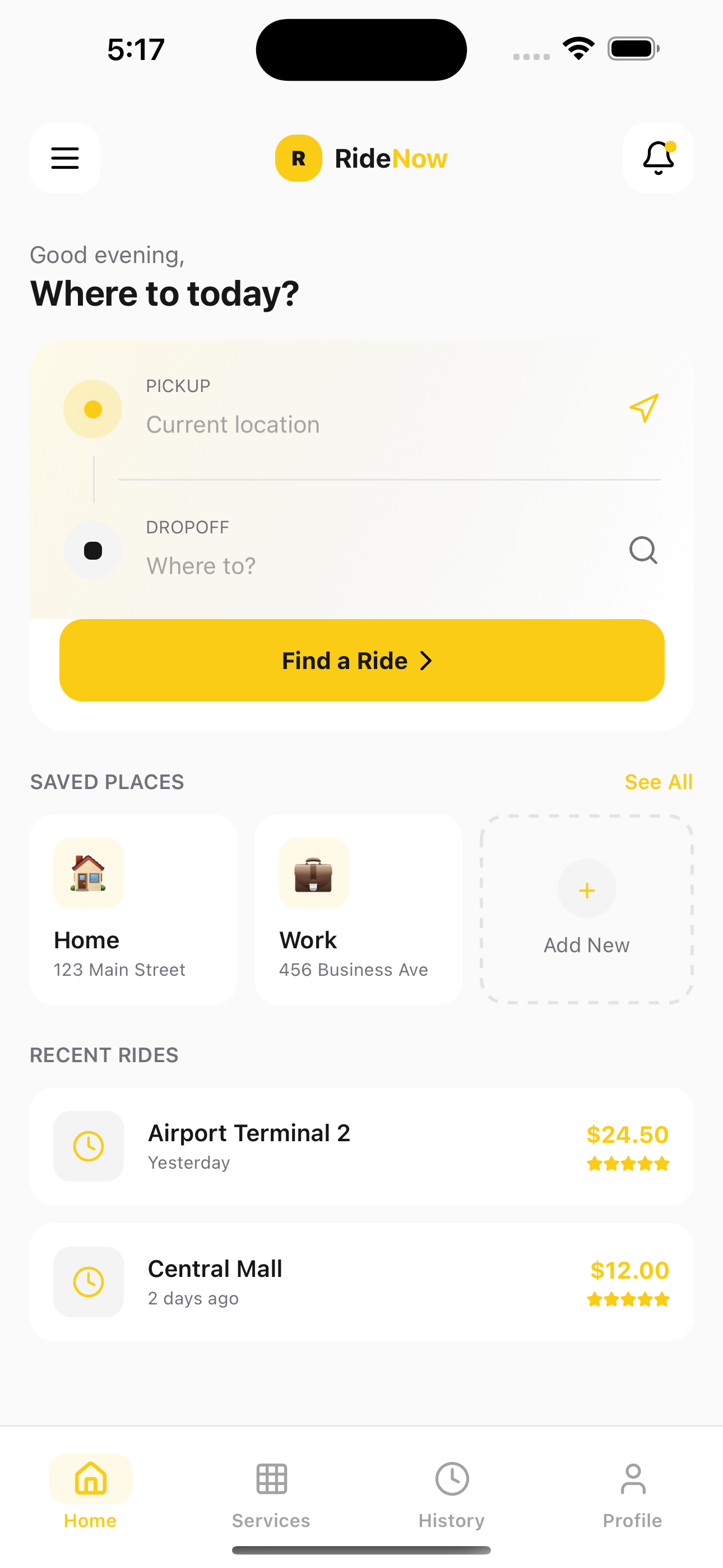
Short answer: building a taxi app in 2026 costs between $30,000 and $250,000+ depending on how you build it, where your team is based, and how many features you ship in v1.
That's a wide range, and it's not because anyone's being lazy with the estimate. The gap between a lean MVP and an enterprise-grade Uber clone is genuinely that big. This guide breaks down where the money actually goes so you can figure out what your taxi app will cost.
The five cost drivers that move the number
Before you look at any specific budget, know what actually changes the total:
1. Team location. A senior React Native developer costs $120 to $180 per hour in the US, $60 to $100 per hour in Europe, and $25 to $50 per hour in India, Eastern Europe, or Latin America. That single variable alone can swing your total cost by 3x.
2. Feature scope. A basic taxi app with auth, a map, booking, and payments takes maybe 400 to 600 developer hours. Add surge pricing, scheduled rides, in-app chat, package delivery, driver earnings, and admin analytics, and you're at 1,500 to 3,000 hours.
3. Design complexity. A "use the template" app can ship with zero custom design work. A pixel-perfect bespoke design with custom illustrations and animations adds 80 to 200 hours of design time alone.
4. Third-party services. Stripe Connect, Twilio, Google Maps, Firebase, Sentry. These add up in development time (integration work) and in ongoing cost (usage fees).
5. Time to market. Faster usually means more expensive. Shipping in 6 weeks means a larger, parallelized team. Shipping in 6 months means a smaller team working sequentially.
Any cost estimate that doesn't tell you which values it assumed for these five drivers is not a useful estimate.
Cost by approach: 4 realistic paths
Path 1: Freelancers
You hire a developer or two on Upwork, Toptal, or via referrals. They work hourly or on fixed milestones.
- Cost: $15,000 to $60,000 for an MVP
- Timeline: 3 to 6 months
- Risk: Highest. Freelancer quality is hit-or-miss. Project management is on you.
- Best for: Technical founders who can manage devs and review code themselves
Path 2: Agency or dev shop
A specialized agency builds the full thing. They handle project management, design, QA, and delivery.
- Cost: $40,000 to $180,000 for an MVP
- Timeline: 4 to 8 months
- Risk: Moderate. Agencies deliver, but the bill is big and you're locked into their pace.
- Best for: Non-technical founders, enterprise buyers, teams that need predictability over cost
Path 3: In-house team
You hire 2 to 4 full-time engineers. You own the codebase, the talent, and the ongoing roadmap.
- Cost: $250,000 to $600,000 per year (salaries alone)
- Timeline: 3 to 6 months for v1, ongoing forever
- Risk: High up-front commitment, low per-feature cost after launch
- Best for: Well-funded startups planning to keep building for years
Path 4: Template + customization
You buy a production-ready React Native template (like our Uber clone template at $99) and pay a developer to customize it, wire up a backend, and ship to app stores.
- Cost: $99 template plus $5,000 to $25,000 for customization and backend work
- Timeline: 2 to 6 weeks
- Risk: Low. You see exactly what you're getting before you buy.
- Best for: Bootstrapped founders, indie developers, MVPs, agencies prototyping for clients
The template approach breaks the curve because it removes the single biggest chunk of work: rebuilding the rider app UI from scratch. A template ships with 8 to 15 pre-built screens, navigation, styling, and the entire booking flow already designed.
Feature-by-feature cost breakdown
Here's what each major piece of a taxi app typically costs if you're starting from scratch:
| Feature | Hours | US team | Offshore team |
|---|---|---|---|
| Auth + onboarding (phone, email, OTP) | 40-80 | $6,000-$14,000 | $1,500-$4,000 |
| Home screen with map and nearby drivers | 50-100 | $7,500-$18,000 | $2,000-$5,000 |
| Ride booking flow (pickup, dropoff, ride type) | 60-120 | $9,000-$22,000 | $2,500-$6,000 |
| Live driver tracking with real-time updates | 80-160 | $12,000-$29,000 | $3,000-$8,000 |
| Payments (Stripe Connect integration) | 40-80 | $6,000-$14,000 | $1,500-$4,000 |
| Trip history and past rides | 20-40 | $3,000-$7,000 | $800-$2,000 |
| Rating and review after ride | 20-30 | $3,000-$5,500 | $800-$1,500 |
| Driver app (separate React Native app) | 200-400 | $30,000-$72,000 | $7,500-$20,000 |
| Admin dashboard (web) | 100-200 | $15,000-$36,000 | $4,000-$10,000 |
| Backend + real-time + matching | 150-300 | $22,000-$54,000 | $6,000-$15,000 |
| QA, polish, app store submission | 80-160 | $12,000-$29,000 | $3,000-$8,000 |
| Total MVP | 840-1,670 hours | $125,000-$300,000 | $32,000-$83,500 |
These numbers assume you build from scratch. A template cuts the rider app UI rows (the first 6 rows) dramatically. Depending on which template you buy, that's $30,000 to $90,000 in savings right there.
Hidden ongoing costs most people forget
The development cost is only half the story. Here's what a live taxi app costs to run every month:
| Service | Low usage (MVP) | Moderate (1K-10K rides/mo) | Heavy (50K+ rides/mo) |
|---|---|---|---|
| Google Maps API | $0-200 | $500-2,500 | $3,000-10,000+ |
| Twilio SMS (OTP + alerts) | $50-200 | $300-1,000 | $2,000-5,000 |
| Stripe Connect fees | 2.9% + 30¢ per txn | 2.9% + 30¢ | 2.9% + 30¢ (negotiable) |
| Cloud hosting (backend) | $50-150 | $200-600 | $1,500-5,000 |
| Database (managed Postgres) | $20-80 | $100-400 | $500-2,000 |
| Push notifications | Free | Free-$50 | $100-500 |
| Sentry / error tracking | Free | $26-80 | $200-500 |
| App Store fees | $99/year Apple + $25 once Google | Same | Same |
| Estimated monthly total | $150-600 | $1,200-4,500 | $7,500-25,000+ |
Maps are the sleeper cost most teams forget. Google Maps charges per map load and per directions request. With live tracking, you can easily burn through the free tier in days. Budget $500 to $3,000 per month even at modest scale, and expect it to grow with usage.
Stripe's transaction fees are proportional so they're never a shock, but they're real: on a $20 average trip, Stripe takes about $0.88 (roughly 4.4%). At 10,000 trips per month that's $8,800 going to Stripe.
Three realistic budget scenarios
Rather than quoting one number, here's what three different teams typically spend:
Scenario A: Lean bootstrapped startup
You're a solo founder or small team validating a niche idea (taxi service for a specific city, airport transfers, corporate rideshare).
- Rider app: React Native Uber clone template ($99) + 1 week of customization ($3,000-$5,000)
- Driver app: Simplified v1 with manual ride acceptance, built from scratch or from a minimal second app ($8,000-$15,000)
- Backend: Node.js + Supabase (auth, database, realtime) ($6,000-$12,000)
- Payments: Stripe Connect ($2,000-$4,000)
- Admin panel: Basic Retool or custom ($2,000-$5,000)
- QA and launch: $2,000-$4,000
- Total up-front: $23,000 to $45,000
- Monthly running cost: $200 to $800
Scenario B: Funded startup, serious launch
You raised a pre-seed or seed round and want to launch a city-wide taxi service with polish.
- Design: Custom branding, mid-tier agency design ($8,000-$15,000)
- Rider app: Custom React Native build or heavily customized template ($25,000-$50,000)
- Driver app: Full-featured ($35,000-$70,000)
- Backend: Production-grade Node or Go backend with Postgres ($30,000-$60,000)
- Payments: Stripe Connect + driver payouts ($6,000-$12,000)
- Admin panel: Custom React dashboard ($15,000-$30,000)
- QA, legal, launch: $10,000-$25,000
- Total up-front: $130,000 to $260,000
- Monthly running cost: $2,500 to $8,000
Scenario C: Enterprise or whitelabel taxi clone
You're a taxi company or transportation provider wanting a fully branded Uber clone with no corners cut.
- Design: Full custom, brand system ($25,000-$50,000)
- Rider + driver apps: Native or premium React Native, production grade ($80,000-$150,000)
- Backend: Custom matching, surge pricing, analytics, reporting ($60,000-$120,000)
- Admin panel + analytics: Enterprise dashboard ($40,000-$80,000)
- Integrations: CRM, accounting, dispatch hardware ($20,000-$50,000)
- QA, compliance, launch: $25,000-$60,000
- Total up-front: $250,000 to $500,000+
- Monthly running cost: $10,000 to $30,000
Most "Uber clone script" providers that quote $5,000 to $15,000 are selling you a watered-down whitelabel version of scenario A. It's fine for validation, not for production.
The template shortcut (and what it actually saves you)
We built a React Native Uber clone template specifically so teams in scenario A can skip the biggest expense: rebuilding the rider app from scratch. For $99 you get:
- 8+ production-ready screens (login, booking, live tracking, ride selection, trip history, profile, services, settings)
- Full TypeScript source code
- Expo SDK 54, NativeWind v4, Expo Router
- Dark mode, clean architecture, production patterns
That's $25,000 to $45,000 worth of custom development work, packaged and ready to customize. You still need a backend, a driver app, and integrations. But the biggest visible chunk of the project is already done.
Common mistakes that blow up your taxi app budget
Budget overruns in ride-hailing projects almost always trace back to the same handful of mistakes. If you see yourself doing any of these, stop and rethink.
Building driver and rider apps at the same pace. The rider app is what gets you to an MVP. The driver app can start as a stripped-down utility that only accepts rides and shows a map. Building both in parallel at full polish doubles your cost with zero upside. Ship the rider app first, use a manual dispatch process or bare-bones driver app for the first 100 rides, then reinvest in the driver app once you have real drivers asking for features.
Hiring senior engineers when you need a senior product thinker. A $180/hour React Native engineer writing code from the wrong spec is expensive. Spend the first week with a senior product consultant or a trusted advisor who has shipped a ride-hailing app before, even if you're paying them $300/hour. One good decision about what NOT to build saves more money than any discount on developer rates.
Scoping in every edge case before shipping v1. Every taxi app has weird edge cases: what happens if the driver cancels mid-ride, what happens if the GPS loses signal, what happens with a multi-stop ride, what happens if the rider's card fails. You cannot solve all of these in v1. Pick the happy path, ship it, and fix edge cases as real users hit them. Trying to cover every case up-front is how $80,000 budgets become $200,000.
Paying for custom design when stock patterns are better. Ride-hailing UX is mostly solved. Users already know how to book a ride because they've used Uber a thousand times. Custom illustrations, bespoke animations, and from-scratch onboarding flows are expensive and rarely worth it for v1. A clean design system and standard UI patterns are faster, cheaper, and often convert better.
Not setting a cost cap on your maps API from day one. Google Maps will happily bill you $10,000 in a month if your app goes viral and you didn't set quotas. Set a daily request cap in your Google Cloud console before you launch. Budget intentionally, then raise the cap as usage grows.
How to decide what you should actually spend
Don't start with "how much does a taxi app cost." Start with "how much runway do I have to prove this works." If that number is less than $30,000, you're in scenario A territory and you need a template. If it's more than $150,000, you have real options.
The worst outcome is spending $80,000 on scenario B and running out of money before you ship. If your budget is in that middle zone, scope down. Build something smaller. Ship v1. Raise more.
Related reading
If you're still figuring out the technical side, we wrote a companion guide to this one: How to Build an App Like Uber (2026 Guide) walks through the architecture, tech stack decisions, and the realistic path from idea to App Store. Read both and you'll have a complete picture of what it takes.
Conclusion
The honest answer to "how much does it cost to build a taxi app" is "somewhere between $1,000 and $500,000." That's useless without context, which is why this guide breaks down the actual decisions: team, scope, features, ongoing services, and the path you choose to build it.
Pick the budget that matches the stage you're at. Validate before you build. Consider a template for anything that's been built a hundred times before. Spend the money you save on the pieces that are actually unique to your product.
Related templates
If you're budgeting for other mobile app categories, RapidNative also ships React Native templates for:
Ready to build your app?
Turn your idea into a production-ready React Native app in minutes.
Free tools to get you started
Free AI PRD Generator
Generate a professional product requirements document in seconds. Describe your product idea and get a complete, structured PRD instantly.
Try it freeFree AI App Name Generator
Generate unique, brandable app name ideas with AI. Get creative name suggestions with taglines, brand colors, and monogram previews.
Try it freeFree AI App Icon Generator
Generate beautiful, professional app icons with AI. Describe your app and get multiple icon variations in different styles, ready for App Store and Google Play.
Try it freeFrequently asked questions
Can I build a taxi app for under $10,000?
If you or a co-founder can code it yourself, yes. With a React Native template, a weekend of work, a cheap backend like Supabase, and a willingness to use free or low-cost services, you can ship a working prototype for under $1,000. Launching publicly at real-world quality is harder to do for under $10,000 unless you use a template as your starting point.
Why is there such a big gap between $5K Uber clone scripts and $200K agency quotes?
They're different products. The $5,000 whitelabel scripts are usually taxi apps you rebrand with zero customization, often built on PHP backends with questionable code quality. The $200,000 agency quotes are custom-built apps with real developers, modern code quality, and ongoing support. The middle ground is where most successful teams land: a template or starter kit customized by a skilled developer for $10,000 to $30,000.
How much do Uber and Lyft themselves spend on engineering?
Uber alone spends over $1.5 billion per year on research and development across its entire product suite. That includes self-driving, delivery, freight, and payments. The ride-hailing app specifically is maintained by hundreds of engineers at any given time. You're not competing on feature parity, you're competing on focus and niche.
Should I use a Flutter template or a React Native template to save money?
Either works. React Native has a larger template ecosystem and better AI tooling support in 2026. Flutter templates tend to have stronger design polish but a smaller pool to choose from. Pick the framework your team already knows, the savings are similar.
What about no-code builders like FlutterFlow or Bubble for a taxi app?
FlutterFlow can ship a basic taxi app and some teams have launched real products with it. The limits come when you need custom real-time logic, advanced animations, or deep native device features. For validation and internal tools, no-code is fine. For production ride-hailing at scale, you'll likely migrate to code within 6 to 12 months.
What are the ongoing monthly costs of running a taxi app?
For a lean MVP expect $150 to $600 per month (maps, SMS, hosting, database). For a moderate-scale taxi service doing 1,000 to 10,000 rides per month, budget $1,200 to $4,500 per month. Heavy-usage apps above 50,000 rides per month can spend $7,500 to $25,000+ per month on third-party services alone, with Google Maps API usually being the biggest line item.